
铜及其制品

Search documents
2026年1月份澳门对外商品贸易总额为146.2亿澳门元
智通财经网· 2026-02-26 11:29
Core Insights - In January 2026, Macau's total goods exports and imports reached MOP 1.46 billion and MOP 13.16 billion respectively, marking year-on-year increases of 29.2% and 24.6% [1] - The total external merchandise trade amounted to MOP 14.62 billion, with a trade deficit of MOP 11.71 billion [1] Export Analysis - Re-exports in January were valued at MOP 1.3 billion, showing a growth of 29.8% compared to January 2025, with significant increases in watches (68.5%) and diamonds and diamond jewelry (32.0%), while beauty and skincare products saw a decline of 23.5% [1] - Local product exports rose to MOP 0.16 billion, up 24.2%, driven by increases in copper and its products (57.7%) and pharmaceuticals and organic chemicals (13.2%), while clothing exports fell by 63.4% [1] - Non-textile exports increased by 35.2% to MOP 1.36 billion, whereas textile and clothing exports decreased by 20.4% to MOP 0.1 billion [1] Import Analysis - Total goods imports rose by 24.6%, with notable increases in mobile phones (1.8 times) and gold jewelry (48.9%) [1] - Imports from mainland China (MOP 4.75 billion), Hong Kong (MOP 0.87 billion), and the EU (MOP 3.72 billion) increased by 50.4%, 33.1%, and 8.0% respectively [2] - Consumer goods imports grew by 13.6% to MOP 9.2 billion, with food and beverages (MOP 2.19 billion), gold jewelry (MOP 1.59 billion), and clothing and footwear (MOP 1.38 billion) increasing by 4.5%, 48.9%, and 17.5% respectively [2]
罗志恒:关税战下的美国——关税收入、实际税率与贸易格局演变
Sou Hu Cai Jing· 2025-10-13 04:55
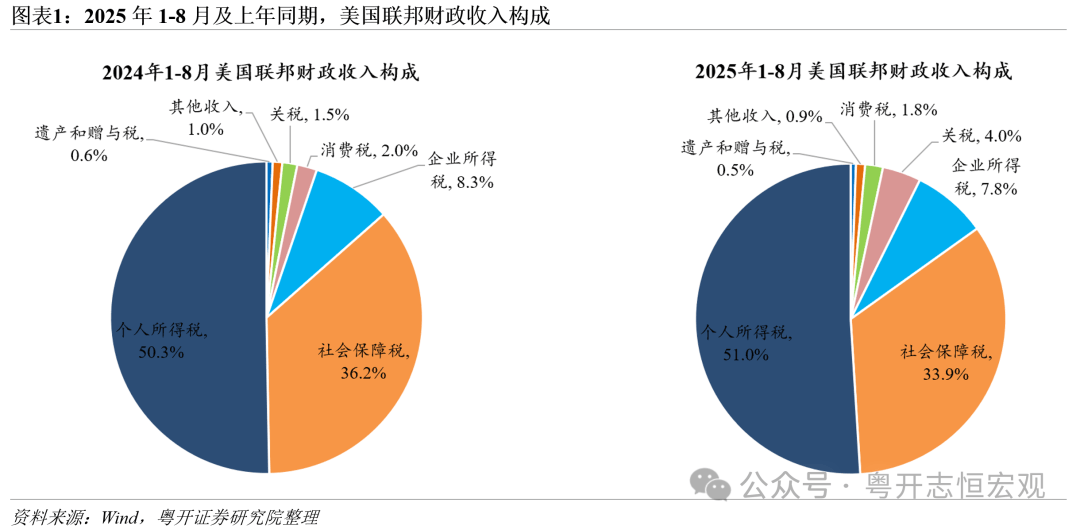
Core Viewpoint - The recent announcement by Trump to impose a 100% tariff on China and export controls on key software is seen as a significant escalation in the US-China trade conflict, which could have profound implications for bilateral trade and the global trade system [1] Group 1: Tariff Revenue and Rates - Since the onset of the trade war, US tariff revenue has surged, becoming the fourth largest source of federal revenue, following individual income tax, social security tax, and corporate income tax [6] - From January to June 2025, the average tariff rate in the US increased from 2.2% to 8.9%, with a notable rise in April due to expanded tariffs on a global scale [8][14] - By August 2025, US tariff revenue reached $144.4 billion, 2.8 times that of the previous year, accounting for 4.0% of federal revenue, an increase of 2.5 percentage points year-on-year [6] Group 2: Tariff Rates by Trade Partner - The actual average tariff rate imposed by the US on China reached 37.4% by June 2025, with significant increases observed for labor-intensive goods and products affected by Section 232 tariffs [24][29] - The average tariff rates for Japan and South Korea were 15.3% and 12.0%, respectively, while rates for the EU, Vietnam, and India ranged between 5% and 10% [24] - The US has seen a decline in its reliance on Chinese imports, with the share of imports from China dropping to 9.4% of total imports, a decrease of 3.4 percentage points year-on-year [28] Group 3: Trade Performance and Deficits - In the first seven months of 2025, US imports grew by 10.7% and exports by 4.8%, but the trade deficit expanded by 21.3% [19] - The US experienced a decline in trade volume with China and Canada, with imports from China down by 18.9% and exports down by 20.2% [19][20] - Despite high tariffs on China, the overall trade deficit with other countries has increased, indicating that the US still relies heavily on imports to meet domestic demand [20] Group 4: Future Tariff Trends - The actual tariff rates are expected to converge with nominal rates as various loopholes and exemptions are closed, leading to an increase in effective tariff rates across different economies [33][34] - Factors such as preemptive imports and exemptions for certain goods have contributed to the current lower effective tariff rates, but these are anticipated to diminish over time [33][35]

澳门第1季对外商品贸易总额共338.2亿澳门元
智通财经网· 2025-04-28 09:30
Core Insights - The total external merchandise trade in Macau for Q1 2025 amounted to 33.82 billion MOP, a decrease of 4.5% compared to the same period last year [1] - Total exports increased by 6.1% to 3.49 billion MOP, with re-exports at 3.15 billion MOP and local product exports at 0.35 billion MOP, rising by 6.4% and 3.5% respectively [1] - Total imports were 30.33 billion MOP, down 5.6%, resulting in a trade deficit of 26.83 billion MOP, which is a reduction of 20.0 million MOP from the previous year [1] Export Analysis - Exports to Hong Kong and the United States increased by 14.0% to 2.69 billion MOP and 7.0% to 50.06 million MOP respectively, while exports to mainland China, Belt and Road countries, and the European Union decreased by 5.8%, 60.4%, and 10.5% respectively [1] - Textile and garment exports rose by 4.3% to 0.36 billion MOP, while non-textile exports increased by 6.3% to 3.14 billion MOP [1] Import Analysis - Imports from the European Union, mainland China, and Belt and Road countries decreased by 6.4%, 2.4%, and 1.4% respectively, while imports from Japan increased by 3.9% [2] - The value of imports from mainland China and Hong Kong fell by 5.5% and 6.1% respectively [2] - Consumer goods imports decreased by 5.5% to 22.58 billion MOP, with declines in clothing and footwear by 8.1% and 8.9%, while food and beverages increased by 10.9% [2] March Specifics - In March 2025, total merchandise exports were 1.11 billion MOP, down 7.5% year-on-year, with re-exports at 0.99 billion MOP, showing a decline of 9.8% [3] - Local product exports rose by 16.0% to 0.12 billion MOP, with copper and its products increasing by 8.3% [3] - Total imports in March decreased by 6.2% to 10.50 billion MOP, with significant declines in mobile phones, building materials, and watches by 44.1%, 34.8%, and 23.5% respectively [3]