
银团贷款服务

Search documents
伦交所:2025年中国内地投行业务费用同比增21%至154亿美元 创2022年以来新高
智通财经网· 2026-01-09 03:37
Group 1: Investment Banking Fees - In 2025, the total investment banking fees in mainland China are expected to reach $15.4 billion, representing a 21% year-on-year growth, marking the second highest value since 2022 [1] - The underwriting fees from the stock market are projected to total $2.95 billion, accounting for 19% of the total investment banking fees, with a significant year-on-year increase of 91% [1] - Bond market underwriting fees are expected to reach $11 billion, reflecting an 11% year-on-year growth, while advisory fees for completed mergers and acquisitions are estimated at $1 billion, up 66% [1] - Syndicated loan fees are projected to decline by 39% year-on-year to $396 million [1] Group 2: Mergers and Acquisitions - The total scale of mergers and acquisitions targeting the Chinese region is projected to reach $474.3 billion in 2025, marking a 62.6% year-on-year increase [2] - Mergers and acquisitions involving Chinese companies are expected to reach $436.1 billion, with a year-on-year growth of 74.7% [2] - Domestic mergers and acquisitions are anticipated to grow by 82.8% year-on-year, reaching $412.1 billion [2] - The financial sector is the most active in terms of mergers and acquisitions, with a transaction scale of $107.3 billion, accounting for 22.6% of the total, and a year-on-year growth of 121% [2] - China International Capital Corporation (CICC) ranks first in announced mergers and acquisitions involving China, with a transaction scale of $89.7 billion and a market share of 18.9% [2] Group 3: Stock Market and Bond Issuance - In 2025, the stock market financing amount for Chinese enterprises is expected to reach $124.3 billion, reflecting a 104% year-on-year increase, rebounding from the lowest level since 2012 [2] - The number of stock market issuances is projected to grow by 34.8% year-on-year [2] - The issuance of primary bonds in the Chinese region is expected to reach $4.1 trillion, a historical high, with a 13.5% increase compared to 2024, and the number of bond issuances is also expected to rise by 14.2% [2]
多家银行新增服务费,涉资信业务、ATM取现等
Xin Lang Cai Jing· 2025-06-17 00:35
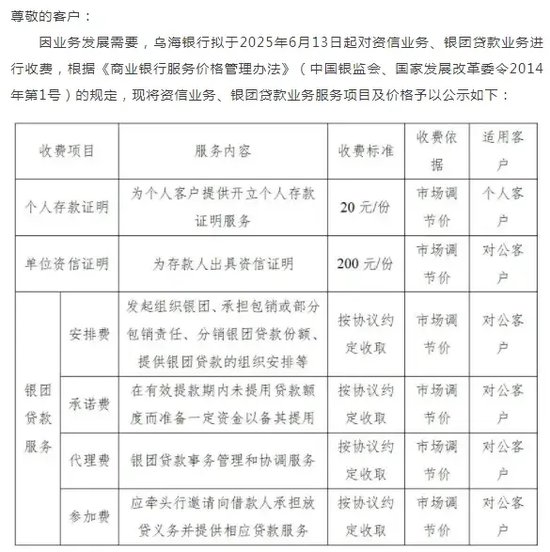
Group 1 - The core viewpoint of the articles highlights that banks are facing increasing pressure on net interest margins due to declining market interest rates, prompting them to seek new revenue channels through the introduction of service fees [1][15][16] - Recently, Wuhai Bank announced that it will start charging fees for credit services and syndicated loan services effective June 13, 2025, as part of its strategy to enhance revenue [3][5] - Other banks, such as Suzhou Bank, have also introduced new service fees, including an annual fee for their credit card services, indicating a broader trend among banks to adjust their fee structures in response to revenue pressures [8][11] Group 2 - Wuhai Bank's new fee structure includes charges for personal deposit certificates at 20 yuan per certificate and corporate credit certificates at 200 yuan per certificate, with exemptions for small and micro enterprises [6][5] - The bank's syndicated loan services will have various fees, including arrangement fees, commitment fees, and agency fees, all charged according to agreements with corporate clients [6][4] - Suzhou Bank has introduced an annual fee of 588 yuan for its platinum credit card and has also adjusted fees for third-party cooperation services related to credit cards, effective from September 2025 [8][10] Group 3 - The overall banking sector is experiencing a decline in revenue growth, with major state-owned banks reporting varying degrees of revenue decline in the first quarter of the year, highlighting the need for banks to diversify income sources [17][18] - The net interest margin for commercial banks has narrowed to 1.43% in the first quarter, a decrease of 9 basis points from the previous quarter, further emphasizing the urgency for banks to enhance non-interest income through service fees [18][19] - Analysts suggest that the introduction of new service fees can be an effective means for banks to increase their intermediary business income and improve overall revenue performance [18]


部分服务费不降反增,银行“花式”增收意欲何为?
Chang Sha Wan Bao· 2025-06-16 13:23
Core Viewpoint - Recent increases in service fees by banks are a response to the pressure on net interest margins, aiming to enhance profitability in a challenging economic environment [1][4]. Group 1: Fee Increases by Major Banks - Major banks, including state-owned banks and local banks, are collectively raising service fees, with adjustments to credit card transaction fees and other banking services [2][3]. - China Bank plans to adjust its credit card service fee structure, effective June 10, 2025, with new fees based on a percentage of the withdrawal amount [2]. - Local banks like Uihai Bank and Chouzhou Commercial Bank are also introducing new fees for various services, including personal credit certificates and international mailing [3]. Group 2: Financial Performance and Challenges - The banking sector is facing significant pressure on profitability, with the net interest margin reported at 1.43% as of the first quarter of 2025, a year-on-year decrease of 11 basis points [4]. - Chouzhou Commercial Bank reported a decline in net profit by 36.94% year-on-year, despite a slight increase in revenue, indicating a challenging operating environment [4]. - Analysts suggest that while banks are increasing fees to alleviate revenue pressure, this may not be a sustainable long-term solution [4]. Group 3: Strategic Recommendations - Experts recommend that banks focus on business innovation and enhancing core competitiveness rather than solely relying on fee increases [6]. - It is suggested that banks should deeply understand local market behaviors and tailor their services accordingly to improve competitiveness [6]. - The emphasis should be on innovative business practices that are unique to local banks, rather than pursuing growth through increased fees during periods of narrowing interest margins [6].