铸钢件

Search documents
【劳模工匠助企行】“工匠来了,思路清晰了”
Xin Lang Cai Jing· 2026-01-26 21:05
Core Viewpoint - The "Great Craftsman Assisting Enterprises in Gansu" event facilitates direct communication between skilled craftsmen and local industry workers, addressing technical challenges and promoting innovation in manufacturing processes [1][4]. Group 1: Technical Challenges and Solutions - A significant technical issue faced by Lanzhou Lanshi Group involves welding cracks in quenched steel castings, which hinders production progress [2]. - Craftsmen provided specific solutions such as annealing, preheating, material selection, and post-weld insulation, along with a fundamental analysis of stress release to address the crack formation [2]. - The event encourages the design of low-cost, controllable tooling to enhance machining stability, demonstrating practical applications of innovative ideas [2][3]. Group 2: Industry Innovation and Collaboration - The event emphasizes the need for equipment networking and the integration of data collection technologies to enhance the intelligence of manufacturing processes [3]. - Craftsmen's suggestions serve as valuable guidance for industry workers, fostering a collaborative environment for skill transmission and innovative thinking [4]. - The initiative aims to transform skilled knowledge into practical tools and fixtures that can improve production efficiency, moving from short-term assistance to long-term cooperation [4][5]. Group 3: Future Engagement and Development - The event has strengthened the confidence of craftsmen and industry workers in pursuing digital and intelligent transformations within their enterprises [5]. - Continuous communication and collaboration between craftsmen and local enterprises are encouraged to promote technological advancements and industry growth [5].
广大特材:公司产品不涉及CBF积层绝缘膜
Zheng Quan Ri Bao Wang· 2026-01-05 14:12
Group 1 - The company stated that its products do not involve CBF laminated insulation film [1] - Some special alloy materials produced by the company are used in the aerospace sector [1] - The company's military-related business involves confidential information that cannot be disclosed [1] Group 2 - The company offers certain mold steel materials, special alloy materials, and some cast steel products that can achieve import substitution [1]

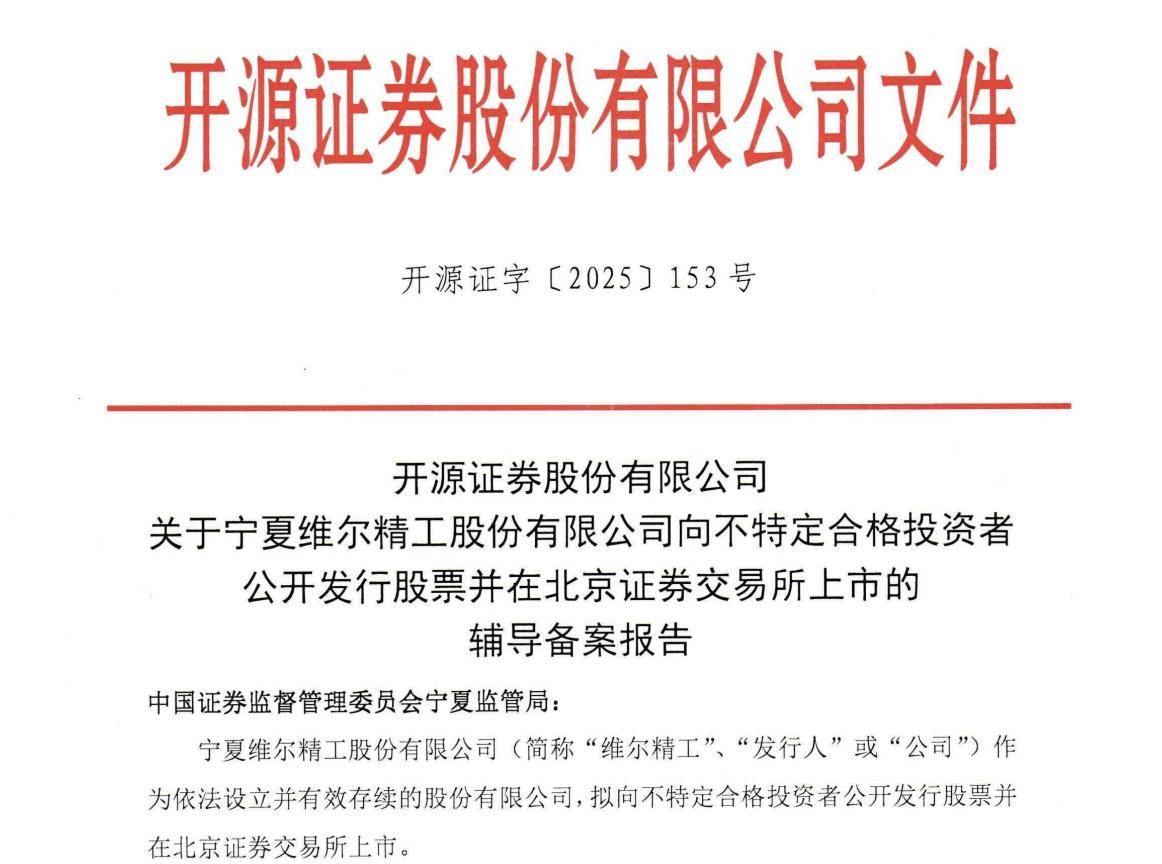
维尔精工筹备北交所上市,更换董秘、财务负责人
Sou Hu Cai Jing· 2025-12-05 01:27
Core Viewpoint - Ningxia Weier Precision Engineering Co., Ltd. has completed its IPO counseling filing with the Ningxia Securities Regulatory Bureau, indicating its intention to go public and expand its operations in high-end equipment manufacturing [4]. Company Overview - Founded on January 13, 2004, Weier Precision specializes in the R&D, production, and sales of key components required for high-end equipment manufacturing, including cast steel, cast iron, and cast aluminum parts [4]. - The company is set to be listed on the New Third Board on July 8, 2025 [4]. Clientele - Major clients include well-known domestic and international companies or their subsidiaries, such as CRRC Changchun Railway Vehicles, Tiandi Benniu, Siemens Mexico, Pinggao Electric, Zhejiang Kesheng Technology, and Fastech Group [4]. Financial Performance - In the first half of 2025, the company's operating revenue was 88.23 million yuan, a decrease of 2.01% year-on-year [5]. - The net profit attributable to shareholders was 20.38 million yuan, an increase of 125.54% year-on-year [5]. - The gross profit margin improved to 39.56%, compared to 22.52% in the same period last year [5]. Shareholder Structure - Wang Xiaoning directly holds 43.97% of the company's shares and indirectly controls an additional 4.42% through Jinweishuo and Jinweisheng. Zhao Aixian directly holds 42.06% of the shares. Both are the controlling shareholders and actual controllers of the company [6]. - The couple, Wang Xiaoning and Zhao Aixian, can collectively control 100% of the company's shares [6]. Management Changes - In November 2025, the company announced the removal of Zhao Aixian as the financial officer and board secretary, and Lu Jianming as the deputy general manager. Wang Xutao was appointed as the new financial officer, and Hu Maifeng was appointed as the board secretary [6]. New Appointments - Wang Xutao, with over 20 years of financial experience and various certifications, has been appointed as the financial officer [7]. - Hu Maifeng, who has 10 years of experience in the financial industry, has been appointed as the board secretary [7].

维尔精工由董事长王小宁一家四口控股100%,妻子赵爱仙任董事
Sou Hu Cai Jing· 2025-12-04 01:47
Core Viewpoint - Ningxia Weier Precision Engineering Co., Ltd. has completed its IPO counseling registration with the Ningxia Securities Regulatory Bureau, indicating its intention to go public and expand its operations in the high-end equipment manufacturing sector [4]. Company Overview - Founded on January 13, 2004, Weier Precision specializes in the R&D, production, and sales of key components required for high-end equipment manufacturing, including cast steel, cast iron, and cast aluminum parts [4]. - The company is set to be listed on the New Third Board on July 8, 2025 [4]. Clientele - Weier Precision's main clients include well-known domestic and international companies or their subsidiaries, such as CRRC Changchun Railway Vehicles, Tiandi Benniu, Siemens Mexico, Pinggao Electric, Zhejiang Kesheng Technology, and Fastech Group [4]. Financial Performance - In the first half of 2025, the company's operating revenue was 88.23 million yuan, a decrease of 2.01% year-on-year [5]. - The net profit attributable to shareholders was 20.38 million yuan, an increase of 125.54% year-on-year [5]. - The gross profit margin improved to 39.56%, compared to 22.52% in the same period last year [5]. Shareholder Structure - Wang Xiaoning directly holds 43.97% of the company's shares and indirectly controls an additional 4.42% through Jinweishuo and Jinweisheng. Zhao Aixian directly holds 42.06% of the shares. Both are the controlling shareholders and actual controllers of the company [6]. - Wang Xiaoning and Zhao Aixian, being a married couple, can collectively control 100% of the company's shares [6]. Management Changes - In November of this year, Weier Precision announced the removal of Zhao Aixian as the financial officer and board secretary, and Lu Jianming as the deputy general manager. Wang Xutao has been appointed as the new financial officer, and Hu Maifeng as the new board secretary [6]. Management Profiles - Wang Xiaoning serves as the chairman and general manager of the company, with a background in engineering and extensive experience in the industry [7]. - Zhao Aixian, with a background in accounting, has held various positions within the company and currently serves as a board member and deputy general manager [7].
广大特材(688186.SH):德阳子公司生产铸钢件产品可用于燃气轮机
Ge Long Hui· 2025-11-11 07:44
Core Viewpoint - The company Guangda Special Materials (688186.SH) has announced that its subsidiary in Deyang produces cast steel components that can be used in gas turbines [1] Company Summary - Guangda Special Materials has a subsidiary located in Deyang [1] - The Deyang subsidiary specializes in the production of cast steel components [1] - These cast steel components are applicable in the gas turbine industry [1]
工业汽轮机产业链结构与核心部件市场格局探析
Zhong Guo Neng Yuan Wang· 2025-06-10 10:52
Core Insights - The industrial gas turbine industry is characterized by a highly specialized and collaborative supply chain, with cast steel components and rotor forgings holding significant market positions due to their essential functions and technological barriers [1][2] Group 1: Industry Overview - Industrial gas turbines operate under extreme conditions of high temperature, pressure, and speed, making the material properties and manufacturing precision of core components critical to the reliability, efficiency, and lifespan of the entire machine [1] - Cast steel components include complex structures such as cylinders, valve housings, and partition sleeves, which are crucial for sealing, guiding, and bearing high-temperature steam [1] - Rotor forgings are the core rotating components that transmit torque and withstand significant centrifugal and thermal stresses, requiring ultra-high purity materials and advanced manufacturing techniques [1] Group 2: Market Dynamics - The market for cast steel components and rotor forgings accounts for approximately 20% of the total industrial gas turbine market size, reflecting their critical weight in the overall cost structure despite their smaller physical volume [2] - The growth of this niche market is driven by two main factors: the global push for industrial energy efficiency and carbon neutrality, leading to increased demand for high-performance components, and the emergence of innovative manufacturing technologies such as additive manufacturing and numerical simulation [2] Group 3: Future Outlook - The technological advancements and industrial upgrades in cast steel components and rotor forgings are expected to continue driving improvements in overall machine performance [3] - Future market focus will not only be on enhancing material performance limits but also on establishing a comprehensive digital quality assurance system throughout the design, manufacturing, and testing processes [3] - The healthy development of this high-value segment is strategically significant for ensuring the safety and competitiveness of national major equipment supply chains [3]
智研咨询发布:铸钢件行业市场动态分析、发展方向及投资前景分析报告
Sou Hu Cai Jing· 2025-05-12 02:03
Core Insights - The article highlights the significance of cast steel components in various industries, particularly in heavy machinery, energy, and rail transportation, indicating that the production of large cast steel parts is a key indicator of a country's manufacturing development level [2] - China remains the world's largest producer of castings, with a production volume of 6.35 million tons in 2023, projected to increase to approximately 6.95 million tons in 2024 due to advancements in green casting and smart manufacturing technologies [2] Industry Overview - Cast steel components are produced through a casting process where molten steel is poured into molds and solidified, forming products with specific shapes and sizes [4] - The industry is characterized by significant economies of scale, where larger production scales lead to lower unit costs, creating barriers for new entrants [10] - The production of cast steel parts is capital-intensive, requiring substantial initial investments and long construction periods, which contributes to high financial barriers for new companies [13] Regulatory Environment - The cast steel industry is regulated by several government bodies, including the National Development and Reform Commission (NDRC) and the Ministry of Industry and Information Technology (MIIT), which oversee policy formulation and industry management [6][7] - Recent government policies aim to support and standardize the casting industry, fostering a conducive environment for its development [8][9] Market Dynamics - The demand for large cast steel components is driven by robust growth in downstream sectors such as manufacturing, energy, and rail transportation [2] - The industry is experiencing a shift towards high-end castings, with an increasing proportion of production focusing on advanced materials and technologies [2] Competitive Landscape - The industry features significant technological barriers, as cast steel products are often customized and require advanced manufacturing techniques, making it challenging for new entrants to compete [11][12] - Key players in the industry include companies like CITIC Heavy Industries and Taiyuan Heavy Industry, which possess strong technical capabilities and established market positions [15]