
锅巴土豆

Search documents
马铃薯蕴藏多少振兴力量——来自甘肃省定西市的调查
Xin Lang Cai Jing· 2026-01-26 23:12
Core Viewpoint - The development of high-quality industries in poverty-stricken areas is crucial for enhancing economic resilience and promoting the optimization and upgrading of rural industries, as exemplified by the potato industry in Dingxi City, Gansu Province [1][2]. Industry Development - Dingxi City's potato industry has transformed from a focus on scale expansion to building a complete industrial chain and improving quality, evolving into a dominant industry that supports poverty alleviation and rural revitalization [2][3]. - By 2025, the total output value of Dingxi's potato industry chain is expected to reach 28 billion yuan, with potato-related income accounting for 23% of farmers' disposable income [2]. Agricultural Practices - The potato industry in Dingxi has established a comprehensive breeding system, promoting standardized green production techniques and building a million-acre standardized base to connect small farmers with larger markets [5][8]. - The region has developed a tiered breeding system for seed potatoes, including greenhouse original seeds, base original seeds, and first-level seeds, enhancing production efficiency and quality [6][8]. Processing and Value Addition - Dingxi has cultivated a cluster of processing enterprises, with 28 deep processing companies and a processing capacity of 960,000 tons, focusing on products like "Dingxi Wide Noodles" [6][10]. - The transition from traditional starch processing to high-value food manufacturing has been marked by innovations in product offerings, such as instant wide noodles that require minimal preparation time [10]. Branding and Market Expansion - The "Dingxi Wide Noodles" brand has gained recognition, being included in the 2025 China Consumer Name Brand list and achieving significant market presence [11][12]. - The city has established partnerships with major cities and restaurant chains to enhance product distribution, aiming for a sales target of 8.6 billion yuan for potato products by 2025 [12][13]. Innovation and Research - Continuous innovation in seed selection and processing technology is vital for meeting market demands and enhancing product quality, with local research institutions collaborating with universities to develop new potato varieties [9][10]. - The focus on brand development has improved the pricing power of potato products, allowing farmers to benefit more from the industry's value addition [13].
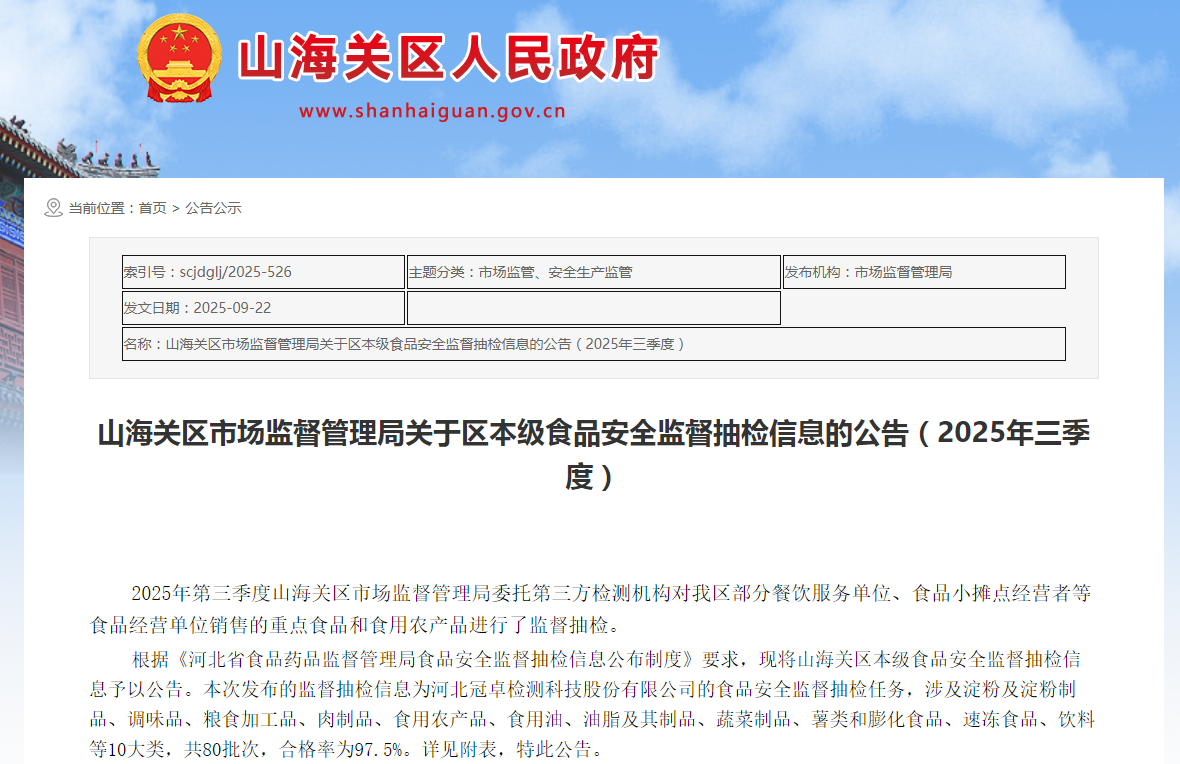
河北省秦皇岛市山海关区市场监督管理局关于区本级食品安全监督抽检信息的公告(2025年三季度)
Zhong Guo Zhi Liang Xin Wen Wang· 2025-10-13 05:05
Core Viewpoint - The announcement from the Shanhaiguan District Market Supervision Administration highlights the results of food safety supervision and sampling inspections conducted in the third quarter of 2025, indicating a high compliance rate of 97.5% across various food categories [3]. Group 1: Inspection Overview - The Shanhaiguan District Market Supervision Administration commissioned Hebei Guanzhuo Testing Technology Co., Ltd. to conduct food safety inspections on key food products and edible agricultural products sold by local food businesses [3]. - A total of 80 batches of food products were tested, covering 10 major categories including starch and starch products, condiments, grain processing products, meat products, edible agricultural products, edible oils, vegetable products, snack foods, frozen foods, and beverages [3]. Group 2: Compliance Rate - The overall pass rate for the inspected food products was reported at 97.5%, reflecting a strong adherence to food safety standards within the district [3].

无地可划无序摆卖 深圳地摊经济:烟火升腾下的治理考验
Nan Fang Du Shi Bao· 2025-07-02 14:05
Core Viewpoint - The development of street vendor economy in Shenzhen is facing significant challenges as it attempts to balance urban order with the needs of citizens, following the shift from a ban to conditional allowance for street vendors two years ago [1] Group 1: Policy and Regulation - The revised Shenzhen regulations allow for designated vendor operating areas, but specific standards and management details are still being explored [1][11] - Many districts, such as Futian and Luohu, are struggling with the issue of "no space to designate" for vendor operations, leading to a lack of suitable areas for street vendors [8][9] - The management methods for street vendors are still in the exploratory phase, with some districts implementing pilot programs to establish designated areas and improve governance [11][15] Group 2: Urban Order and Public Safety - The influx of street vendors has led to urban order challenges, including traffic congestion and safety hazards, particularly in high-traffic areas like Futian Port [3][4] - Issues such as open gas canisters and unsanitary conditions at vendor sites raise significant safety and health concerns [4][5] - The "hit-and-run" tactics employed by vendors to evade enforcement highlight the ongoing struggle between street vendors and regulatory authorities [6][14] Group 3: Economic Impact and Community Needs - The street vendor economy serves as a vital source of income for many low-income individuals and new residents, creating approximately 600 jobs daily in certain areas [12] - There is a strong demand for affordable and convenient food options among residents, with a significant portion of consumers being price-sensitive [13] - Complaints regarding noise, pollution, and safety issues from residents indicate a growing tension between the benefits of street vendors and the need for urban cleanliness and order [13][21] Group 4: Recommendations and Solutions - Experts suggest that regulations need to be refined to clarify vendor operating standards and processes, as well as to establish a clear mechanism for vendor entry and exit [19][20] - Utilizing underused urban spaces, such as corners of urban villages and near subway stations, could help alleviate the issue of street vendor placement [20] - Implementing a combination of education and enforcement strategies may help manage vendor activities while considering the needs of both vendors and residents [20][21]