预付卡发行与受理

Search documents
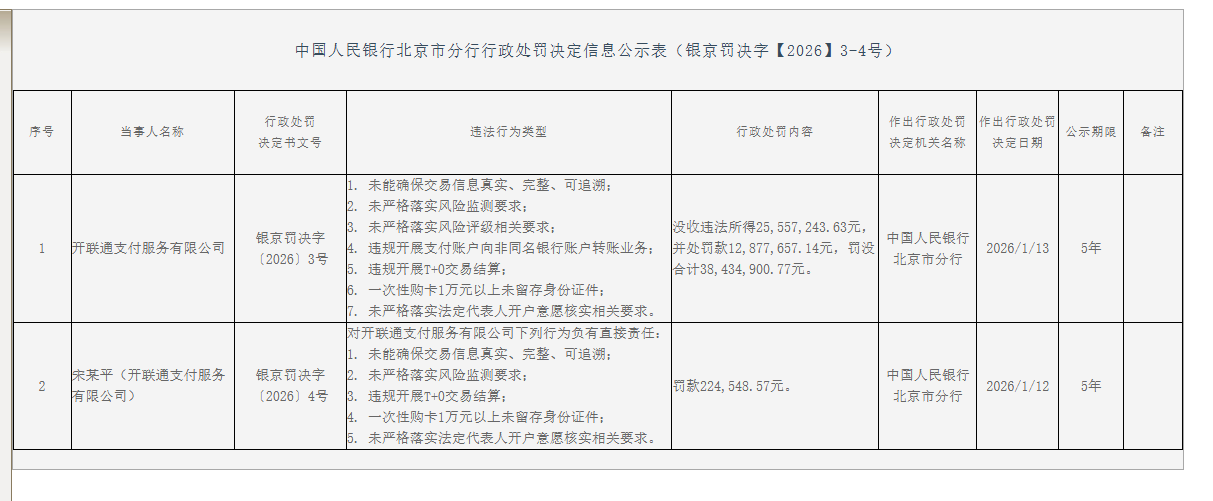
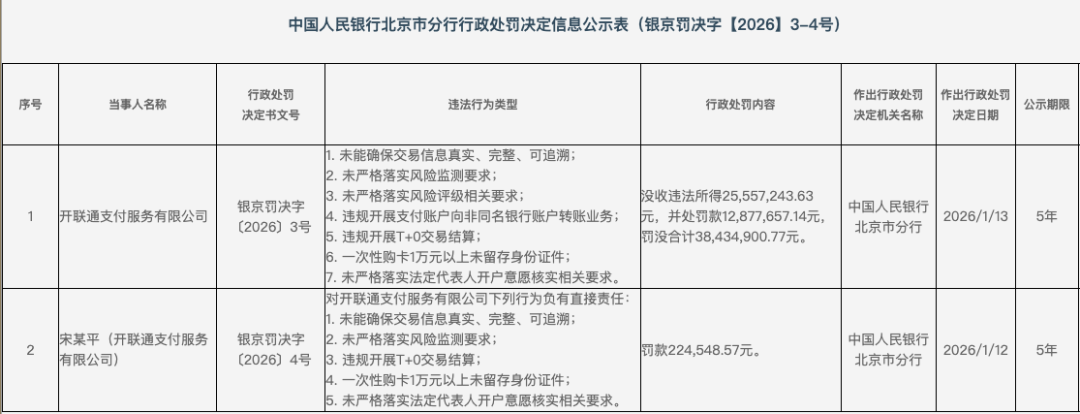
开联通支付被罚款3843万元 涉违规开展T+0交易结算等7项违法行为
Feng Huang Wang Cai Jing· 2026-01-22 09:44
Core Viewpoint - Kailiantong Payment has been penalized for multiple violations, resulting in a total fine and confiscation amounting to approximately 38.43 million yuan [1][2][3]. Group 1: Violations and Penalties - The company was found guilty of seven types of violations, including failure to ensure transaction information is true, complete, and traceable, and not strictly implementing risk monitoring requirements [1][2]. - The total amount confiscated from the company was 25.557 million yuan, with an additional fine of 12.878 million yuan, leading to a combined penalty of 38.43 million yuan [1][2]. - A specific individual, Song Mou Ping, was held directly responsible for five of these violations and fined 224,548.57 yuan [1][2]. Group 2: Previous Penalties - This incident marks the second penalty for Kailiantong Payment since last year, with a previous fine of 1.1885 million yuan imposed on February 8, 2025, for three violations related to customer identity verification and reporting obligations [3]. Group 3: Company Background - Kailiantong Payment was established in 2010 with a registered capital of 100 million yuan and is one of the first 27 non-bank payment institutions to receive a payment business license from the People's Bank of China [2]. - The company's main services include prepaid card issuance and acceptance, internet payment, cross-border payment, and customized enterprise payment solutions [2].

开联通支付,被重罚3843万元!
Shen Zhen Shang Bao· 2026-01-22 04:37
Core Viewpoint - The People's Bank of China (PBOC) has imposed a total fine of 38.43 million yuan on Kailiantong Payment Service Co., Ltd. for seven violations, including illegal T+0 transaction settlements and failure to ensure the authenticity and traceability of transaction information [1][3][5]. Group 1: Violations and Penalties - Kailiantong Payment was fined 25.56 million yuan for illegal gains and an additional 12.88 million yuan in penalties, totaling 38.43 million yuan [1][3]. - The seven types of violations include: 1. Failure to ensure transaction information is authentic, complete, and traceable 2. Not strictly implementing risk monitoring requirements 3. Not adhering to risk rating requirements 4. Conducting transfers from payment accounts to non-matching bank accounts 5. Engaging in T+0 transaction settlements 6. Failing to retain identification documents for card purchases over 10,000 yuan 7. Not verifying the account opening intentions of legal representatives [3][4]. Group 2: Company Background and Previous Penalties - Kailiantong Payment, established in 2010 with a registered capital of 100 million yuan, is one of the first 27 non-bank payment institutions to receive a payment business license from the PBOC [5]. - The company has received penalties previously, including a fine of 1.19 million yuan in February 2025 for failing to identify customers properly [5]. - The company has multiple execution records and has been urged to pay overdue taxes, including value-added tax and urban maintenance construction tax [5].
中通支付获准增资至2.1亿元
Bei Jing Shang Bao· 2026-01-09 13:02
Core Viewpoint - Zhongtong Payment Co., Ltd. has been approved to increase its registered capital to 210 million RMB by the People's Bank of China Guangxi Zhuang Autonomous Region branch [1] Company Overview - Zhongtong Payment was established in 2008 and obtained its Payment Business License in June 2012 [1] - The company's business scope includes internet payment (current value account operation Type I) and prepaid card issuance and acceptance (in Guangxi, Guangdong, and Yunnan, current value account operation Type II) [1]
支付牌照年注销量达12张!2.93亿元罚单压顶,行业加速出清
Bei Jing Shang Bao· 2026-01-06 13:03
Core Insights - The third-party payment industry is undergoing significant restructuring and regulatory tightening, with a notable increase in license cancellations and penalties in 2025 [1][3][5] Group 1: Industry Restructuring - As of December 26, 2025, a total of 12 payment licenses have been revoked, reducing the number of licensed institutions to 163, which is over 40% lower than the peak [3] - Zhonggang Yintong Payment, established in 2011, became the 108th license holder to be revoked, having been in a suspended renewal status for over three years due to regulatory issues [3][4] - The exit of institutions is characterized by a predominance of those with single business types or limited operational regions, indicating a structural reshaping of the industry [4] Group 2: Regulatory Environment - In 2025, the People's Bank of China and its branches issued at least 82 penalties in the payment sector, totaling over 293 million yuan, with many penalties exceeding 10 million yuan [5][6] - The regulatory approach has intensified, with a focus on core risk areas such as clearing violations and anti-money laundering failures, reflecting a "zero tolerance" stance [6][7] - The trend of increasing penalties highlights the regulatory body's commitment to enforcing compliance and maintaining market order [6][10] Group 3: Challenges for Small Institutions - Small and medium-sized payment institutions are facing significant challenges, including stringent regulatory requirements, reduced profit margins due to fee transparency, and the need for long-term investment in transformation [9][10] - Many exiting institutions exhibit compliance shortcomings and lack the capital to meet new regulatory requirements, leading to increased operational difficulties [4][10] Group 4: Future Industry Trends - The payment industry is expected to enter a phase characterized by "precise regulation and capability competition," with market concentration increasing as resources shift towards a few leading institutions [10] - The upcoming classification and rating system will enable differentiated regulation, promoting a more structured and competitive environment [10][11] - The focus will be on creating a collaborative ecosystem where large institutions provide systemic support while smaller entities leverage regional advantages and specialized services [10][11]

再注销一家 第三方支付牌照持续出清
Xin Lang Cai Jing· 2026-01-04 21:06
Core Viewpoint - The payment industry in China is undergoing a significant consolidation, with the People's Bank of China (PBOC) actively revoking payment licenses, indicating a shift towards stricter regulatory compliance and market exit for non-compliant entities [1][2][3] Group 1: License Revocation - The PBOC has revoked the payment license of Zhonggang Yintong Information Technology Service Co., Ltd., marking the 108th license cancellation and the 12th in 2025 [1] - Zhonggang Yintong's license had been in a "suspended renewal" status for over three years due to non-compliance with regulatory requirements [1] - The company, established in 2011, initially focused on prepaid card issuance and later expanded into internet payment services [1] Group 2: Industry Trends - In recent years, the payment license landscape has been reshaped, with 15 licenses revoked in 2023, 10 in 2024, and 12 in 2025 [2] - Analysts attribute the reduction in payment licenses to enhanced regulatory scrutiny, financial difficulties faced by some institutions, and internal consolidation within payment companies [2] - The majority of revoked licenses pertain to prepaid card services, which are struggling to remain profitable due to regulatory changes and market competition from digital alternatives [3] Group 3: Future Outlook - The ongoing license cancellations are expected to lead to a more regulated market environment, increasing compliance costs but ultimately enhancing the industry's credibility and stability [3] - Payment institutions are encouraged to explore horizontal expansion through "payment+" solutions and partnerships to innovate their service offerings [4]
人民银行再注销一张支付牌照
Bei Jing Shang Bao· 2025-12-26 12:44
Group 1 - The core point of the article is the recent addition of Zhonggang Yintong Information Technology Service Co., Ltd. to the list of "cancelled licensed institutions" by the People's Bank of China, indicating a tightening regulatory environment for payment service providers [1] - In 2022, the company was denied the renewal of its payment license, which included internet payment and prepaid card issuance and acceptance services in Shanghai [1] - A total of 12 payment institutions have been cancelled by the People's Bank of China in the current year, bringing the total number of cancelled licenses to 108 [1]
又一张支付牌照被央行注销!
Xin Lang Cai Jing· 2025-12-26 12:43
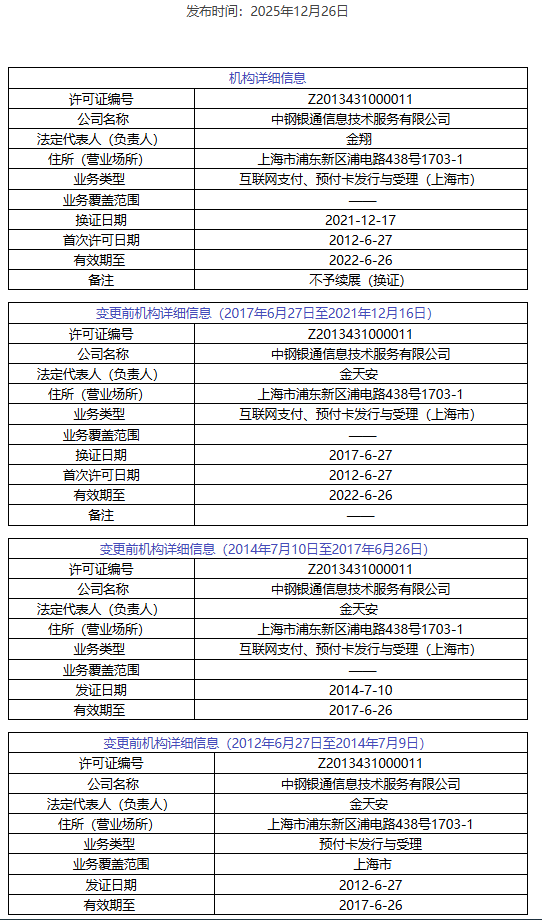
Core Points - The People's Bank of China has added Zhonggang Yintong Information Technology Service Co., Ltd. to the list of "cancelled licensed institutions" [1][4] - The company previously held licenses for internet payment and prepaid card issuance and acceptance in Shanghai [1][4] - The payment license was not renewed in June 2022 [1][4] Company Details - License Number: Z2013431000011 [3][5] - Company Name: Zhonggang Yintong Information Technology Service Co., Ltd. [3][5] - Legal Representative: Jin Qi [3][5] - Business Location: 1703-1, 438 Puxin Road, Pudong New District, Shanghai [3][5] - Business Types: Internet payment, prepaid card issuance and acceptance (Shanghai) [3][5] - License Issuance Date: June 27, 2012 [3][5] - License Expiration Date: June 26, 2022 [3][5] - License Renewal Date: December 17, 2021 [3][5] - Note: License not renewed (for renewal) [3][5]
36家机构“候场”更名,有赞支付已获批更名、增资
Bei Jing Shang Bao· 2025-07-13 12:26
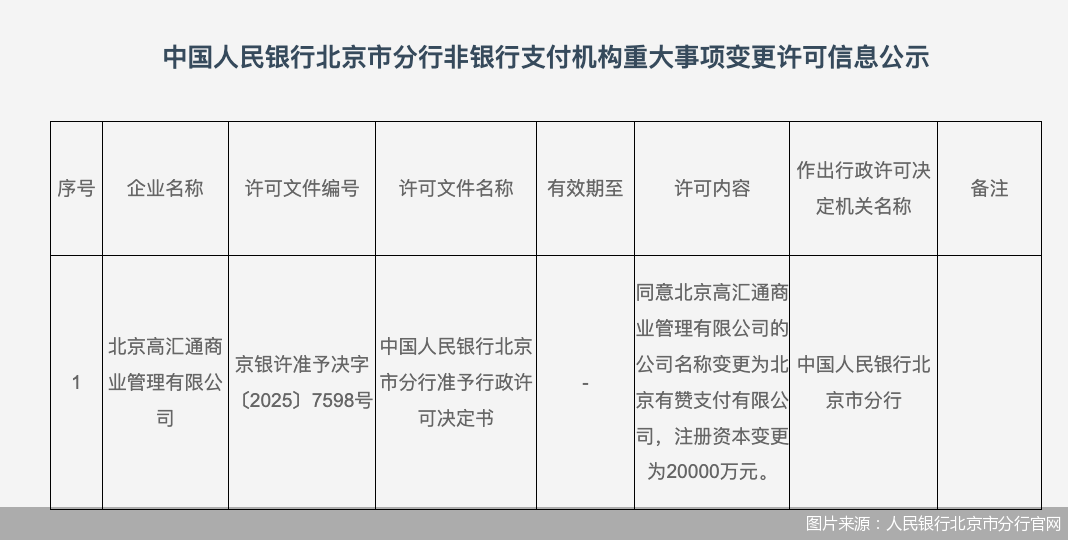
Core Viewpoint - The payment industry is undergoing significant changes to comply with new regulations, as evidenced by the recent rebranding and capital increase of Beijing Youzan Payment Co., Ltd, formerly known as Beijing Gao Huitong Commercial Management Co., Ltd [1][3]. Company Summary - Beijing Youzan Payment has changed its name and increased its registered capital from 150 million to 200 million yuan, aligning with the regulatory requirements set forth by the People's Bank of China [1][2]. - The company was established in August 2008 and has held payment licenses since June 2012, expanding its operations to multiple regions and adding internet payment capabilities [2][3]. - As of June 2025, the company will cease its prepaid card operations, retaining only the first category of stored value account operations [2][3]. Industry Summary - The implementation of the Non-Bank Payment Institutions Supervision and Management Regulations has prompted a wave of changes among payment institutions, with over 30 companies approved for various modifications since the start of 2025 [4]. - Currently, more than 80 payment institutions have names that do not comply with the new regulations, with 36 still lacking the word "payment" in their names as of July 13 [4]. - The industry is expected to continue experiencing consolidation and transformation, with companies focusing on expanding their services and exploring new business opportunities, including technological innovations and international expansion [5].
富友支付十年“上市梦”:三冲港交所,因业务合规问题多次被处罚
Hua Xia Shi Bao· 2025-05-15 09:40
Core Viewpoint - Shanghai Fuyou Payment Service Co., Ltd. is making efforts for its IPO, having submitted its prospectus to the Hong Kong Stock Exchange for the third time, but has faced challenges including declining profitability and compliance issues [1][4]. Financial Performance - In 2024, Fuyou Payment achieved a revenue of 1.634 billion yuan, an increase of 8.54% year-on-year, but its net profit decreased by 9.31% to 84.325 million yuan [4]. - The company's gross margin for 2024 was 25.9%, which, while up 0.7 percentage points from 2023, was down 2.5 percentage points from 2022 [4]. - The decline in gross margin is attributed to increased commission rates for channel partners and competitive pressures in the cross-border payment service sector [5]. Business Strategy - Fuyou Payment plans to allocate 35% of the IPO proceeds to enhance its product offerings through innovative solutions, 30% for technology platform investments, 15% for expanding its payment network, 10% for overseas business expansion, and 10% for working capital [2]. Compliance Issues - Since 2021, Fuyou Payment has faced four administrative penalties totaling approximately 6.9 million yuan due to non-compliance with relevant laws and regulations [6]. - The company has been involved in 47 lawsuits related to its previous services for P2P platforms, with 39 cases resolved by the last feasible date [6][7]. Market Position - In 2024, the total transaction payment volume (TPV) of China's comprehensive digital payment service market was 268.6 trillion yuan, with Fuyou Payment holding approximately 0.8% market share, ranking eighth overall and fourth among independent providers [7]. - The top three digital payment service providers dominate the market, holding a combined market share of 75.6%, creating significant competitive pressure for smaller players [8]. Future Outlook - The ability of Fuyou Payment to successfully complete its IPO remains uncertain, with ongoing monitoring of its progress [9].