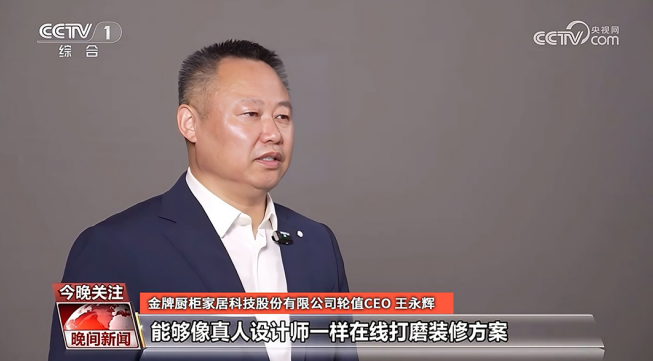
飞流AI家装设计智能体

Search documents
金牌家居(603180.SH):预计2025年归母净利润2000万元到2800万元,同比减少85.95%到89.96%
Ge Long Hui A P P· 2026-01-29 13:38
Core Viewpoint - The company, Jinpai Home (603180.SH), is expected to experience a significant decline in net profit and net profit excluding non-recurring gains in 2025, primarily due to adverse market conditions and strategic investments impacting short-term profitability [1][2]. Group 1: Financial Projections - The company anticipates a net profit attributable to shareholders of between 20 million to 28 million yuan for 2025, representing a year-on-year decrease of 85.95% to 89.96% [1]. - The expected net profit excluding non-recurring gains is projected to be between -26 million to -18.5 million yuan, indicating a year-on-year decline of 113.15% to 118.47% [1]. - The forecasted operating revenue for 2025 is estimated to be between 3.475 billion to 3.266 billion yuan, reflecting a year-on-year decrease of 0% to 6% [1]. Group 2: Reasons for Decline - The decline in profit is attributed to factors such as the downturn in the real estate market, weak industry demand, and intensified price competition, which have led to reduced operating revenue and a decline in gross margin [2]. - The company is investing in a multi-channel retail strategy, including the establishment of new retail formats and overseas production bases, which is expected to impact short-term profits but aims to strengthen long-term competitiveness [2]. - Additional costs from the issuance of convertible bonds, estimated at approximately 25 million yuan, and increased depreciation from new production facilities are also contributing to the temporary profit decline [2].

金牌家居:2025年全年净利润同比预减85.95%—89.96%
2 1 Shi Ji Jing Ji Bao Dao· 2026-01-29 11:13
Core Viewpoint - The company, Jinpai Home, anticipates a significant decline in net profit for the year 2025, projecting a net profit attributable to shareholders of between 20 million to 28 million yuan, representing a year-on-year decrease of 85.95% to 89.96% [1] Financial Performance - The expected net profit excluding non-recurring gains and losses for 2025 is projected to be between -26 million to -18.5 million yuan, indicating a year-on-year decrease of 113.15% to 118.47% [1] - The company forecasts total revenue for 2025 to be between 3,474.72 million to 3,266.23 million yuan, reflecting a year-on-year decrease of 0% to 6% [1] Industry Challenges - The company faces multiple pressures including a complex economic environment, a downturn in the real estate sector, and intensified competition in the custom home furnishing industry, which have adversely affected revenue and profit margins [1] Strategic Initiatives - The company is committed to a long-term optimistic strategy, focusing on the collaborative development of four key areas: new retail, home decoration, refined decoration, and overseas expansion [1] - Investments are being made in establishing a multi-channel retail network, including new retail window stores, home decoration material selection stores, shared large stores, and community stores [1] - The company is also developing overseas production bases, including a facility in Thailand and satellite factories in Dallas and Malaysia, to enhance its retail and engineering business [1] Technological Advancements - The company is iterating its first "Feiliu AI" home decoration design intelligence system, aiming to create a complete business loop from intelligent design to home decoration services [1] Cost Impacts - The issuance of convertible bonds in 2023 has incurred interest expenses of approximately 25 million yuan, and the depreciation from new production bases in Chengdu and overseas satellite factories has also impacted profits in the short term [1]
“智造、出海、AI”,三年三阶!金牌家居x吴晓波,一直在把脉大家居行业走向
Xin Lang Cai Jing· 2025-12-29 13:44
Group 1 - The core focus of the 2025 speech by Wu Xiaobo is on finding actionable paths within the AI wave, emphasizing its profound impact on the physical world, industries, and young entrepreneurs [1][21] - The collaboration between Jinpai Home and Wu Xiaobo has consistently defined the development direction of China's home furnishing industry, addressing key industry challenges each year [3][23] Group 2 - In 2023, the industry faced challenges due to a downturn in real estate and increased competition, leading to a shift from "scale competition" to "value competition" [4][24] - Jinpai Home's achievements in smart manufacturing were highlighted, including the integration of digital twin technology and intelligent control systems, which significantly improved production efficiency [8][28] - The introduction of the "1㎡ gym" concept showcased innovative product development aimed at meeting consumer needs in urban environments [6][26] Group 3 - In 2024, the focus shifted to global expansion, with Jinpai Home positioning itself as a model for high-quality overseas operations, transitioning from "product export" to "industry export" [10][30] - Jinpai Home's strategy included establishing factories in Thailand and the U.S. to mitigate trade barriers and enhance local production capabilities [10][30] - The company implemented a localized strategy tailored to different markets, ensuring a better fit for local consumer needs [12][32] Group 4 - By 2025, Jinpai Home aims to leverage AI technology to address challenges in the home furnishing industry, enhancing design communication and service delivery [13][33] - The "Feiliu AI" solution was introduced to streamline the home renovation process, significantly reducing design time and improving user experience [18][38] - This AI initiative is seen as a transformative force, shifting the industry from product competition to ecosystem competition, thereby facilitating digital transformation [18][39] Group 5 - The three-year collaboration between Jinpai Home and Wu Xiaobo has effectively tracked the evolution of the home furnishing industry, focusing on smart manufacturing, global expansion, and AI innovation [19][39] - The partnership has demonstrated that industry leaders must balance deep-rooted practices with the ability to capture emerging trends for sustainable growth [19][39]


媒体聚焦定制家居行业转型升级,金牌家居解码AI家装设计智能体
Jing Ji Wang· 2025-12-26 08:01
Core Insights - The article highlights the technological innovation and AI integration in the custom home furnishing industry, focusing on Kingboard Home's advancements in AI home design and its transition from manufacturing to intelligent manufacturing [1][3]. Group 1: Transition to Intelligent Manufacturing - The custom home furnishing industry is experiencing a systemic leap due to the wave of artificial intelligence technology, with Kingboard Home embracing this trend by integrating AI, big data, and cloud computing into all processes from product design to user service [3]. - Kingboard Home has developed a data-driven flexible manufacturing and collaborative optimization system, achieving smart production scheduling, dynamic quality control, adaptive scheduling, and resource optimization, significantly enhancing flexible manufacturing capabilities [3]. - For instance, at the Chengdu super factory, Kingboard Home successfully addressed the challenges of large-scale flexible manufacturing through AI and digitalization, resulting in a production efficiency increase and a more than 10% improvement in per capita efficiency, along with a threefold increase in assembly efficiency [3]. Group 2: AI Home Design Innovation - The "Feiliu AI Home Design Intelligent System" represents a soft innovation aimed at enhancing user experience, allowing families to have their own AI designer that realizes their design visions [3][5]. - Feiliu AI supports multimodal interaction, enabling users to search or upload floor plans, generate aesthetically pleasing 3D renderings, and switch to 720° VR panoramic views for a virtual tour of their future home [5]. - The system allows for DIY layout adjustments, providing users with intuitive and responsive options for space layout and personalized space creation, along with automatic generation of cost estimates for hard and soft furnishings, ensuring clear and controllable renovation budgets [5]. Group 3: Future Directions - Kingboard Home plans to continue deepening the integration of "AI + industry" innovation, using technology as a driving force to enhance large-scale personalized customization capabilities and overall service experience [6]. - The company aims to evolve into a new quality production enterprise, contributing new momentum to the sustainable evolution of the home furnishing industry [6].