
饮食服务

Search documents
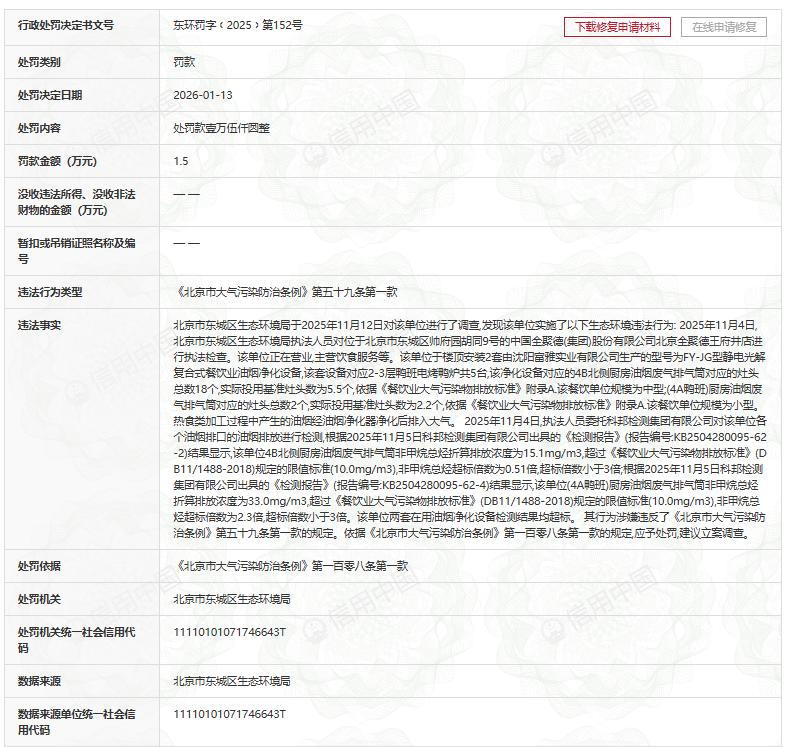
全聚德王府井店被罚 厨房油烟废气排放超过限值标准
Zhong Guo Jing Ji Wang· 2026-01-19 06:08
Core Viewpoint - China Quanjude (Group) Co., Ltd. has been fined for violating environmental regulations related to air pollution from its restaurant operations in Beijing [1][3]. Group 1: Regulatory Violations - The Beijing Dongcheng District Ecology and Environment Bureau conducted an investigation on November 12, 2025, and found that the company had committed ecological and environmental violations [1][3]. - The company installed two sets of oil fume purification equipment that did not meet the required standards for emissions, leading to excessive discharge of non-methane total hydrocarbons [2][3]. Group 2: Emission Testing Results - Testing conducted by Kebo Testing Group on November 5, 2025, revealed that the emissions from the 4B north kitchen exhaust exceeded the standard limit of 10.0 mg/m³, with a measured concentration of 15.1 mg/m³, which is 1.51 times the limit [2]. - The emissions from the 4A duck kitchen exhaust were even higher, with a concentration of 33.0 mg/m³, exceeding the limit by 2.3 times [2]. Group 3: Penalties and Company Information - The company has been fined 15,000 yuan for these violations, as per the regulations outlined in the Beijing Air Pollution Prevention and Control Ordinance [3][5]. - China Quanjude was established in 1994 and is primarily engaged in the restaurant industry, with a registered capital of approximately 3.07 billion yuan [3].


宏观深度报告:2025重振消费之路(四)
Ping An Securities· 2025-08-13 13:59
Group 1: Service Industry and Consumption Dynamics - In 2023, China's final consumption rate was 56.8%, which is 10.5 percentage points lower than that of middle-income countries and 19.2 percentage points lower than high-income countries[7] - Service industry output primarily flows into the consumption sector, with 78.5% of service industry final use being consumption, compared to only 36.2% for the industrial sector[12] - Urban residents' consumption accounts for 35.5%, rural residents 8.4%, and government consumption 34.6% of final use, highlighting the significant role of both resident and government consumption[15] Group 2: Potential Directions for Service Industry Development - The healthcare and social security sector in China accounted for only 2.6% of GDP in 2022, significantly lower than the sample region average of 7.2%[38] - The accommodation and catering industry represented 1.8% of GDP in 2024, which is 0.8 percentage points lower than the sample region average[38] - Cultural, sports, and entertainment sectors accounted for just 0.7% of GDP in 2022, compared to the sample region average of 2.5%[38] Group 3: Recommendations for Industry Improvement - For healthcare and elderly care services, macro policies should support the construction and operation of elderly care institutions through fiscal subsidies and loans, while also providing direct elderly care subsidies to low-income seniors[2] - In the cultural and tourism sector, the government should increase investment in cultural infrastructure and explore mechanisms like cultural consumption vouchers to stimulate demand[2] - In the accommodation and catering sectors, policies should focus on reducing tax burdens for individual operators and providing direct consumption subsidies to stimulate market demand[2] Group 4: Employment and Income Impact - The service industry accounted for 62.4% of non-agricultural employment in 2023, surpassing its 60.5% share of non-agricultural GDP[27] - The value added in the service industry flows more towards labor compensation, with 52.9% of service industry value added going to labor, compared to 34.8% in the industrial sector[23] - Each 1% increase in service industry employment leads to a 1.15% increase in manufacturing employment, indicating a strong multiplier effect[29]