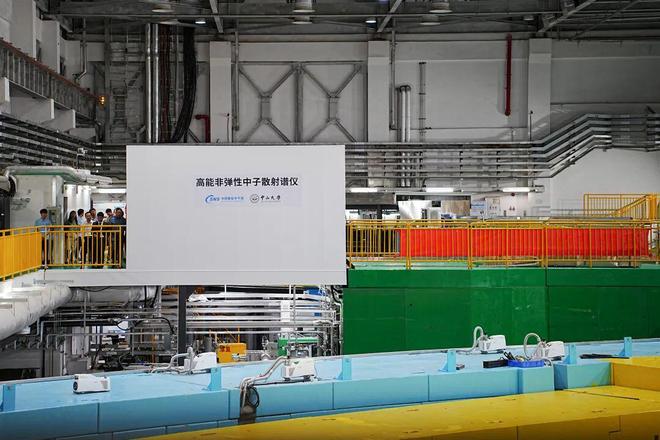
高能直接几何非弹性中子散射飞行时间谱仪

Search documents
新思想引领新征程丨粤港澳大湾区深入推进国际科技创新中心建设 奋力打造全球科技创新高地
Yang Guang Wang· 2025-12-22 08:06
Group 1 - The Guangdong-Hong Kong-Macao Greater Bay Area aims to establish itself as a global technology innovation hub, focusing on the development of emerging industries and leveraging the complementary advantages of the three regions [1][2] - The establishment of the Higher Education Regional Technology Transfer Center in the Greater Bay Area aims to facilitate the transformation of high-level projects from 27 renowned universities, including Hong Kong University of Science and Technology and University of Macau [1] - The region is home to over 400 invention patents authorized daily, showcasing its strong innovation aggregation effect [1] Group 2 - A high-energy direct geometry non-elastic neutron scattering time-of-flight spectrometer was recently accepted and delivered in Dongguan, marking a significant advancement in China's research capabilities [2] - The Greater Bay Area is witnessing a surge in technology innovation, with over 70,000 national high-tech enterprises and major scientific infrastructure projects under construction [2][3] - The region's innovation cluster, particularly the "Shenzhen-Hong Kong-Guangzhou" area, has ranked first globally in innovation index, while the "Macau-Zhuhai" cluster has been recognized among the top 100 globally for two consecutive years [3] Group 3 - The Guangdong Provincial Government emphasizes collaboration with Hong Kong and Macau in fields such as artificial intelligence, low-altitude economy, and biomanufacturing to build a comprehensive innovation community [3][4] - The ongoing development of infrastructure connectivity and regulatory mechanisms is enhancing the efficient flow of various elements within the Greater Bay Area, supporting industrial collaboration and innovation [3] - The "14th Five-Year Plan" period is critical for the Greater Bay Area to become a globally influential international technology innovation center, focusing on frontier emerging fields and cross-border industrial technology integration [4]
我国首台高能非弹性中子散射谱仪完成验收“超级相机” 为微观世界拍高清“纪录片”
Ren Min Ri Bao· 2025-12-05 22:15
不久前,在位于广东东莞的中国散裂中子源,我国首台高能直接几何非弹性中子散射飞行时间谱仪正式 完成验收并交付使用。这台由中山大学和散裂中子源科学中心联合研制建设的大型科研仪器,用于观测 物质微观世界的结构与动力学性质,填补了我国百毫电子伏以上非弹性中子散射的空白。 "如果把常规的科学仪器比作人眼,那么这台谱仪就是一台'超级相机',能够精准捕捉物质内部原子、 分子在皮秒(万亿分之一秒)时间尺度下的动态,记录下原子和分子振动、旋转、传递能量的微观过 程。"建设团队成员、中山大学物理学院副教授刘新智说,"就像是为物质微观世界拍高清'纪录片'。" "超级相机"如何让微观世界纤毫毕现?刘新智介绍,这台"超级相机"的工作原理是通过测量物质的自旋 波和声子谱等动力学性质,研究构成物质的原子之间微观相互作用。因此,科学家并非使用仪器直接观 测成像,而是利用中子不带电、穿透力强的特性,探测物质内部的微观运动——当中子与物质中的原子 核或电子发生"非弹性碰撞"时,中子会改变速度与方向,通过这些变化可以反推出物质内部的动态信 息。 中山大学物理学院副院长王猛介绍,这台谱仪可以获取散射后中子的空间分布信息和能量变化,在动量 与能量空间 ...
“超级相机”,为微观世界拍高清“纪录片”
Ren Min Ri Bao· 2025-12-05 22:03
Core Viewpoint - The successful completion and delivery of China's first high-energy direct geometry inelastic neutron scattering time-of-flight spectrometer marks a significant advancement in the observation of the microscopic structure and dynamic properties of materials, filling a gap in inelastic neutron scattering above 100 meV in China [1][2]. Group 1: Instrument Overview - The spectrometer, developed by Sun Yat-sen University and the China Spallation Neutron Source, is likened to a "super camera" that captures dynamic processes of atomic and molecular vibrations and rotations on a picosecond timescale [1]. - It operates by measuring the spin waves and phonon spectra of materials, utilizing the non-charged and penetrating nature of neutrons to probe microscopic movements within materials [1][2]. Group 2: Applications and Research Support - The instrument can provide spatial distribution and energy change information of scattered neutrons, aiding in the study of magnetic atomic correlations within materials, thus supporting foundational research across physics, chemistry, biology, and materials science [2]. - In high-temperature superconductivity research, the spectrometer can accurately measure spin fluctuations and phonon density of states in superconductors, providing critical experimental evidence for understanding high-temperature superconducting mechanisms [2]. - In the field of energy materials, it can measure the spatial distribution of phonon spectra in thermoelectric materials, guiding the design of higher-performance thermoelectric materials [2]. - In biomedicine, neutron scattering technology allows scientists to study the motion of biomolecules under conditions closer to physiological environments, opening new avenues for drug development [2]. Group 3: Development Process - The construction of the spectrometer began in 2019 after a strategic cooperation agreement was signed in 2017, following two years of feasibility studies and research [3]. - The development involved collaboration among multiple technical teams to overcome challenges in key components such as the neutron chopper and large vacuum scattering chamber [3]. - After two years of debugging, the spectrometer has achieved internationally leading performance levels, capable of rapid switching between multi-wavelength and single-wavelength modes, and providing environments for a wide range of inelastic neutron scattering experiments [3]. - The "super camera" will be open for use by domestic and international researchers, serving national strategic needs and fostering the development of top-tier professionals [3].
新华社:首台“超能力仪器”成功验收
仪器信息网· 2025-11-17 05:47
Core Viewpoint - The successful acceptance of China's first high-energy direct geometry inelastic neutron scattering time-of-flight spectrometer fills a significant gap in the country's capabilities for inelastic neutron scattering above 100 meV, enabling advanced studies of material's microscopic structures and dynamic properties [2][3]. Group 1: Instrument Capabilities - The high-energy inelastic neutron scattering spectrometer can measure both the spatial distribution and energy changes of scattered neutrons, allowing for the analysis of material's microscopic dynamic behaviors in momentum and energy space [3]. - It operates with an incident neutron energy range of 10-1500 meV, achieving an optimal energy resolution of 3% for dynamic excitation signals [3]. - The spectrometer supports a wide temperature range of 1.5-800 K and a magnetic field environment of up to 7T, covering most experimental scenarios for inelastic neutron scattering [3]. Group 2: Scientific Value - In high-temperature superconductivity research, the spectrometer can accurately measure spin fluctuations in superconductors, analyze their relationship with superconductivity, and provide critical experimental evidence for understanding high-temperature superconducting mechanisms [4]. - In the field of energy materials, it can track the diffusion processes of atoms and ions in lithium batteries and hydrogen storage materials, offering theoretical guidance for designing higher-performance energy materials [4]. - In biomedicine, the spectrometer enables the study of the dynamic behavior of biological macromolecules like proteins under near-physiological conditions, paving the way for new drug development [4]. Group 3: Future Prospects - The construction team of the spectrometer has initiated the development of a multi-field coupling loading analysis module, supported by national major scientific instrument development projects [4]. - With its acceptance and upcoming user access, the spectrometer is set to embark on a journey of scientific exploration, helping scientists uncover more mysteries of nature and providing strong support for the development of fundamental disciplines such as physics, chemistry, materials science, and biology [4].

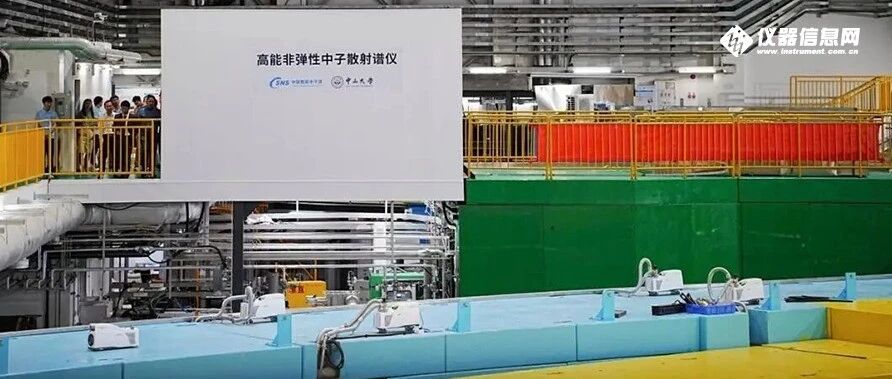
我国研发的微观世界“超级相机”成功验收;三星宣布未来五年内将在韩国进行450万亿韩元投资丨智能制造日报
创业邦· 2025-11-17 03:06
Group 1 - Samsung announced a total investment of 450 trillion KRW in South Korea over the next five years, focusing on R&D and expanding semiconductor investments, including the construction of a fifth factory in Pyeongtaek, expected to be operational by 2028 [2] - Chipone Integrated Circuit released a new silicon carbide G2.0 technology platform aimed at high efficiency, high power density, and high reliability, applicable in electric vehicles and AI data center power supplies [2] - An international research team led by Aalto University in Finland developed a method to perform complex tensor calculations using single light propagation, marking a significant step towards general AI hardware development [2] Group 2 - China's first high-energy direct geometric non-elastic neutron scattering time-of-flight spectrometer has been successfully accepted, filling a gap in non-elastic neutron scattering above 100 meV in the country [2]

填补空白!我国首台,交付使用
Huan Qiu Wang Zi Xun· 2025-11-16 14:03
Core Points - The first high-energy direct geometry inelastic neutron scattering time-of-flight spectrometer in China has been accepted and put into use, marking a significant advancement in material dynamics research [1][3] - This spectrometer will provide experimental conditions for research in physics, chemistry, materials science, mechanics, and interdisciplinary studies [1] Group 1 - The unique feature of the spectrometer is its ability to utilize the non-charged and penetrating nature of neutrons to directly probe the microscopic movements within materials [3] - It fills the gap in inelastic neutron scattering above 100 meV in China, allowing for the measurement of both spatial distribution and energy changes of scattered neutrons [3] - The spectrometer can measure the dynamic behavior of microscopic structures in both momentum and energy space, enhancing the understanding of material properties [3] Group 2 - The spectrometer employs a combination of Fermi chopper and bandwidth chopper to enable rapid switching between multi-wavelength and single-wavelength modes [3]