
鹰击系列导弹

Search documents
十五五开局之年,关注订单增长与军贸提速 - 2026年度国防军工行业策略报告
2025-11-14 03:48
Summary of Key Points from the Conference Call Industry Overview - The defense and military industry in China has shown significant growth, with revenue reaching 451.1 billion yuan in the first three quarters of 2023, representing a year-on-year increase of 31.8% [1][2][3] - The military electronics sector experienced a remarkable growth rate of 81%, while naval equipment grew by 70%, indicating a strong demand for shipbuilding and risk diversification in the manufacturing sector [1][2][5] Core Insights and Arguments - The defense budget for 2025 is expected to increase by over 7%, accounting for approximately 7% of GDP, primarily allocated for military readiness, barrack construction, and weaponry, with weapons accounting for about 45% to 55% of the budget [1][3][5] - China's military exports have diversified from light weapons to advanced vessels and fighter jets, with plans to transfer drone production lines to friendly nations, enhancing local production capabilities [1][6][4] - The Chinese military aims to achieve several strategic goals: becoming a strong military by 2027, a global military power by 2035, and a world-class power by 2050, necessitating significant upgrades in weaponry and equipment [1][7][8] Performance of Sub-sectors - Different sub-sectors within the defense industry have varied performances: aerospace grew by 7%, aviation declined by 2%, ground equipment increased by 21%, naval equipment surged by 70%, and military electronics soared by 81% [2][5] - The naval equipment sector's revenue and profit growth reflects the development of the shipbuilding industry, with Chinese manufacturers seeking alternative suppliers due to U.S. restrictions on new contracts [5] Military Trade Developments - China's military exports have expanded significantly, with a focus on advanced military hardware and a shift towards exporting complete production lines rather than just individual products [6][4] - New fighter jets like the J-20E, J-20S, and the upcoming J-35 are expected to enhance China's competitiveness in the international military market [6] Future Military Modernization Goals - The Chinese Air Force aims to achieve a world-class operational capability by 2035, with a projected fleet of over 100 advanced fighter jets, including J-20, J-35, J-16, and J-15, along with the development of unmanned systems [1][10][8] - The modernization strategy includes converting retired J-6 aircraft into drones to establish a comprehensive unmanned combat system [10] Technological Advancements - Significant advancements in electromagnetic catapult technology have been achieved, with over 6,000 successful tests of new systems, showcasing China's leading position in this area [3][36] - The development of nuclear-powered aircraft carriers is progressing, with a mature nuclear power system that enhances safety and reduces maintenance costs [40] Impact of Military Trade on Financial Performance - Military trade significantly impacts the financial performance of defense companies, with net profit margins potentially increasing from 5% to 15%-20% upon securing contracts [54] Overall Industry Outlook - The defense sector is expected to continue its growth trajectory in 2026, driven by genuine and sustained demand, despite some companies potentially underperforming [55]
(抗战胜利80周年)九三阅兵的四重亮点
Zhong Guo Xin Wen Wang· 2025-09-03 11:34
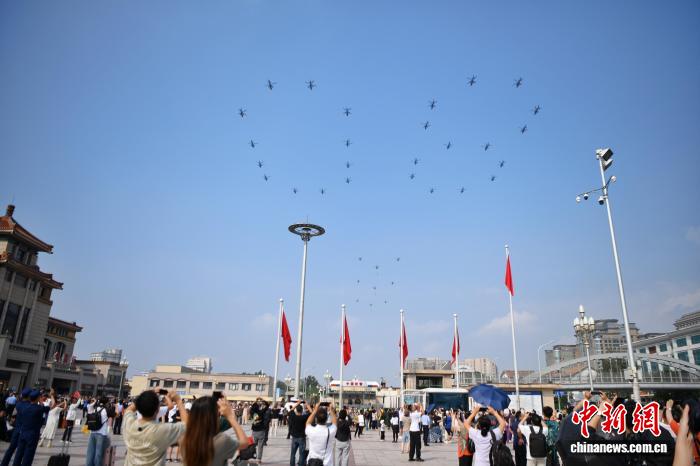
Core Points - The 80th anniversary of the victory in the Chinese People's War of Resistance Against Japanese Aggression and the World Anti-Fascist War was commemorated with a grand military parade in Beijing on September 3, marking the second such event since 2015 [1] Group 1: Commemoration Highlights - The parade featured significant symbols of the anti-Japanese war, including 80 cannon salutes and sculptures of 14 peace doves representing the 14 years of resistance [2][4] - The numbers "1945" and "2025" were prominently displayed, symbolizing the victory and the future, respectively, and were widely discussed online [2][4] Group 2: Military Equipment Showcase - The parade showcased new generation military equipment, including the 99B tank and the "Dongfeng-5C" intercontinental ballistic missile, highlighting China's advanced military capabilities [6][8] - The "Eagle Strike" missile series was presented as a key asset for maritime defense, enhancing China's strike capabilities against naval threats [6] Group 3: Structural Military Reforms - The parade illustrated the new military structure of China, which includes the recent establishment of information support, military space, and cyber forces, marking their first appearance at a national event [9] - The military space force was highlighted as a strategic branch, emphasizing its role in enhancing space security and crisis management [9] Group 4: Representation of Women in the Military - The parade featured female pilots, including Tan Hongmei, who flew the Y-20A tanker, showcasing the increasing role of women in the military [10][12] - A female militia unit made its debut, reflecting the evolving image of the Chinese militia and aligning with the theme of the anti-Japanese war [10][12]

反舰导弹、红旗家族……阅兵场上多种武器装备“上新” 专家解读→
Yang Shi Wang· 2025-09-03 09:27
Group 1 - The core message of the news highlights the display of advanced military capabilities during a recent military parade, showcasing a new generation of weaponry and the spirit of resistance from historical military achievements [1] - The parade featured a flag team representing 80 honor flags from anti-Japanese war heroes, symbolizing the continuation of the great spirit of resistance [1] - The equipment showcased included various combat groups such as land, sea, air defense, information warfare, unmanned operations, logistics support, and strategic strike groups, demonstrating the military's strong capabilities in modern warfare [1][4] Group 2 - The Eagle Strike missile family made its debut, with multiple hypersonic missiles being displayed for the first time, indicating significant advancements in missile technology [4] - The Eagle Strike 19 missile utilizes an air-breathing hypersonic design, overcoming substantial technical challenges, which is a source of national pride [4] - The hypersonic missiles are expected to have a significantly increased range compared to previous generations, enhancing their operational effectiveness [4] Group 3 - The Red Flag family of air defense missiles has expanded, forming a comprehensive air defense network capable of addressing threats at various altitudes [5][6] - The development of the Red Flag series reflects China's independent technological advancements in air defense, achieving significant breakthroughs [9] - The advanced early warning systems support the Red Flag family in accurately detecting and engaging a wide range of aerial threats [9] Group 4 - The parade showcased numerous unmanned combat systems, many of which were presented for the first time, highlighting the military's focus on integrating unmanned technologies [10] - Ground-based unmanned vehicles demonstrated capabilities for precise firepower suppression against dynamic and static targets [12] - Advanced unmanned underwater vehicles and surface vessels were also featured, showcasing their roles in reconnaissance, blockade, and attack operations [14][15] Group 5 - The display included advanced unmanned aerial vehicles (UAVs), such as stealth attack drones and integrated reconnaissance-strike drones, indicating improvements in UAV technology [17] - The UAVs are designed to operate in conjunction with manned stealth fighters, enhancing situational awareness and battlefield communication [17] - The integration of UAVs into air combat operations is becoming increasingly vital for achieving air superiority [17]

反舰导弹方队:打击海上之敌的“尖兵利器”
Xin Hua She· 2025-09-03 02:08
Core Viewpoint - The article highlights the display of a naval missile formation, showcasing advanced anti-ship missiles, which enhances the naval capabilities of the People's Navy and serves as a strategic asset for maritime defense [1]. Group 1: Missile Capabilities - The missile formation consists of two guidance vehicles and sixteen transport vehicles, featuring the YJ-15, YJ-19, YJ-17, and YJ-20 hypersonic anti-ship missiles [1]. - These four types of anti-ship missiles can be deployed on various platforms, including carrier-based aircraft, surface vessels, and submarines, indicating versatility in operational deployment [1]. - The missiles are characterized by long range, high speed, and strong destructive power, making them effective tools for engaging maritime adversaries [1]. Group 2: Strategic Importance - The YJ series of missiles enhances the three-dimensional anti-ship system, significantly improving the People's Navy's long-range rapid strike capabilities [1]. - These capabilities are crucial for safeguarding maritime rights and interests, as well as for competing for maritime dominance, positioning the missiles as a "strategic heavy weapon" [1]. - The anti-ship missile formation was primarily organized by a specific naval unit, reflecting the military's focus on strengthening its operational readiness [1].