
麦草方格

Search documents
铁轨穿沙而过,这里藏着一群“向沙漠要绿洲”的人
Xin Lang Cai Jing· 2025-12-29 15:11
Core Viewpoint - The article highlights the significant achievements and ongoing research efforts at the Shapotou Station, a key site for desertification control and ecological restoration in China, showcasing its evolution from a basic research station to a renowned ecological research base [1][12]. Group 1: Historical Development - The Shapotou Station was established in 1955 to address severe sand damage during the construction of the Baolan Railway, marking the beginning of systematic desertification research in China [2][3]. - Initially, researchers lived in a simple earthen house in a nearby village, focusing on the feasibility of using plants for sand fixation along the railway [2][3]. - By 1960, the Chinese Academy of Sciences decided to enhance the station's infrastructure, leading to the construction of brick buildings and the establishment of laboratories by 1964 [3][4]. Group 2: Research and Technological Advancements - The Shapotou Station has developed a comprehensive monitoring system, the Shapotou Evapotranspiration Instrument Group, which is the largest of its kind in northern China, facilitating advanced data collection on water balance in desert ecosystems [7][9]. - The station has accumulated extensive data on water, soil, meteorology, and biology, making it a valuable resource for researchers and local management authorities [9][10]. Group 3: Ecological Restoration Efforts - The station has successfully transformed 1.5 million acres of the Tengger Desert from "sand encroachment" to "green recovery" through targeted afforestation and ecological engineering techniques [9][12]. - Innovative methods such as the "grass grid" technique and the integration of various plant species have been employed to create effective ecological barriers along the railway [11][12]. Group 4: Education and Training - The Shapotou Station serves as a popular educational base, receiving over 5,000 visitors annually, primarily students, to learn about desertification control techniques [12]. - It has conducted over 30 training sessions on desertification prevention, educating more than 1,000 technical personnel on cutting-edge sand control methods [12]. Group 5: Future Directions - The station is pursuing the "Shapotou Model 2.0," which combines woven sand barriers with artificial crusts to enhance sand fixation, aiming for more efficient desertification control [13]. - Future research will focus on sustainable development in arid ecosystems, ecological restoration, biodiversity conservation, and green industry development [13].
麦草方格,方寸之间锁流沙
Ren Min Ri Bao· 2025-10-23 00:33
Core Viewpoint - The article highlights China's unique ecological governance model, particularly the innovative "wheat straw grid" method for desertification control in the Tengger Desert, showcasing effective practices and contributions to global desertification management [1][2]. Group 1: Ecological Governance Practices - The "wheat straw grid" method, developed in the 1950s, has been implemented over 430,000 acres in the Tengger Desert, significantly reversing desertification and promoting the growth of over 100 million desert plants [5][6]. - The method involves creating square grids of wheat straw to stabilize sand, reduce wind speed, and promote the formation of biological soil crust, which enhances plant growth [3][6]. - The Tengger Desert has seen a retreat of 25 kilometers due to these efforts, with a protective system established along the Baolan Railway, consisting of wheat straw grids and vegetation [5][6]. Group 2: Technological Advancements - Recent advancements in technology have led to the mechanization and automation of the wheat straw grid method, increasing efficiency by over 60% and extending the lifespan of the grids from 2 years to 5-6 years [6][7]. - The introduction of new equipment, such as multifunctional sand-fixing vehicles and drones, has improved the maintenance and implementation of the wheat straw grids [6]. Group 3: Economic and Tourism Development - The ecological restoration efforts have transformed the Tengger Desert from an ecological burden into a unique tourism resource, attracting significant visitor numbers and generating substantial revenue [8]. - In 2024, the Shapotou Scenic Area received 1.46 million visitors, resulting in a total tourism revenue of 428 million yuan, demonstrating the economic potential of integrating ecological restoration with tourism [8].

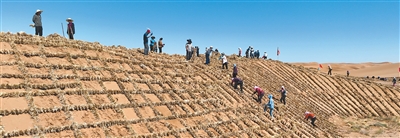
麦草方格,方寸之间锁流沙(生态治理中的中国智慧)
Ren Min Ri Bao· 2025-10-21 22:39
Core Viewpoint - The article highlights China's unique ecological governance model, particularly the innovative "wheat straw grid" method for desertification control in the Tengger Desert, showcasing successful practices in integrated ecological protection and management [1][2]. Group 1: Ecological Governance Practices - The "wheat straw grid" method, developed in the 1950s, has been instrumental in stabilizing sand and preventing desertification in the Tengger Desert, covering over 430,000 acres in Ningxia [2][4]. - The method involves creating square grids of wheat straw to trap sand, reduce wind speed, and promote the growth of vegetation, effectively reversing desertification by 25 kilometers [4][5]. Group 2: Technological Advancements - Recent advancements in technology have accelerated the formation of biological soil crusts, reducing the natural process time from approximately 10 years to about 1 year [5]. - The introduction of mechanized and automated methods, such as the use of multifunctional sand-fixing vehicles and drones, has increased efficiency in the application of the wheat straw grids by over 60% [5][6]. Group 3: Economic and Environmental Impact - The successful implementation of the wheat straw grid method has transformed the Tengger Desert from an ecological burden into a tourist attraction, with the region receiving 1.46 million visitors and generating a total tourism revenue of 428 million yuan in 2024 [7]. - The biodiversity in the area has significantly increased, with the number of plant species rising from fewer than 25 in the 1950s to over 450 today, enhancing the ecological landscape [7].
吸引50多个国家和地区的专家学者前来参观考察 麦草方格,方寸之间锁流沙(生态治理中的中国智慧)
Ren Min Ri Bao· 2025-10-21 21:50
Core Insights - The article highlights China's unique ecological governance model, particularly the innovative "straw grid" method for desertification control in the Tengger Desert, showcasing China's wisdom and solutions in ecological management [1][2]. Group 1: Ecological Governance Practices - The "straw grid" method, developed in the 1950s, involves laying straw in square patterns to stabilize sand, effectively reducing wind erosion and promoting vegetation growth [2][3]. - Over 430,000 acres of straw grids have been established in the Tengger Desert, contributing to the reversal of desertification and the growth of over 100 million sand-resistant plants [3][5]. - The successful implementation of this method has transformed the Tengger Desert from a severely sandstorm-affected area to a region with a protective ecological barrier for infrastructure like the Baolan Railway [3][6]. Group 2: Technological Advancements - Recent advancements in technology have accelerated the formation of biological soil crusts, reducing the natural process from approximately 10 years to about 1 year [5]. - The introduction of mechanized and automated methods, such as the use of multi-functional sand-fixing vehicles and drones, has increased efficiency in establishing straw grids by over 60% [5][6]. Group 3: Economic and Tourism Development - The ecological restoration efforts have transformed the Tengger Desert into a tourist attraction, with the Shapotou Scenic Area receiving 1.46 million visitors and generating a total tourism revenue of 428 million yuan in 2024 [7]. - The integration of agriculture, culture, and tourism has turned the desert from an ecological burden into a valuable tourism resource, showcasing the successful application of ecological governance [7].