鼎盛白金信用卡

Search documents
白金信用卡权益大缩水:贵宾厅限次、酒店减量银行吐槽没赚头,“羊毛党”薅了个寂寞
Mei Ri Jing Ji Xin Wen· 2025-12-10 10:12
Core Viewpoint - The high-end credit card benefits are being significantly reduced by multiple banks, leading to a shift in the value proposition of these cards as banks struggle with profitability in this segment [2][5][7]. Group 1: Changes in High-End Card Benefits - Many banks are announcing reductions in high-end card benefits for the upcoming year, including limiting access to airport lounges and increasing the thresholds for redeeming points [2][5]. - Specific changes include limiting airport lounge access from unlimited visits to a maximum of six per year and increasing the points required for cash redemption from 400 to 500 points per dollar [6][5]. - The overall trend indicates a significant contraction in benefits, with services like health check-ups being completely removed [5][6]. Group 2: Profitability Challenges - High-end credit cards are not profitable for banks due to high costs associated with benefits and low commission rates from merchants, which average around 0.3% [7][9]. - The cost of providing services such as airport transfers can range from 200 to 300 yuan, while the revenue generated from card usage is minimal if customers do not carry a balance [8][7]. - The presence of "arbitrageurs" exploiting card benefits further erodes profitability, prompting banks to tighten rules and reduce benefits [10][7]. Group 3: Strategic Focus on High-End Cards - Despite the lack of profitability, banks continue to invest in high-end credit cards as a strategy to attract and retain high-value customers, linking these cards to broader wealth management services [11][14]. - High-end cards serve as a "hook" to deepen relationships with customers, enhancing loyalty and engagement across various banking services [15][14]. - The focus is shifting from acquiring new customers to maintaining existing high-quality clients, with banks aiming to create distinctive offerings in niche markets [19][18].


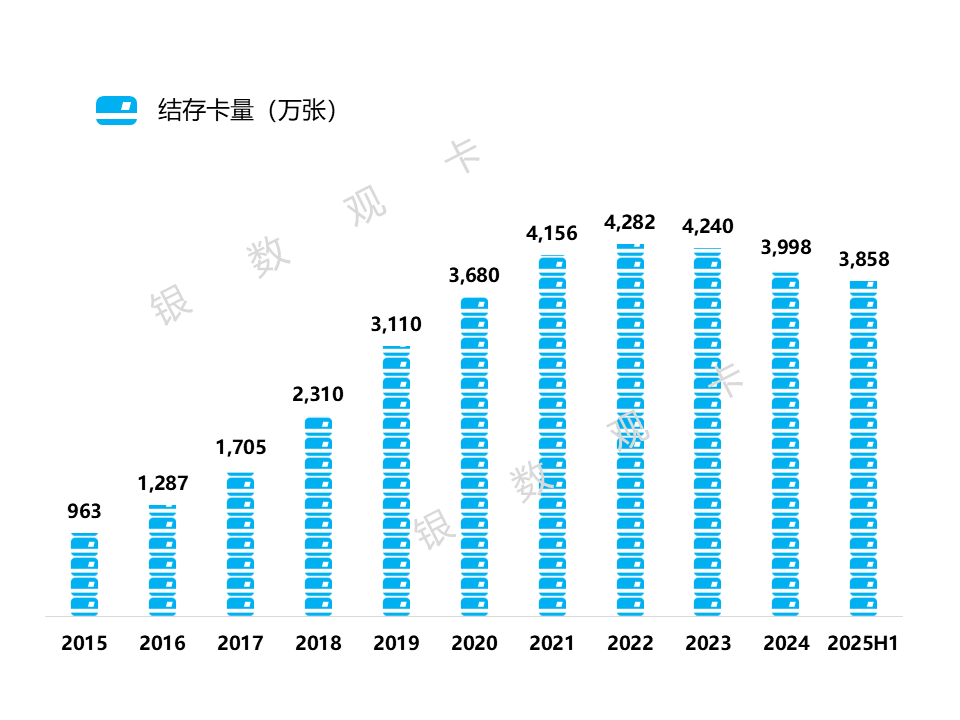
邮储银行:信用卡结存卡量3,857.56万张,消费金额4,564.42亿元
Sou Hu Cai Jing· 2025-08-29 15:08
Core Insights - Postal Savings Bank of China (PSBC) has demonstrated a robust performance in its credit card business, capitalizing on national policies aimed at boosting consumption and expanding domestic demand [9] Business Performance Overview - As of the end of the reporting period, PSBC's credit card outstanding balance reached 38.5756 million cards [1] - The total credit card overdraft and other loans amounted to CNY 224.706 billion as of June 30, 2025 [3] - In the first half of 2025, the total credit card consumption amount was CNY 456.442 billion [6] - The non-performing loan ratio for credit cards stood at 1.55%, an increase of 0.07 percentage points compared to the end of the previous year [8] Strategic Initiatives - PSBC has focused on enhancing its credit card business through precise marketing strategies and optimizing customer engagement, resulting in over 40 million users participating in promotional activities, which boosted consumption by over CNY 30 billion [9] - The bank has launched a trade-in project in collaboration with China UnionPay, targeting key consumer sectors such as home appliances and automobiles, providing substantial consumer subsidies [9] - The bank has upgraded its product offerings for high-end customers, introducing premium credit cards that include value-added services in travel, healthcare, and wellness [9] Retail Banking Performance - PSBC has maintained a strong retail banking strategy, with personal deposits reaching CNY 14.22 trillion, an increase of CNY 591.44 billion from the previous year [11] - Personal loans amounted to CNY 4.86 trillion, reflecting an increase of CNY 887.93 billion [11] Revenue Breakdown - For the first half of 2025, the revenue from personal banking was CNY 116.911 billion, accounting for 65.15% of total revenue, while corporate banking contributed CNY 40.746 billion, or 22.71% [12] - The total operating revenue for the first half of 2025 was CNY 179.446 billion, slightly up from CNY 176.789 billion in the same period of 2024 [12]