高端信用卡

Search documents
白金信用卡权益大缩水:贵宾厅限次、酒店减量……
Mei Ri Jing Ji Xin Wen· 2025-12-11 13:51
Core Insights - The high-end credit card benefits are being significantly reduced by multiple banks, leading to a decline in the perceived value of these cards [1][3][4] - The profitability of high-end credit cards is under scrutiny, as banks struggle to balance the high costs of benefits with low revenue from transaction fees [4][5][6] - Banks are shifting their strategies from aggressive customer acquisition to maintaining existing high-value clients, focusing on overall customer value rather than just credit card profitability [8][10] Summary by Sections Benefit Reductions - High-end credit card benefits such as unlimited airport lounge access and hotel stays are being cut back, with some banks reducing annual hotel stays from two nights to one [1][2] - Changes include limiting airport lounge access to a maximum of six visits per year and increasing the points required for redeeming benefits [3] Profitability Challenges - High-end credit cards are not profitable for banks due to high costs associated with benefits and low transaction fee revenue, which averages around 0.3% in China [4][5] - The cost of services like airport transfers can range from 200 to 300 yuan, further straining profitability [4] Strategic Shifts - Banks are focusing on high-end credit cards as a means to identify and engage high-value customers, integrating these products into broader wealth management strategies [8][9] - The industry is moving towards a model that prioritizes maintaining existing customers over acquiring new ones, especially as the market becomes saturated [10]
白金信用卡权益大缩水:贵宾厅限次、酒店减量银行吐槽没赚头,“羊毛党”薅了个寂寞
Mei Ri Jing Ji Xin Wen· 2025-12-10 10:12
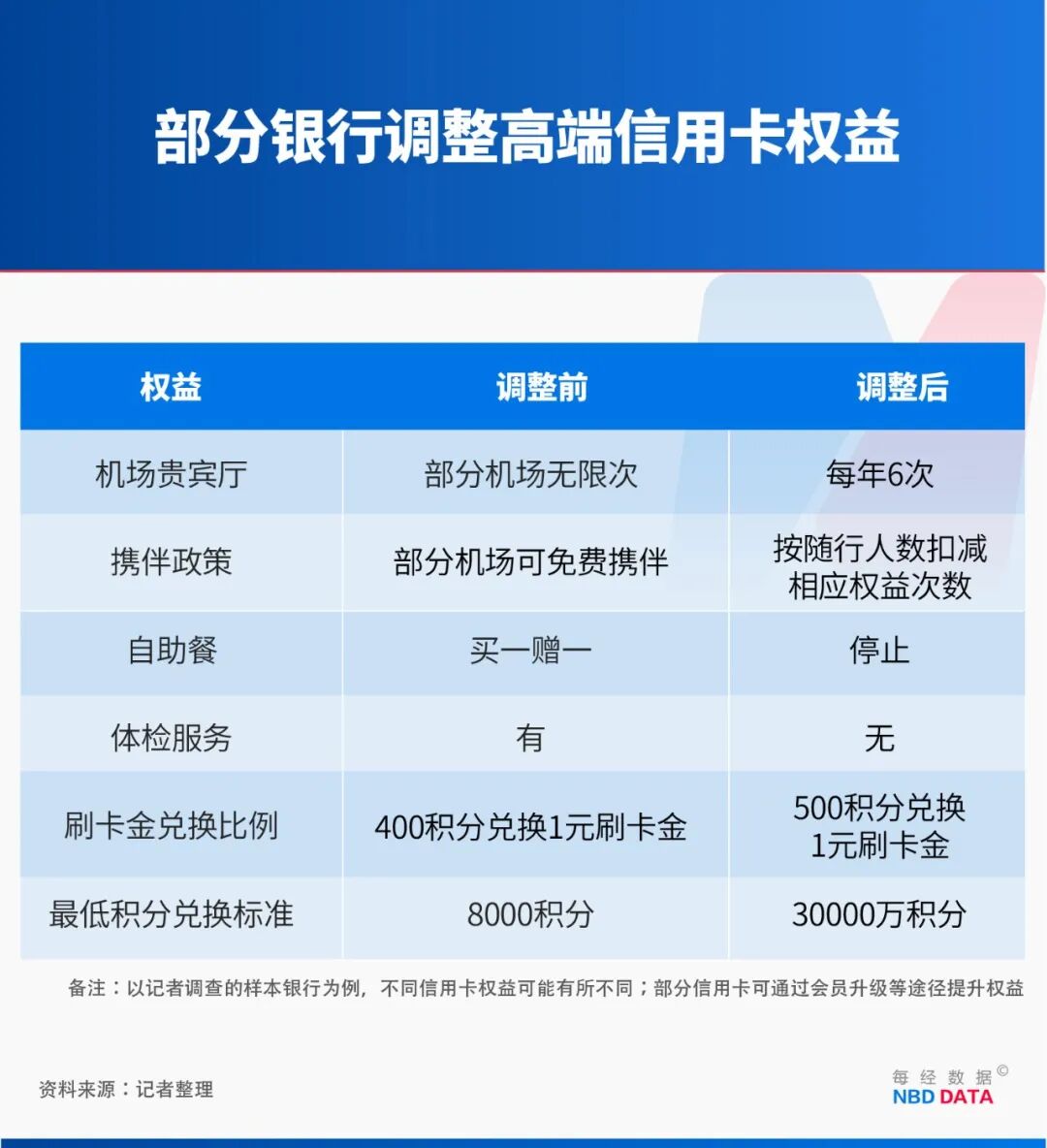
Core Viewpoint - The high-end credit card benefits are being significantly reduced by multiple banks, leading to a shift in the value proposition of these cards as banks struggle with profitability in this segment [2][5][7]. Group 1: Changes in High-End Card Benefits - Many banks are announcing reductions in high-end card benefits for the upcoming year, including limiting access to airport lounges and increasing the thresholds for redeeming points [2][5]. - Specific changes include limiting airport lounge access from unlimited visits to a maximum of six per year and increasing the points required for cash redemption from 400 to 500 points per dollar [6][5]. - The overall trend indicates a significant contraction in benefits, with services like health check-ups being completely removed [5][6]. Group 2: Profitability Challenges - High-end credit cards are not profitable for banks due to high costs associated with benefits and low commission rates from merchants, which average around 0.3% [7][9]. - The cost of providing services such as airport transfers can range from 200 to 300 yuan, while the revenue generated from card usage is minimal if customers do not carry a balance [8][7]. - The presence of "arbitrageurs" exploiting card benefits further erodes profitability, prompting banks to tighten rules and reduce benefits [10][7]. Group 3: Strategic Focus on High-End Cards - Despite the lack of profitability, banks continue to invest in high-end credit cards as a strategy to attract and retain high-value customers, linking these cards to broader wealth management services [11][14]. - High-end cards serve as a "hook" to deepen relationships with customers, enhancing loyalty and engagement across various banking services [15][14]. - The focus is shifting from acquiring new customers to maintaining existing high-quality clients, with banks aiming to create distinctive offerings in niche markets [19][18].


白金信用卡权益大缩水:贵宾厅限次、酒店减量⋯⋯银行吐槽没赚头,“羊毛党”薅了个寂寞
3 6 Ke· 2025-12-10 09:50
Core Viewpoint - The high-end credit card benefits are being significantly reduced by multiple banks, leading to a decline in the perceived value of these cards, as banks struggle with profitability in this segment [1][5][7]. Group 1: Benefit Reductions - Many banks are cutting back on high-cost benefits such as unlimited airport lounge access, reducing it to a maximum of six visits per year [5][6]. - The redemption thresholds for rewards points are being raised, with some banks changing the conversion rate from 400 points to 500 points for one unit of cash back [5][6]. - Additional benefits like complimentary dining and health check services are being eliminated entirely [5][6]. Group 2: Profitability Challenges - High-end credit cards are not profitable for banks due to high costs associated with benefits and low interchange fees, which average around 0.3% in China [7][8]. - The typical high-end cardholder often uses the card solely for payments without generating interest income for the bank, further complicating profitability [7][8]. - The presence of "arbitrageurs" exploiting card benefits has led to increased costs for banks, prompting them to tighten rules around benefit usage [9]. Group 3: Strategic Shifts - Banks are shifting focus from expanding customer bases to managing existing high-value clients, emphasizing a strategy of resource allocation towards wealth management and private banking [10][13]. - High-end credit cards are viewed as tools for identifying valuable customers and enhancing overall profitability through cross-selling opportunities in other financial services [10][13]. - The credit card industry is transitioning into a phase of maintaining existing customers rather than aggressively acquiring new ones, as the market becomes saturated [19][20].
多家银行,差异化布局“开门红”
Zhong Guo Zheng Quan Bao· 2025-12-07 09:37
Core Viewpoint - The "opening red" marketing activities are being launched by various banks, with different focuses depending on the size of the bank, where smaller banks emphasize deposit and loan services, while larger state-owned and joint-stock banks are shifting towards wealth management services [1][4]. Group 1: Small and Medium Banks - Many small and medium banks have initiated their "opening red" marketing campaigns earlier, focusing on comprehensive offerings including deposits, loans, and financial services [1][2]. - Specific initiatives include credit card payment discounts, promotional offers on life service vouchers, and exclusive wealth management products [2]. - The "opening red" marketing strategy has been deployed earlier this year, with banks like Ningbo Donghai Bank and Huaxia Bank outlining specific goals related to deposit growth and loan services [2][3]. Group 2: Large Banks - In contrast to smaller banks, large state-owned banks and some joint-stock banks are adopting a more relaxed approach, with no significant "opening red" marketing activities reported [4]. - These banks are focusing on wealth management, with increased activity in selling insurance products and offering fee discounts on certain fund products [4]. - The strategy reflects a shift towards enhancing wealth management services rather than aggressive deposit gathering [4]. Group 3: Market Dynamics - The trend of "opening red" marketing is influenced by the need for banks to stabilize operations, particularly for smaller banks facing greater operational pressures [5]. - The proportion of new deposits in the first quarter has increased significantly, indicating a strategic shift in how banks approach deposit gathering [3].





护航创新创业 中信银行郑州分行赋能科创企业发展
Huan Qiu Wang· 2025-12-04 03:24
Core Insights - The 10th "Maker China" National Finals for small and medium-sized enterprises (SMEs) innovation and entrepreneurship competition was held in Zhengzhou, gathering representatives from various sectors including enterprises, financial institutions, and research institutes [1][2] - CITIC Bank participated as a financial service partner, providing insights on the "14th Five-Year Plan" and macroeconomic outlook, while also facilitating various financial and project matching activities [1][2] Group 1 - CITIC Bank focuses on high-quality development and leverages the full financial license advantages of CITIC Group to empower technology innovation enterprises [2] - The bank offers a comprehensive financial service solution for technology enterprises throughout their lifecycle, from seed stage to IPO, emphasizing services beyond just credit [2] - Customized products for tech enterprises include "Tech e-loan," "Xiaotianyuan" digital management platform, and various other financial services aimed at enhancing enterprise growth [2] Group 2 - As the financial cooperation bank for the 2025 "Maker China" competition, CITIC Bank aims to support over 4,000 participating enterprises and connect with more than 1,600 service providers across emerging fields like artificial intelligence [2] - The Zhengzhou branch of CITIC Bank will continue to follow up on the competition's outcomes, enhancing financial services and innovation results conversion, while strengthening collaborations with local governments and investment institutions [2] - The bank aims to enrich the connotation of technology innovation financial services, contributing to the growth of technology enterprises in Henan province [2]

多家银行调整高端信用卡权益
Jin Rong Shi Bao· 2025-08-08 07:59
Core Viewpoint - Recent adjustments to high-end credit card benefits by multiple banks indicate a shift towards a more sustainable and long-term operational model in the credit card industry, reflecting the pressures faced by banks in a competitive market [1][4]. Group 1: Bank Adjustments - Several banks, including China Merchants Bank, Everbright Bank, and HSBC China, have announced updates to their high-end credit card products, such as increasing usage thresholds and adjusting applicable ranges [1]. - China Merchants Bank's adjustments include changing the annual fee waiver conditions for its high-end credit cards, moving from "10,000 points for annual fee waiver" to "10,000 points + 180,000 yuan in rigid spending for annual fee waiver" [2]. - Over 10 banks have made similar adjustments to their high-end credit card benefits this year, with notable changes including the removal of airport lounge services and reductions in overseas spending cashback [3]. Group 2: Market Dynamics - The credit card market is entering a phase of stock competition, characterized by declining growth rates in card issuance and rising customer acquisition costs [3]. - Experts suggest that banks are raising thresholds to filter customers, directing resources towards high-spending and high-contribution users, which may enhance overall profitability in the credit card sector [3]. - Since 2025, over 30 credit card centers have been closed, indicating a trend towards consolidation and efficiency within the industry [3]. Group 3: Expert Opinions - Analysts view the current adjustments not merely as a reduction in benefits but as proactive measures by banks to pursue sustainable business models and promote overall industry health [4].
多家银行高端信用卡权益缩水
Xin Lang Cai Jing· 2025-08-03 00:37
Core Viewpoint - Several banks have recently announced adjustments to high-end credit card benefits, indicating a shift in the credit card market towards a more competitive environment with increasing pressure on profitability [1] Group 1: Bank Adjustments - In July, multiple banks including China Merchants Bank, Everbright Bank, and HSBC (China) announced updates to their high-end credit card products, such as raising usage thresholds and adjusting applicable ranges [1] - Prior to these announcements, Agricultural Bank of China, Shanghai Pudong Development Bank, and Guangfa Bank also released similar notices regarding credit card benefits [1] Group 2: Market Dynamics - The credit card market is entering a phase of stock competition, characterized by a slowdown in issuance growth and rising customer acquisition costs [1] - The profitability of credit card operations has primarily relied on transaction fees and interest income, leading to a relatively singular profit model [1] Group 3: Expert Analysis - Financial expert Tian Lihui noted that the adjustments reflect banks' efforts to seek balance under pressure, highlighting the transition from magnetic stripe cards to chip cards as a technological upgrade [1] - Analyst Wang Pengbo from Botong Consulting indicated that the reduction in credit card benefits reflects significant profitability pressures within the credit card departments of banks [1]



美股前瞻 | 三大股指期货齐涨,美欧达成15%关税协议,“超级周”来袭
智通财经网· 2025-07-28 12:22
Market Overview - US stock index futures are all up ahead of the market opening, with Dow futures up 0.07%, S&P 500 futures up 0.20%, and Nasdaq futures up 0.37% [1] - European indices show mixed results, with Germany's DAX down 0.11%, UK's FTSE 100 down 0.15%, France's CAC40 up 0.24%, and Europe's Stoxx 50 up 0.50% [2][3] - WTI crude oil prices increased by 1.86% to $66.44 per barrel, while Brent crude oil rose by 1.73% to $68.83 per barrel [3][4] Upcoming Events - A significant week is anticipated for the US market, with the Federal Reserve's meeting and earnings reports from major tech companies like Amazon, Apple, Meta, and Microsoft [5] - Key economic indicators, including GDP and non-farm payroll data, will also be released throughout the week [5] Trade and Economic Predictions - A new trade agreement between the US and EU could lead to a predicted 46% drop in global exports to the US by 2027, amounting to a decrease of $2.68 trillion [6] - Goldman Sachs forecasts an 11% increase in Chinese stocks if a trade agreement between the US and China is reached, raising the MSCI China Index target from 85 to 90 [9] Company News - Tesla has confirmed a $16.5 billion semiconductor supply agreement with Samsung [9] - Heineken reported a 0.4% decline in Q2 beer sales due to retail disputes in Europe, affecting their ability to capitalize on summer sales [10][11] - US LNG developers saw stock prices rise collectively after the EU committed to purchasing $250 billion worth of LNG from the US over the next three years [11] - Citigroup launched a new high-end credit card, Strata Elite, targeting high-net-worth individuals, competing with American Express and JPMorgan Chase [12]


高端信用卡,决定“不卷了”
21世纪经济报道· 2025-07-21 14:57
Core Viewpoint - The recent adjustments in high-end credit card benefits by multiple banks are proactive measures aimed at achieving sustainable business models and overall industry health amidst rising costs and increased risk management pressures [2][12]. Group 1: Industry Trends - Several banks, including China Merchants Bank, have announced updates to high-end credit card products, such as increased usage thresholds and changes in applicable benefits [2]. - The current round of adjustments is characterized as a transition from a "race for scale" to a focus on high-quality development, reflecting a shift in the banking industry's approach to credit card offerings [12]. Group 2: Specific Changes in Credit Card Products - China Merchants Bank upgraded its Visa dual-standard magnetic stripe cards to chip versions, adjusting the annual fee waiver rules for its classic and exquisite white credit cards [4]. - The classic white card now requires a spending threshold of 180,000 yuan for the main card and 100,000 yuan for the supplementary card to qualify for fee waivers, while the exquisite white card has added benefits such as two annual stays at selected hotels and no foreign exchange fees [4][5]. Group 3: Market Dynamics - The high-end credit card segment has historically been crucial for banks, targeting high-net-worth individuals whose spending patterns can significantly impact the economy [8]. - The shift towards chip cards aligns with global trends, as most overseas markets have already transitioned from magnetic stripe to chip technology, enhancing security and compatibility for cardholders [10][11]. Group 4: Future Outlook - As major banks complete their updates to high-end credit card benefits, market uncertainty is expected to decrease, leading to a more stable and predictable environment for cardholders [12]. - The adjustments in high-end credit card offerings are seen as a reflection of the banking industry's efforts to balance service models with sustainable business practices, moving away from unsustainable cost structures [6][9].