2纳米定制计算SoC

Search documents
业界首颗3.5D芯片,博通正式交付
半导体行业观察· 2026-02-27 02:19
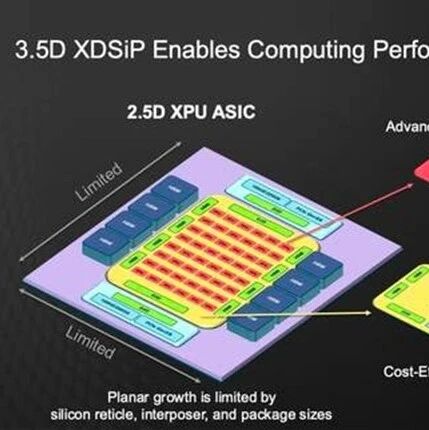
Core Viewpoint - Broadcom has announced the delivery of the industry's first 2nm custom computing SoC based on its 3.5D XDSiP platform, which combines 2.5D technology and face-to-face (F2F) 3D integration, marking a significant advancement in semiconductor integration technology [2][3]. Group 1: Technology and Innovation - The 3.5D XDSiP platform is a modular multi-dimensional stacked chip platform that supports independent scaling of compute, memory, and network I/O within a compact form factor, enabling efficient low-power computing for massive AI workloads [2]. - Broadcom's XDSiP technology integrates 2nm process innovations with face-to-face 3D integration, providing unprecedented computing density and energy efficiency, crucial for next-generation AI and high-performance computing [3]. - The design of Broadcom's XDSiP utilizes hybrid copper bonding (HCB) technology, optimizing inter-chip communication and significantly enhancing interconnect speed while reducing signal routing distances [10]. Group 2: Market and Strategic Partnerships - Fujitsu is the first company to publicly adopt Broadcom's 3.5D XDSiP technology, which is a key driver for its FUJITSU-MONAKA project aimed at delivering high-performance, low-power processors [3][11]. - Broadcom expects to sell at least 1 million chips based on its stacked design technology by 2027, representing a potential revenue source worth billions of dollars [15]. - The company has collaborated with major tech firms like Google and OpenAI to develop custom processing units, contributing to significant growth in its AI chip business, which is projected to double year-over-year [16]. Group 3: Competitive Landscape - Broadcom's 3.5D XDSiP technology aims to compete with existing solutions from AMD and Intel, as it seeks to establish a standardized platform for building multi-chip processors [13]. - The company is positioned as a significant competitor to NVIDIA and AMD in the AI chip market, with its technology allowing clients to build more powerful and energy-efficient chips to meet the growing computational demands of AI software [15][16]. - Broadcom's initial design is similar to AMD's MI300X but is open for licensing to any interested parties, indicating a strategic move to broaden its market reach [8][13].