多芯片架构

Search documents
业界首颗3.5D芯片,博通正式交付
半导体行业观察· 2026-02-27 02:19
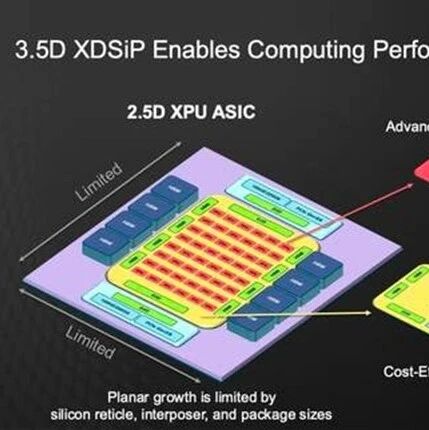
Core Viewpoint - Broadcom has announced the delivery of the industry's first 2nm custom computing SoC based on its 3.5D XDSiP platform, which combines 2.5D technology and face-to-face (F2F) 3D integration, marking a significant advancement in semiconductor integration technology [2][3]. Group 1: Technology and Innovation - The 3.5D XDSiP platform is a modular multi-dimensional stacked chip platform that supports independent scaling of compute, memory, and network I/O within a compact form factor, enabling efficient low-power computing for massive AI workloads [2]. - Broadcom's XDSiP technology integrates 2nm process innovations with face-to-face 3D integration, providing unprecedented computing density and energy efficiency, crucial for next-generation AI and high-performance computing [3]. - The design of Broadcom's XDSiP utilizes hybrid copper bonding (HCB) technology, optimizing inter-chip communication and significantly enhancing interconnect speed while reducing signal routing distances [10]. Group 2: Market and Strategic Partnerships - Fujitsu is the first company to publicly adopt Broadcom's 3.5D XDSiP technology, which is a key driver for its FUJITSU-MONAKA project aimed at delivering high-performance, low-power processors [3][11]. - Broadcom expects to sell at least 1 million chips based on its stacked design technology by 2027, representing a potential revenue source worth billions of dollars [15]. - The company has collaborated with major tech firms like Google and OpenAI to develop custom processing units, contributing to significant growth in its AI chip business, which is projected to double year-over-year [16]. Group 3: Competitive Landscape - Broadcom's 3.5D XDSiP technology aims to compete with existing solutions from AMD and Intel, as it seeks to establish a standardized platform for building multi-chip processors [13]. - The company is positioned as a significant competitor to NVIDIA and AMD in the AI chip market, with its technology allowing clients to build more powerful and energy-efficient chips to meet the growing computational demands of AI software [15][16]. - Broadcom's initial design is similar to AMD's MI300X but is open for licensing to any interested parties, indicating a strategic move to broaden its market reach [8][13].


反潮流的TSV
半导体行业观察· 2025-12-10 01:50
Core Viewpoint - The advancement in semiconductor technology is shifting from device scaling to interconnects, with advanced packaging becoming the new frontier, particularly through the use of larger Through-Silicon Vias (TSVs) to enhance electrical performance, power delivery, thermal management, and manufacturing yield [2][11]. Group 1: Evolution of Interconnect Technology - The journey began with wire bonding, the standard interconnect technology of the 20th century, followed by flip-chip packaging, which reduced interconnect size and parasitic effects [4]. - The introduction of silicon interposers in the early 21st century provided a platform for high-density interconnects, enabling the development of breakthrough technologies like Xilinx FPGA Virtex 7 and AI accelerators [4][6]. - TSVs are vertical channels that allow direct communication between chips, significantly reducing signal delay and enhancing overall system performance compared to traditional wire bonding [4][6]. Group 2: Characteristics and Functions of Interposers - Interposers serve as a critical layer between silicon chips and printed circuit boards (PCBs), enhancing functionality and performance through high-density interconnects [6]. - They are custom-designed based on specific chip packaging requirements and play three key roles: providing a mounting surface for semiconductor chips, enabling connections between chips, and connecting the stacked structure to the packaging substrate [6][7]. - Interposers are typically made from silicon, glass, or organic substrates, with TSMC being a major supplier [7]. Group 3: Advantages of Larger TSVs - Larger TSVs (up to 50μm in diameter and 300μm in depth) are being developed to support higher power transmission, lower high-frequency losses, and improved thermal management [11][15]. - The transition from traditional TSVs (5-10μm in diameter) to larger TSVs represents a fundamental shift in packaging concepts, enabling better performance for high-performance computing (HPC), AI, and 5G applications [16]. - Larger TSVs can accommodate greater currents, reduce IR drop, and enhance signal integrity, which is crucial for high-frequency applications [15][16]. Group 4: Challenges and Future Directions - Despite the advantages, larger TSVs present challenges such as increased mechanical stress due to mismatched thermal expansion coefficients and reduced available routing space on the interposer [13]. - The industry is exploring new materials and designs to mitigate these challenges while ensuring cost-effectiveness and reliability in future applications [16]. - Future interposers are expected to integrate more functionalities and materials, supporting heterogeneous integration of CPUs, GPUs, memory, and RF devices, while also addressing thermal management and cost scaling [16].