22万科04等债券

Search documents
万科债暴跌20%!机构却在悄悄布局?
Sou Hu Cai Jing· 2025-11-27 05:43
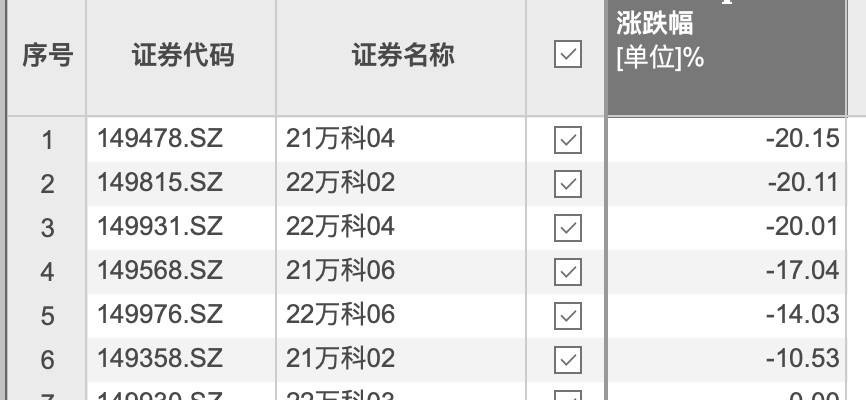
Group 1 - Vanke's bonds experienced a dramatic decline, with several bonds such as "21 Vanke 04", "22 Vanke 02", and "22 Vanke 04" dropping over 20%, triggering a temporary trading halt [1][2] - A loan agreement worth up to 22 billion yuan was signed between Vanke and Shenzhen Metro Group a month prior, but this amount is insufficient compared to the total debt obligations of 236.91 billion yuan [2] - The volatility in Vanke's bond market signals that institutional investors are conveying a message through these price movements, indicating underlying market dynamics [3] Group 2 - Despite a bull market lasting six months with an index increase of over 20%, less than 40% of individual stocks outperformed the market, highlighting the challenges of making profits in a rising market [4] - The "disposition effect" in behavioral finance suggests that investors tend to sell winning stocks too early while holding onto losing stocks for too long, with a reported 81% loss rate among retail investors from January to August [6] - The real risk in a bull market is not losing money but rather not making enough profit, which can lead to vulnerability during market corrections [6] Group 3 - The concept of "institutional shaking" is crucial for understanding market behavior, where large funds engage in actions that may appear risky but are actually strategic [7] - An example from the "solid-state battery" sector showed that after a significant price increase, institutional buying behavior indicated a "shakeout" pattern, which often corresponds with market lows [9] Group 4 - Analyzing Vanke through a quantitative lens reveals that while the bond market is turbulent, certain trading behaviors suggest differing market sentiments among specific accounts [12] - Investors are encouraged to focus on identifying institutional intentions rather than speculating on Vanke's debt repayment capabilities, advocating for the establishment of a personal quantitative observation system [12] Group 5 - Three data-driven recommendations for investors include: monitoring anomalies in stock movements, maintaining behavioral profiles of key stocks, and quantifying market sentiment to avoid subjective biases [13]


万科股债双杀,A股股价跌至10年新低
第一财经· 2025-11-26 04:09
Core Viewpoint - Vanke's bonds have experienced significant declines, with multiple bonds dropping over 20%, indicating a broader trend of poor performance in the company's domestic bonds since November [3][5]. Group 1: Bond Performance - As of November 26, Vanke's bonds such as "21 Vanke 04" and "22 Vanke 02" have fallen by over 20%, triggering trading halts [3][4]. - The overall performance of Vanke's domestic bonds has been weak, with continuous declines throughout November [3]. Group 2: Stock Price Movement - Vanke A's stock price has dropped to around 6 CNY per share, marking a cumulative decline of over 13% in the last 60 trading days, reaching its lowest point since 2015 [5]. - Vanke Enterprises' stock has also decreased by more than 2%, falling from 5.94 HKD to approximately 4 HKD since September 12 [5]. Group 3: Financing and Debt Management - Vanke signed a framework agreement with Shenzhen Metro Group for a loan of up to 22 billion CNY, with a total loan amount of approximately 236.91 billion CNY [5]. - As of November 2, 2025, Shenzhen Metro has provided Vanke with 203.73 billion CNY in credit loans, with 197.1 billion CNY already drawn [5]. - Vanke's outstanding domestic bond principal and interest due from November 2025 to June 2026 is estimated at 155.46 billion CNY, along with approximately 0.3 billion USD in dollar bond interest [5][6]. Group 4: Risk Management and Future Outlook - The framework agreement is seen as a measure to enhance risk management rather than a reduction in support from Shenzhen Metro, indicating Vanke's need to improve its self-financing capabilities [6]. - Vanke has already repaid approximately 303.25 billion CNY in domestic and foreign bond principal and interest this year, with 165.22 billion CNY funded by Shenzhen Metro's credit loans [6].