3D集流体

Search documents
固态电池CNTp-3D集流体交流
2025-10-27 15:22
Summary of Conference Call on 3D Current Collectors and Solid-State Battery Technology Industry and Company Involved - The conference call discusses the advancements in the **3D current collector technology** and its application in **solid-state batteries**. - The collaboration between **Oriental Materials** and **Low Elements** to establish a joint venture for new materials is also highlighted. Core Points and Arguments 1. **3D Current Collector Technology**: - The 3D current collector replaces traditional copper foil and graphite anodes with a nanocarbon fiber composite structure, significantly enhancing battery energy density and addressing issues like dendrite formation in metal lithium batteries [1][2][3]. - Compared to Tesla's 4,680 battery's first-generation graphite anode, the 3D current collector reduces thickness from 219 micrometers to 60 micrometers and weight from over 300 grams per square meter to 20 grams per square meter, improving safety and reliability [1][6]. 2. **Industrialization Challenges**: - The main bottleneck in industrialization is the adaptation of electrolytes. Sodium batteries have made quicker progress due to easier matching with organic solvents, while lithium batteries are slightly behind but are expected to achieve mass production in the next two to three years [1][7]. 3. **Electrolyte Improvements**: - The use of fluorinated electrolytes can significantly enhance the cycle life of lithium-ion batteries, although at a higher cost. Solid-state battery technology aims to improve stability with metal lithium, enhancing cycle life and safety [1][8]. 4. **Market Applications**: - The 3D current collector has been applied in military projects, such as loitering munitions, where high energy density is crucial. Future applications are expected in high-value markets like robotics and drones [1][9]. 5. **Cost Competitiveness**: - The price of the 3D current collector material is approximately 1,500 RMB per kilogram, significantly lower than carbon nanotubes, which range from 45,000 to 400,000 RMB [1][10]. 6. **Joint Venture with Low Elements**: - The partnership aims to leverage existing facilities for rapid production capacity expansion, with plans to complete site modifications and trial production lines within 3 to 6 months [2][14]. 7. **Production Capacity and Resource Needs**: - The production of dispersions from dry powders requires substantial organic solvents, necessitating entry into chemical parks, which Oriental Materials can provide [2][13]. 8. **Customer Base and Market Outlook**: - From January to September 2025, 27 leading companies have collaborated on developing products using the 3D current collector or AnoFree batteries, indicating a strong potential customer base [1][16]. - Future projections suggest that 40% of the 3D current collector products will be used in military applications, while 60% will cater to civilian markets [1][17]. Other Important but Possibly Overlooked Content - The 3D current collector technology is positioned to gradually replace traditional lithium-ion batteries in the next three to five years, particularly in high-value applications [1][8]. - The collaboration with CATL (Contemporary Amperex Technology Co., Limited) has already resulted in 23 shipments since 2025, indicating a strong partnership and market demand [1][18].
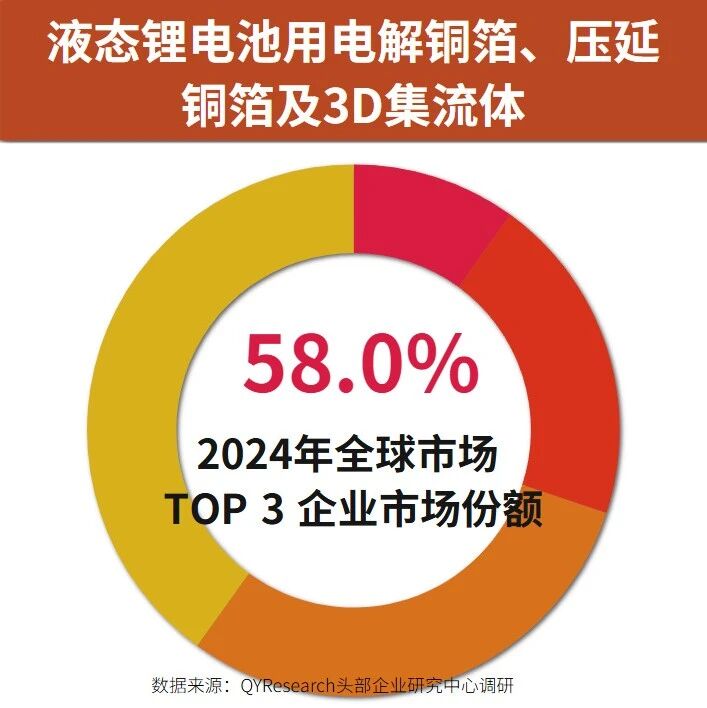
行业聚焦:全球液态锂电池用电解铜箔、压延铜箔及3D集流体市场市场头部企业份额调研(附Top10 厂商名单)
QYResearch· 2025-09-05 09:29
Core Viewpoint - The liquid lithium battery market for electrolytic copper foil, rolled copper foil, and 3D current collectors is projected to reach $20.17 billion by 2030, with a compound annual growth rate (CAGR) of 11.8% from 2024 to 2030 [1][12]. Market Overview - The electrolytic copper foil is the dominant product type, accounting for approximately 49% of the market share [6]. - The automotive sector is the primary demand source, representing about 55% of the market [9]. Key Players - Major manufacturers in the global liquid lithium battery copper foil market include Longdian Huaxin, Jiujiang Defu Technology, Guangdong Jiayuan Technology, Changchun Group, SK Nexilis, Nord New Materials, LOTTE Chemical, Hubei Zhongyi Technology, JX Advanced Metals, and Guangdong Chaohua Technology [4]. Market Drivers and Challenges - Key drivers include the rapid development of new energy vehicles and energy storage systems, increasing demand for high-performance lithium batteries, and the recognition of 3D current collectors for enhancing battery energy density and safety [12]. - Challenges include fluctuations in copper prices, technical difficulties in processing high-end ultra-thin copper foil, and the long verification cycles for new products in the industry [12]. Opportunities - The demand for high-performance current collector materials is expanding due to the growth of solid-liquid hybrid batteries and high-energy-density liquid lithium batteries. Innovations in electrolytic and rolled copper foil technologies present significant opportunities [12].