
AD钙奶冰淇淋

Search documents
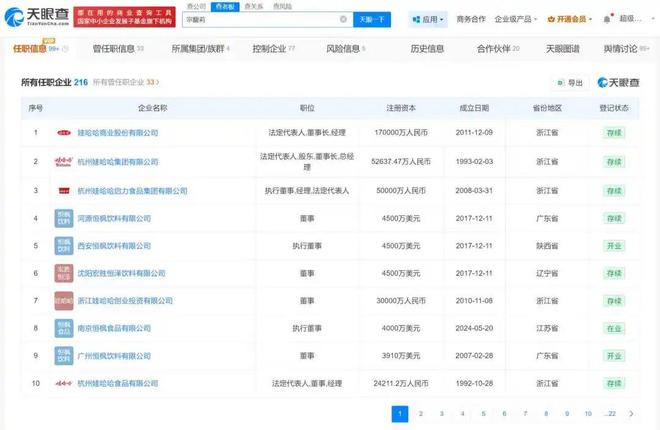
宗馥莉辞职原因曝光,将独立经营“娃小宗”!名下仍关联超200家企业
2 1 Shi Ji Jing Ji Bao Dao· 2025-10-11 01:13
Core Viewpoint - The internal conflict within Wahaha Group has escalated, marked by the resignation of Zong Fuli from key positions, including legal representative and chairman, amid trademark compliance issues and her decision to launch her own brand, "Wawa Xiaozong" [1][10]. Group 1: Resignation and Leadership Changes - Zong Fuli resigned from her positions at Wahaha Group on September 12, confirmed by company insiders [1]. - Xu Simin, former legal head of Hongsheng Group, is set to succeed Zong Fuli as chairman [2]. Group 2: Internal Conflicts and Shareholder Dynamics - The resignation highlights the intensifying internal conflicts within Wahaha Group, with Zong Fuli holding stakes in over 210 companies, including Wahaha [3]. - The current shareholder structure shows Zong Fuli with 29.40% ownership, while other stakeholders hold 46.00% and 24.60% respectively, indicating a complex power dynamic [6]. Group 3: Trademark Issues and Brand Strategy - Zong Fuli's resignation is linked to compliance issues regarding the use of the "Wahaha" trademark, which is valued at over 90 billion yuan [9]. - An internal document revealed plans to transition to the new brand "Wawa Xiaozong" starting in the 2026 sales year, necessitating unanimous consent from all shareholders for trademark usage [7][17]. Group 4: Challenges in Succession and Governance - The situation reflects broader challenges in the succession of family businesses, where generational transitions often involve conflicts over management philosophy and control [14][16]. - Zong Fuli's management style, influenced by Western education, contrasts with the traditional "family culture" established by her father, leading to governance challenges [15][18]. Group 5: Future Implications for Wahaha - The ongoing leadership changes and trademark disputes may hinder Wahaha's modernization efforts and governance evolution, emphasizing the need for clear decision-making processes and power transition strategies [18].

21评论|宗馥莉黯然辞职,难解的民企传承困局
2 1 Shi Ji Jing Ji Bao Dao· 2025-10-10 23:50
Core Insights - The recent resignation of Zong Fuli from key positions at Wahaha highlights deeper challenges within the company beyond mere personnel changes [1][2] - The transition of leadership from founder Zong Qinghou to his daughter Zong Fuli reflects a struggle between traditional management practices and modern governance approaches [3][4] Company Governance - Zong Fuli's leadership has faced internal resistance, particularly regarding accusations of "emptying" the company and legal disputes related to shareholding changes [2][4] - The company's ownership structure has shifted to a three-way balance, with Zong Fuli holding 29.40% of shares, while other stakeholders hold 46.00% and 24.60% respectively [2] - The governance model at Wahaha has been heavily influenced by its founder's "family culture," which may hinder the establishment of a more efficient modern corporate structure as the company scales [2][4] Leadership Transition - Zong Fuli's management style, influenced by Western education, emphasizes institutional governance over traditional practices, aiming to shift from "human governance" to "legal governance" [3][4] - The presence of Zong Fuli's half-siblings has added complexity to the leadership transition, indicating potential familial conflicts that could impact company stability [3][4] - Successful generational transitions in other Chinese enterprises often involve carefully designed mechanisms rather than simple position changes, highlighting the need for strategic planning in Wahaha's case [3][4] Future Outlook - The decision to rebrand to "Wah Xiaozong" from 2026 indicates a strategic pivot, but the clarity of decision-making processes and power transition plans will be crucial for Wahaha's modernization [4][5] - The ongoing challenges faced by Zong Fuli in her leadership role suggest that the focus should shift from individual successors to the establishment of a robust governance framework for the company's future [5]