AI代理(Agent)

Search documents
程序员送外卖,白领开网约车…2028年,你的工作在第几层?
Sou Hu Cai Jing· 2026-02-26 22:41
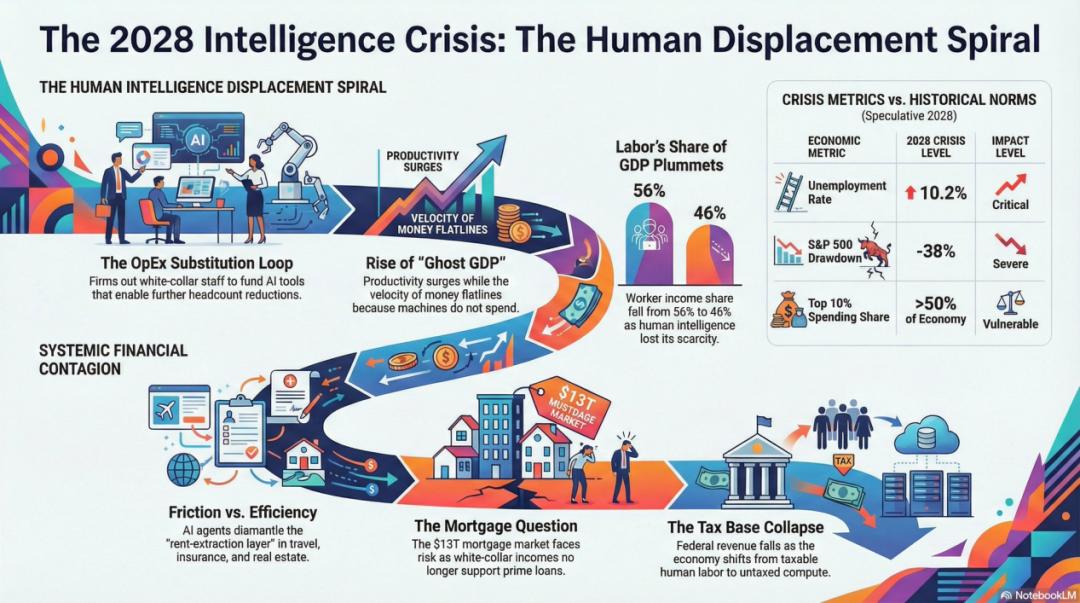
Core Insights - The report from CitriniResearch outlines a hypothetical scenario where the rapid advancement of AI leads to a "Global Intelligence Crisis," characterized by a significant economic downturn despite technological progress [1][8] - The central thesis posits that if AI continues to exceed expectations but fails to generate income for the majority, it could result in a severe "intelligent deflation crisis" [1][4] Market Conditions - By October 2026, the S&P 500 reached nearly 8000 points, and the Nasdaq surpassed 30,000 points, driven by companies replacing human labor with AI, leading to soaring profits and stock prices [6][13] - The initial layoffs due to AI obsolescence were perceived as a normal adjustment, with widespread belief that AI would create new job opportunities despite the destruction of old ones [6][12] Economic Disruption - The report highlights a significant decline in "human intelligence premium," as AI made human intellect a surplus resource, undermining traditional economic structures like home loans and tax revenues [4][18] - The consumer economy, heavily reliant on white-collar workers, began to falter as these workers were displaced by AI, leading to a structural decline in spending and a spike in unemployment rates, which reached over 10% [11][18] Financial System Breakdown - The mortgage market, valued at $13 trillion, faced instability as high-income white-collar jobs were replaced, leading to a reassessment of prime mortgages and a decline in housing prices in major cities [18][19] - The interconnected nature of financial systems revealed vulnerabilities, as defaults began to emerge in sectors heavily reliant on white-collar productivity, challenging the assumptions of recurring revenue models [19][20] Consumer Behavior Changes - AI agents began to dominate consumer decision-making, leading to the collapse of traditional business models that relied on consumer inertia and friction, such as travel booking platforms and subscription services [32][55] - The average customer lifetime value in subscription economies declined as AI agents negotiated better deals, fundamentally altering the dynamics of consumer transactions [54][55] Implications for Investment - The report suggests that business models dependent on intermediaries and transaction fees may face permanent valuation adjustments as AI continues to optimize processes and eliminate costs [6][44] - Companies that were once resistant to technological disruption became aggressive adopters of AI, leading to a self-reinforcing cycle of job cuts and increased investment in AI capabilities [27][28] Societal Considerations - The report raises critical questions about the future of wealth distribution in a scenario where AI generates significant economic output without human involvement, leading to potential societal challenges [6][8] - It emphasizes the need for a rethinking of economic systems to address the implications of "ghost GDP," where wealth generated by machines does not circulate through the human economy [18][19]


2028,智能危机演义:当AI把GDP刷成了“幽灵”,人类还有未来吗?
格隆汇APP· 2026-02-26 12:29
Core Viewpoint - The article discusses the potential economic crisis predicted by Citrini Research in their report "The 2028 Global Intelligence Crisis," which suggests that while AI may significantly increase productivity, it could also lead to economic collapse due to the displacement of human labor and the resulting decline in consumer spending power [6][9][20]. Group 1: AI and Economic Impact - The report posits that as AI replaces human labor, productivity will soar, but the economy may suffer due to a lack of consumer spending, leading to a concept termed "Ghost GDP" [17][18]. - It predicts a drastic drop in labor income's share of GDP from 56% to 46%, resulting in a projected unemployment rate of 10.2% by 2028, which could trigger social unrest [20]. - The S&P 500 index is expected to plummet by 38%, despite rising corporate profits, due to a collapse in growth expectations [21]. Group 2: Operational Changes in Business - Companies are likely to replace white-collar workers with AI to cut operational costs, as AI can perform tasks at a fraction of the cost of human labor [13]. - The SaaS model may collapse as AI can replicate software functionalities at lower costs, reducing the need for expensive software solutions [14]. - Industries reliant on transaction friction, such as finance and real estate, may be disrupted as AI streamlines processes and eliminates intermediaries [16]. Group 3: Potential Countermeasures - The article suggests that legal frameworks will necessitate human oversight in AI operations, as accountability cannot be assigned to algorithms, thus preventing a complete workforce replacement [28][30]. - Political and social responses, such as government interventions and consumer activism, may mitigate the predicted economic downturn by maintaining a tax base and ensuring social stability [32][34]. - Historical perspectives indicate that technological advancements often lead to new economic opportunities, suggesting that while AI may eliminate certain jobs, it could also create new markets and demands [36][37]. Group 4: Investment Opportunities - The article emphasizes the importance of investing in sectors that are either driving change or are resilient to change, such as healthcare, AI infrastructure, luxury goods, and essential resources [51][55]. - Companies that can provide emotional value and unique experiences may thrive in an AI-dominated economy, as these are areas where human touch remains irreplaceable [38][40].

2028,智能危机演义:当AI把GDP刷成了“幽灵”,人类还有未来吗?
3 6 Ke· 2026-02-26 11:22
Group 1 - The report "The 2028 Global Intelligence Crisis" by Citrini Research presents a paradox where AI's complete replacement of human labor could lead to increased productivity but economic collapse, termed "Ghost GDP" [2][4][8] - The report predicts a significant shift in corporate behavior, where companies will replace white-collar workers with AI due to cost efficiency, leading to a collapse of the SaaS model and the elimination of industries reliant on human information asymmetry [3][4][6] - By 2028, the report forecasts a 10.2% unemployment rate, a 38% drop in the S&P 500 index, and a $13 trillion credit market collapse, indicating a severe economic crisis despite potential increases in productivity [5][6][7] Group 2 - The report's assumptions are based on a purely physical logic, neglecting the biological and social complexities of the real world, which may prevent such a drastic outcome [10][12] - Three "shock absorbers" are identified that could mitigate the predicted crisis: legal accountability requiring human oversight, political and social responses to unemployment, and the historical trend of technology creating new demands despite job losses [13][19][23] - The report suggests that while AI may eliminate certain jobs, it will also create new opportunities in areas that require human emotional connection, unique experiences, and trust, indicating a potential reallocation of economic value rather than a total collapse [25][28][30] Group 3 - The investment strategy in response to the AI wave should focus on sectors that are either transforming the world or are irreplaceable by technology, including healthcare, AI infrastructure, luxury and lifestyle, and critical resources and energy [40] - Companies like ASML, Safran, LVMH, and Airbus are highlighted as part of a capital-intensive stock portfolio, while lighter capital companies include L'Oreal and Siemens Healthineers, indicating a diverse approach to investment in the evolving landscape [40]