
AI医生分身

Search documents
外媒关注“蚂蚁阿福”:医疗健康需求爆发,AI红利加速落地
Huan Qiu Wang· 2026-02-11 15:04
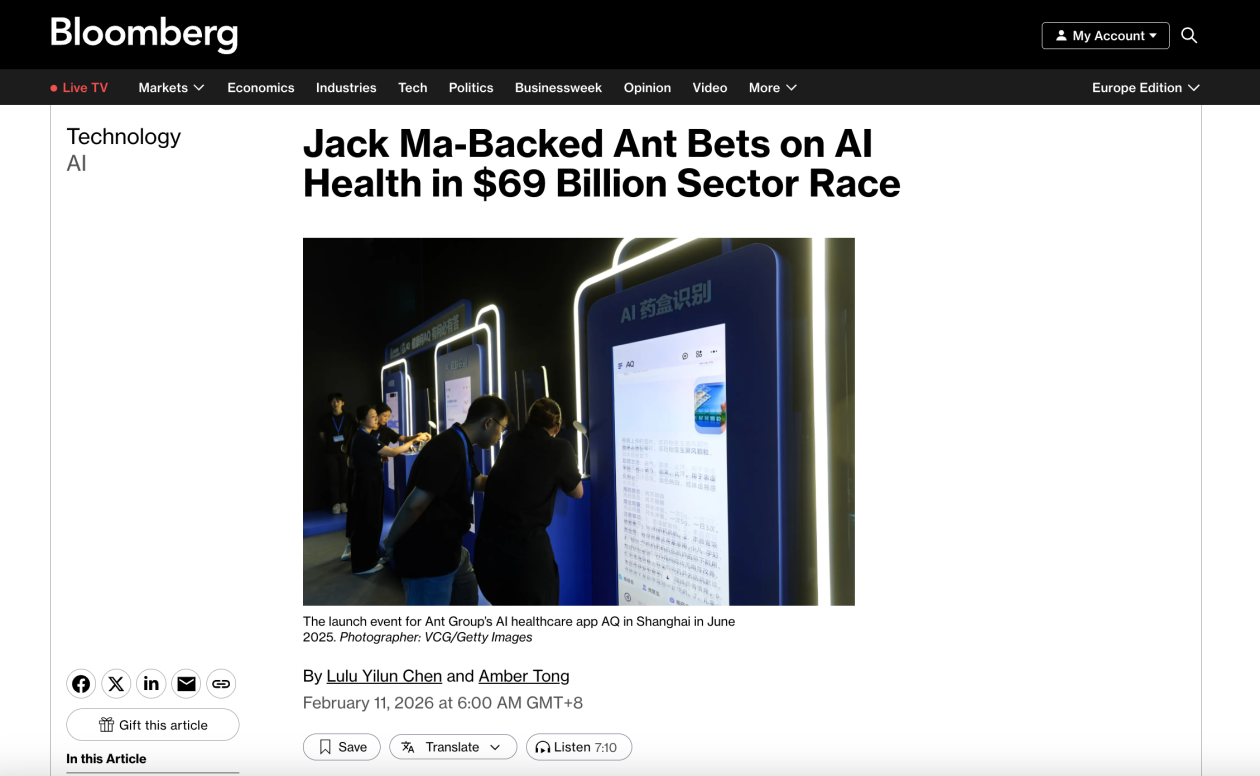
Core Insights - China is leveraging policy advantages, deep involvement of tech giants, and a large user base to showcase its technological edge in the global healthcare AI arena [1][3] - The rapid development of healthcare AI in China is significantly supported by strong policy guidance, which has provided a clear growth path for the industry [1][3] Industry Overview - By 2024, approximately 400 million people in China are expected to use digital healthcare services, with over 800 million users linking their basic medical insurance information to Alipay [3] - The Chinese online healthcare market is projected to reach 480 billion RMB (approximately 69 billion USD) by 2025 [3] Company Highlights - Ant Group's AI health assistant "Ant Aifu" has attracted over 1,000 licensed doctors to train its digital avatars, demonstrating significant engagement and utility [3] - In the past year, AI avatars managed over 27 million inquiries, with "Ant Aifu" currently having around 30 million active users and processing approximately 10 million health consultations daily [3] - Alibaba Health is expected to achieve over 60% profit growth in 2024, indicating the commercial viability of the "AI + healthcare" model [3] Competitive Landscape - Despite its leading position, the healthcare AI sector in China faces intense competition from established companies like Tencent, DeepSeek, and Ping An Medical Technology [4] - Continuous innovation is essential for maintaining competitive advantages in this rapidly evolving market [4]

2025年AI的温柔转身:从颠覆行业到生活“缝补匠”
3 6 Ke· 2025-12-26 10:06
Group 1: AI Industry Developments - In 2025, the AI industry experienced significant advancements, transitioning from isolated technological breakthroughs to a comprehensive ecosystem development [1] - Major players like DeepSeek and Meta made notable contributions, with DeepSeek gaining attention for its efficient reasoning capabilities and Meta focusing on open-source ecosystems [1] - Alibaba Cloud launched the Qwen3 series, positioning Qwen3 Max as the "Android of the AI era," marking the beginning of intense competition in the AI ecosystem [1] Group 2: AI Applications for Accessibility - The AI application "Lingguang" helped bridge communication gaps for individuals with disabilities, allowing users to create simple applications for daily needs [2] - "Be My Eyes," an app connecting visually impaired users with sighted volunteers, integrated GPT-4o, enhancing decision-making efficiency for users [3] - The introduction of AI-powered guide dogs in Shenzhen improved navigation for visually impaired individuals in public transport, providing real-time assistance [4] Group 3: AI in Education and Healthcare - The AI English tutor "Owen" has supported over 7 million online speaking practice sessions, providing accessible education to children in remote areas [5] - AI technology in classrooms, such as the Seewo AI box, automates data entry and generates feedback reports, helping teachers optimize their strategies [5] - AI medical applications, like the remote diagnosis platform in Guigang, have improved healthcare access for patients in rural areas, facilitating timely medical consultations [6]