AI服务器机架

Search documents
英伟达的AI芯片,被卖马桶和织布的“卡”了脖子
虎嗅APP· 2026-02-15 13:04
Core Viewpoint - The article discusses the unexpected beneficiaries of the AI boom, highlighting how various companies from different industries are profiting from the increased demand for AI-related technologies and materials. Group 1: Supply Chain Challenges - Nvidia has decided to allocate its production capacity to AI instead of releasing new graphics cards, leading to frustration among PC gamers [4][5]. - The price of memory components, such as a 256GB DDR5 memory kit, has skyrocketed, comparable to the cost of a house in Shanghai [4][5]. - The demand for T-glass, a special glass fiber fabric used in advanced chip packaging, has surged, causing significant price increases from manufacturers like Nittobo and Resonac [10]. Group 2: Diverse Industry Winners - TOTO, a well-known bathroom products company, has seen its stock price soar due to its development of a static suction cup used in chip manufacturing, which is crucial for handling delicate silicon wafers [12][14]. - Ajinomoto, originally a seasoning company, has created a valuable insulating film for semiconductors, which is now essential in the packaging of CPUs and GPUs [19][21]. - Kao, a consumer goods company, has developed a specialized cleaning agent for silicon wafers, ensuring cleanliness during chip production [24][26]. Group 3: Innovative Solutions - A Taiwanese company, Chuanhu Technology, has developed robust drawer slides for heavy AI server racks, showcasing how traditional manufacturing can adapt to high-tech needs [30][31]. - The article emphasizes that the AI industry relies on various materials and technologies from seemingly unrelated sectors, illustrating the interconnectedness of modern technology [32].


GPU封装基板需求猛增 英伟达Blackwell迈向野蛮扩张之路
智通财经网· 2025-07-04 12:52
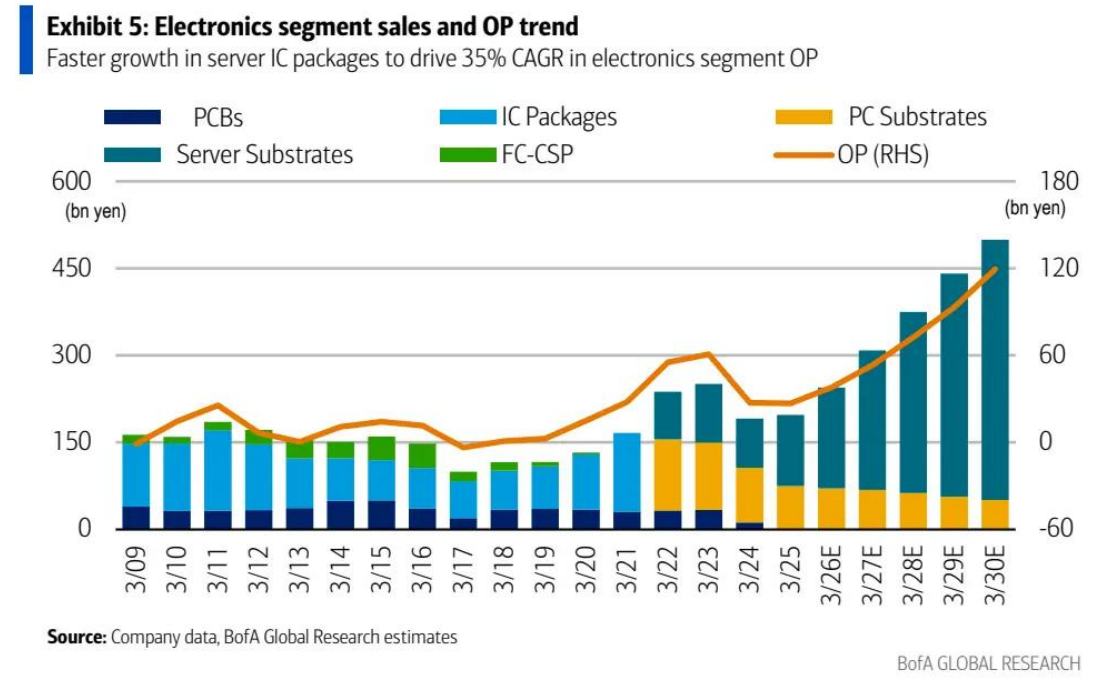
Core Viewpoint - Bank of America projects a compound annual growth rate (CAGR) of 35% for Ibiden's electronic components business over the next five years, driven by surging demand for GPU packaging substrates used in AI chip production [1] Group 1: Company Performance and Projections - Ibiden is expected to significantly increase its production capacity by 60-70% from 2024 to 2026, capitalizing on the historical expansion opportunities in ASICs [1][13] - The EPS forecast for Ibiden has been raised substantially through fiscal year 2028 due to the explosive growth in demand for ABF advanced packaging substrates [1] - Bank of America has upgraded its earnings expectations and 12-month target price for Ibiden, indicating strong confidence in the company's future performance [9] Group 2: Market Demand and Trends - The demand for ABF packaging substrates is closely tied to the production of AI chips, particularly Nvidia's Blackwell series, which is expected to enter a "super growth cycle" in the second half of the year [2][5] - The AI chip market, including GPUs and ASICs, is projected to grow from $126 billion in 2024 to over $400 billion by 2027, and reach at least $650 billion by 2030 [16] - The increasing reliance on ABF substrates for high-performance AI chips is driven by their superior electrical and thermal properties, which are essential for advanced packaging systems [7][8] Group 3: Competitive Landscape - Nvidia's AI GPUs currently account for over 80% of Ibiden's ABF substrate sales, but the share of AI ASICs is expected to approach 20% by 2030 [9][16] - Major cloud computing giants are securing long-term orders with Ibiden and other select Taiwanese packaging manufacturers, indicating strong demand for advanced packaging solutions [9][10] - The rapid growth in AI chip shipments is forcing substrate manufacturers to expand their high-end ABF production capacity ahead of schedule to meet the increasing output [10]