AI服务器集群设施

Search documents
英伟达业绩即将来袭 “AI算力牛市叙事”能否击溃“AI泡沫”?
智通财经网· 2026-02-25 09:49
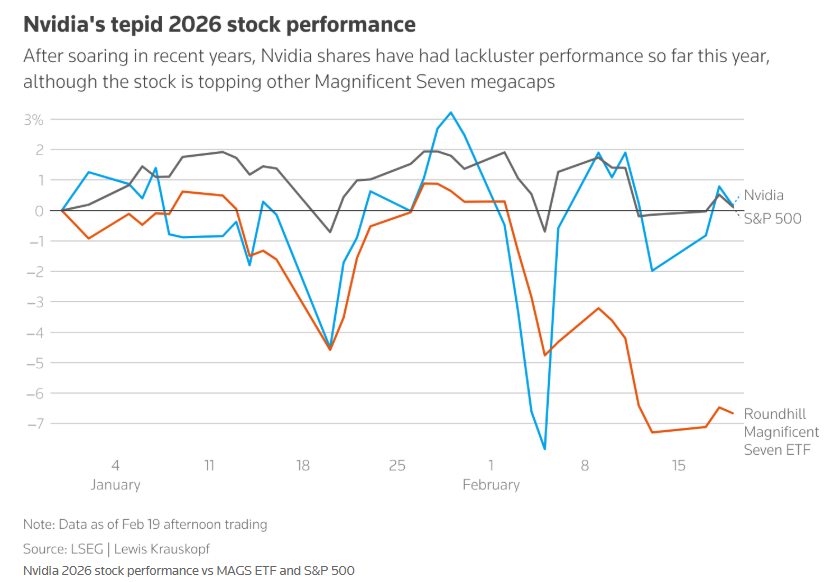
Core Viewpoint - Nvidia, referred to as the "AI chip leader," is set to report quarterly earnings, which will serve as a "stress test" for AI computing investments, with investors looking for evidence of profit growth linked to the substantial AI capital expenditures of major tech companies [1][10]. Group 1: Nvidia's Market Position and Competition - Nvidia's stock has only risen about 2% in 2026, primarily due to concerns over AI-related narratives impacting software stocks and increased competition from hyperscalers developing their own AI ASIC chips [2]. - Google has emerged as a strong competitor to Nvidia in AI computing infrastructure, having secured a deal to provide TPU AI computing clusters to Anthropic, a developer of AI products [5]. - Nvidia's market dominance in AI chips is under threat as hyperscalers announce plans for more cost-effective self-developed AI ASIC chips, which could challenge Nvidia's long-standing leadership [1][5][9]. Group 2: Financial Expectations and Market Reactions - Analysts expect Nvidia's Q4 revenue to surge over 68% to $66.16 billion, with a forecast for Q1 2027 revenue growth of 64.4% to $72.46 billion, although the growth rate is anticipated to slow compared to previous quarters [11][14]. - The options market indicates a potential stock price volatility of about ±5% following Nvidia's earnings report, reflecting the company's significant influence on the broader market [17]. - There are concerns regarding the sustainability of AI capital expenditures, with expectations that the ongoing investment cycle may only be in its early to mid-stages, despite the potential for substantial returns [14][16]. Group 3: AI Infrastructure Investment Trends - The total AI infrastructure investment wave is projected to reach $3 trillion to $4 trillion by 2030, driven by unprecedented demand for AI computing capabilities [14]. - The demand for DRAM and NAND storage chips is expected to remain strong due to the increasing importance of storage in AI training and inference systems [15]. - Nvidia's recent partnership with Groq for AI inference technology aims to solidify its market share, as the company seeks to maintain its 80% dominance in the AI chip sector [9][20]. Group 4: Supply Chain and Regulatory Factors - Nvidia faces potential supply chain constraints that could limit chip output, particularly as it competes for capacity with TSMC's advanced manufacturing processes [19]. - The company is optimistic about regaining access to the Chinese market for AI chip sales, which could enhance revenue and profit expectations [19]. - Analysts believe Nvidia's pricing power and secured high-bandwidth memory allocations will protect it from the adverse effects of rising storage chip prices [20].


英伟达(NVDA.US)业绩重磅来袭 “AI算力牛市叙事”能否击溃“AI泡沫”?
智通财经网· 2026-02-25 09:19
Core Viewpoint - Nvidia, referred to as the "AI chip leader," is set to report its quarterly earnings, which will serve as a "stress test" for AI computing infrastructure investments, with a focus on whether its profits can align with the substantial AI capital expenditure budgets of major tech companies [1][10]. Group 1: Nvidia's Market Position and Competition - Nvidia's stock has only risen about 2% in 2026, primarily due to concerns over AI-related narratives impacting software stocks and increased competition from hyperscalers developing their own AI ASIC chips [2][6]. - Google has emerged as a strong competitor to Nvidia in AI computing infrastructure, having secured a deal to provide TPU AI computing clusters to Anthropic, a developer of AI chatbots [5][10]. - Nvidia's dominance in the AI chip market is under threat as hyperscalers accelerate their self-developed, cost-effective AI ASIC chip strategies [1][5]. Group 2: Earnings Expectations and Market Reactions - Analysts expect Nvidia's Q4 revenue to surge over 68% to $66.16 billion, with a forecast for Q1 2027 revenue growth of 64.4% to $72.46 billion [11][14]. - The options market indicates a potential stock price fluctuation of approximately ±5% following Nvidia's earnings report, reflecting its significant market capitalization and weight in the S&P 500 index [10][16]. - Nvidia's earnings report is critical in addressing concerns about the sustainability of AI capital expenditures and whether the company can continue to deliver strong profit growth [10][16]. Group 3: AI Infrastructure Investment Trends - The total AI capital expenditure by major U.S. tech companies is expected to exceed $700 billion this year, indicating a potential 60% increase [6][10]. - The global AI infrastructure investment wave is anticipated to reach $3 trillion to $4 trillion by 2030, driven by unprecedented demand for AI computing capabilities [14][15]. - The demand for DRAM/NAND storage chips is surging due to the increasing importance of storage in AI training and inference systems, highlighting the exponential growth in global AI computing demand [15]. Group 4: Nvidia's Strategic Moves - Nvidia has secured a $20 billion deal to license chip technology from AI startup Groq, aiming to enhance its leadership position in the AI inference market [8][10]. - The company is also negotiating to sell millions of AI chips to Meta, further solidifying its role in the AI infrastructure landscape [8][10]. - Nvidia's management has indicated ongoing discussions with major clients regarding data center orders for the upcoming year, suggesting a robust backlog of AI computing infrastructure orders [17][18].