AI选品系统

Search documents
2025年Q4电商行业战略动态调查报告——AI与即时零售重塑竞争格局
Sou Hu Cai Jing· 2025-11-30 17:12
Core Insights - The Chinese e-commerce industry has transitioned from a traffic-driven era to a "hardcore competition" phase focused on technology and ecosystem collaboration by Q4 2025 [1][22] - Key trends include the commercialization of AI technology, the intensification of instant retail, the deepening of omnichannel operations, and the evolution of competitive dimensions [3] Group 1: AI Technology Commercialization - AI has shifted from a technology reserve to a key growth driver for e-commerce giants, with Alibaba making significant investments leading to substantial revenue growth in AI-related products [4] - JD has applied AI extensively in marketing and service, achieving over 90% coverage in intelligent customer service and an 18% increase in conversion rates for core categories [4] - Smaller merchants benefit directly from AI, with Pinduoduo's AI selection system improving ROI by 40% for partners, while Douyin and Kuaishou have reduced content production cycles by 50% [4] Group 2: Instant Retail Market Competition - Instant retail has become a critical battleground for growth, with Alibaba, JD, and Meituan competing fiercely, aiming for a trillion-yuan transaction scale within three years [6] - In Q4, the transaction volume for instant retail reached 220 billion yuan, a 65% year-on-year increase, with Meituan holding a 45% market share [6] - The market is projected to exceed one trillion yuan by 2026, with front warehouse models contributing over 50% of transaction volume [6] Group 3: Omnichannel Operations - The fragmentation of traffic has driven platforms to transition towards "omnichannel collaboration," with Douyin e-commerce integrating advertising and e-commerce traffic pools [8] - Traditional platforms are accelerating their content transformation, with Alibaba and JD enhancing their content capabilities to complement their existing strengths [8] - Omnichannel operations have become a standard in the industry, moving away from single-channel strategies [8] Group 4: Shift from Price Wars to Value Wars - As customer acquisition costs rise, platforms are shifting from price competition to "value wars," focusing on quality and service [9] - Pinduoduo's "billion support plan" aims to enhance merchant quality, while JD emphasizes "quality retail" strategies [9] - The emergence of "heart-price ratio" reflects a consumer trend prioritizing product quality and service experience over mere pricing [9] Group 5: Company-Specific Strategies - Alibaba is focusing on AI and instant retail as dual drivers for growth, but faces short-term profit pressures due to significant investments [12] - JD is leveraging high-frequency delivery to expand into local life services, showing promising conversion rates but facing challenges with ongoing losses [13] - Pinduoduo remains the only major player with positive net profit growth, emphasizing cost-effectiveness and agricultural product sales [15] - Douyin e-commerce is rapidly increasing its market share through deep integration of content and commerce, but still needs to cultivate user habits for shelf-based e-commerce [16] Group 6: Future Trends - AI is expected to fundamentally reshape the e-commerce landscape, with intelligent systems becoming new traffic hubs [17] - Instant retail is projected to evolve into a core business model, with continuous innovations in operational models [17] - The integration of content and commerce will become standard, with platforms adopting a closed-loop system for user engagement [17] Group 7: Strategic Variables - The focus for the next year will be on breakthroughs in AI technology and instant retail profitability models by major players like Alibaba and JD [22] - The progress of content platforms like Douyin and Kuaishou in shelf-based e-commerce will be crucial for determining the final shape of omnichannel integration [22]



物美定义新公式:“AI+零售”=打碎、重组“人货场”
Cai Jing Wang· 2025-11-11 07:06
Core Insights - The retail industry is undergoing significant transformation, with companies like Wumart Group leveraging AI to enhance operational efficiency and customer experience [1][11] - Wumart is focusing on integrating AI into various aspects of its operations, including product selection, inventory management, and customer service, to create a more intelligent retail ecosystem [10][11] Group 1: AI Integration in Retail - Wumart is utilizing AI technologies such as smart scales and self-checkout systems to improve customer experience and operational efficiency, achieving a product recognition accuracy of over 99% [2][3] - The implementation of AI self-checkout systems has reduced customer wait times and improved transaction efficiency, with error rates in loss prevention below 0.1% [3] - AI-driven product selection and inventory management systems are enhancing Wumart's ability to meet consumer demands and optimize stock levels, resulting in a fivefold increase in customer traffic and sales at specific locations [5][6] Group 2: Operational Efficiency and Cost Management - Wumart's AI systems are designed to automate repetitive tasks, allowing employees to focus on higher-value service roles, thus improving overall service quality [4] - The AI inventory management system boasts a replenishment accuracy rate of over 95%, significantly reducing stockouts and ensuring timely restocking of high-demand items [6] - The AI-driven clearance strategy has streamlined the process of managing perishable goods, reducing the time required for clearance from one hour to five minutes [7] Group 3: Enhanced Customer Engagement - Wumart's AI customer service system operates 24/7, handling high-frequency inquiries and significantly reducing the workload on human staff by 70% [3] - The integration of AI in customer interactions allows for seamless transitions to human agents when complex issues arise, improving customer satisfaction [3][4] - The focus on creating value for consumers through AI technologies reflects a broader trend in the retail industry towards personalized and efficient shopping experiences [2][11] Group 4: Future Outlook and Industry Trends - The collaboration between Wumart and DMALL highlights the importance of comprehensive AI solutions that cover the entire retail chain, from product selection to customer engagement [10] - The retail sector is expected to increasingly rely on deep data analysis and the development of unmanned retail models, which will open new growth opportunities [10] - Wumart's approach to balancing competitive advantage with market appeal positions it well for future challenges in the evolving retail landscape [11]
电商选品决策指南:如何用数据分析避免新品失败
Sou Hu Cai Jing· 2025-09-15 07:49
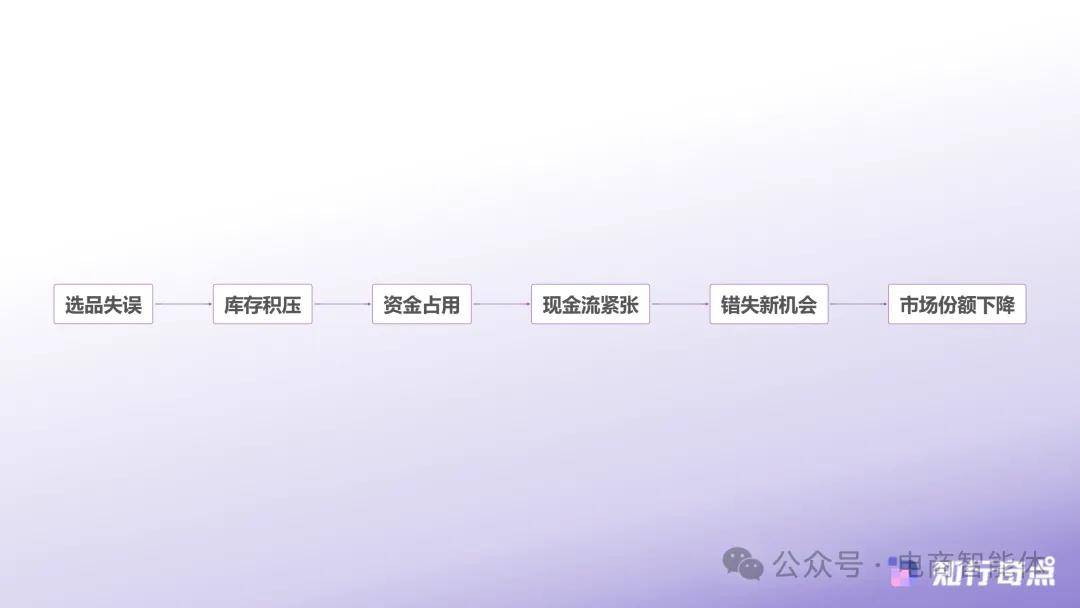
电商行业有句老话:"选品定生死,运营定高低"。行业统计表明, 超过60%的电商新品在上架后3个月内沦为滞销库存。每一次选品失败都像一场小型危机——资金被套牢、仓储成本激增、团队信心受挫。尤其在跨境电 商和3C数码等高投入领域,一次重大的选品失策足以让整季利润蒸发。 2025年亚马逊全球开店最新报告揭示,全球电商消费模式正经历重大转型,选品决策的准确性变得空前重要。与此同时,亚马逊平台新政策规定,自2025 年4月4日起,存放时间超270天的库存将被强制清理,这无疑增加了选品错误的代价。 不仅仅是经济损失 大多数电商从业者低估了选品失败的真实影响。表面上看只是"损失了一笔钱",但实际影响要深远得多。 资金链条的断裂风险最为直接。以服装品类为例,一批失败的选品通常涉及5-10万元的采购资金,加上仓储、推广等附加成本,实际损失可能翻倍。更糟 糕的是,这些滞销库存锁死了原本可以投资潜力产品的流动资金。环至美物流的研究表明,库存积压可能导致资金占用增加15%以上,库存周转率每下降 10%,企业现金流压力就会明显上升。 错失商机的隐形成本更难以计算。当库房被滞销品填满,真正有潜力的产品却无法入仓。2025年5月跨境电商案 ...