Azure Local

Search documents
Microsoft Expands Sovereign Cloud With Offline AI Capabilities, Disconnected Operations - Microsoft (NASDAQ:MSFT)
Benzinga· 2026-02-24 15:14
Core Insights - Microsoft Corporation is expanding its Sovereign Cloud platform to enhance digital sovereignty for enterprises, governments, and regulated industries by enabling large AI models and productivity tools to operate in fully disconnected environments [1] Group 1: New Capabilities - Three new capabilities were announced, focusing on Azure Local disconnected operations, Microsoft 365 Local disconnected, and an expansion of Foundry Local to support large, multimodal AI models without cloud connectivity [2] - Azure Local disconnected operations and Microsoft 365 Local disconnected are now available globally, while Foundry Local's large model support is accessible to qualified customers [3] Group 2: Importance for Regulated Industries - The announcement is particularly relevant for organizations under strict regulatory conditions where external cloud dependencies are restricted or unacceptable [4] - Microsoft's Sovereign Private Cloud integrates Azure Local, Microsoft 365 Local, and Foundry Local into a unified stack that can operate in connected, hybrid, and fully disconnected modes [4] Group 3: Microsoft 365 Local Disconnected - Microsoft 365 Local disconnected provides Exchange Server, SharePoint Server, and Skype for Business Server directly within a customer's sovereign private cloud, ensuring operational continuity of collaboration tools even when offline, with support guaranteed until at least 2035 [5] - At the time of publication, Microsoft shares increased by 0.24% to $385.38 [5]



微软承诺在加拿大和印度投入超300亿美元,用于建设“主权AI”
3 6 Ke· 2025-12-10 04:43
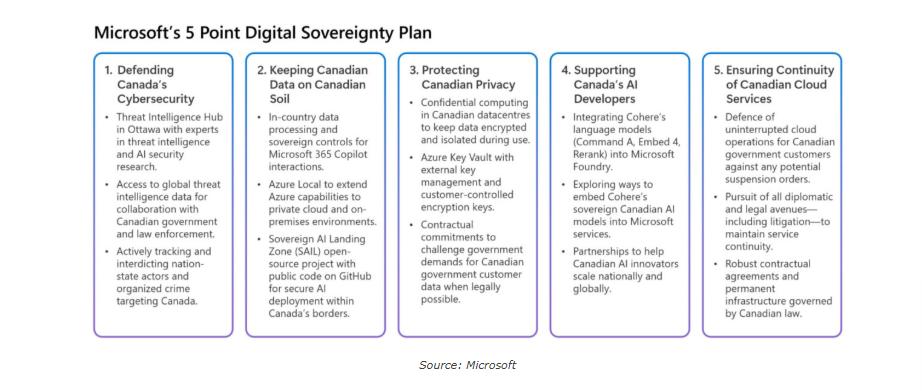
Core Insights - Microsoft has committed to invest over $30 billion in Canada and India to establish large-scale infrastructure, aiming to control the global data ecosystem [1] - The investment in Canada includes CAD 19 billion (approximately $13.4 billion) for local cloud expansion, with a legal commitment to resist foreign judicial requests for data stored in Canada [1] - In India, the investment has surged to $17.5 billion, nearly six times the initial target set for January 2025, integrating Azure AI services into the Indian government welfare portal to cover approximately 310 million workers [1][6] Group 1: Investment and Infrastructure - Microsoft plans to invest CAD 19 billion in Canada by 2027 for local cloud expansion, with a focus on legal protections against foreign data requests [1] - The investment in India has increased to $17.5 billion, significantly enhancing Microsoft's strategic presence in the region [1][6] - The company is shifting its focus from centralized "super factories" in the U.S. to distributed, nation-level infrastructure [1] Group 2: Technology and Compliance - Microsoft is implementing three key technological pillars to strengthen data sovereignty: enhanced data residency commitments, expansion of Azure Local services, and the introduction of Sovereign AI Landing Zone (SAIL) [3][5] - Azure Local will support cloud operations in fully offline, physically isolated environments, addressing stringent regulatory requirements [5] - Microsoft has made a legal commitment to use all available legal and diplomatic avenues to protect access to critical infrastructure in Canada [5] Group 3: User Engagement and Skills Development - The investment strategy includes deep integration with India's e-Shram labor welfare portal, providing job matching for over 310 million informal workers [6] - Microsoft aims to train 20 million people in India by 2030, while a smaller initiative in Canada targets training 250,000 workers, focusing on Indigenous and remote communities [8] - The strategy emphasizes building a complete ecosystem rather than merely capital investment, with a focus on large-scale infrastructure to support AI workloads [7] Group 4: Competitive Landscape - Microsoft's investments come amid a global race for computing power and market share, with other companies like OpenAI, Amazon, and Oracle also enhancing their sovereign cloud services [9] - The demand for computing resources is distorting supply chains, as seen with Micron Technology's shift away from consumer memory markets [9] - Microsoft's distributed strategy contrasts with competitors' centralized approaches, focusing on building sovereign computing capabilities within national borders [9]
Amazon challenges competitors with on-premises Nvidia ‘AI Factories'
TechCrunch· 2025-12-03 00:43
Core Insights - Amazon has launched a new product called "AI Factories" that enables large corporations and governments to operate its AI systems within their own data centers, allowing customers to provide the power and data center while AWS manages the AI system and integrates it with other AWS cloud services [1] Group 1: Product Overview - The AI Factories product is designed to address concerns regarding data sovereignty, ensuring that companies and governments maintain absolute control over their data without sending it to external model makers or sharing hardware [2] - AWS's AI Factory is a collaboration with Nvidia, utilizing a combination of AWS and Nvidia technologies [3] Group 2: Technology and Features - Companies deploying these AI systems can choose between Nvidia's latest Blackwell GPUs or Amazon's new Trainium3 chip, leveraging AWS's networking, storage, databases, and security, while also accessing Amazon Bedrock and AWS SageMaker AI for model management and training [4] Group 3: Competitive Landscape - Other major cloud providers, such as Microsoft, are also investing in AI Factories, with Microsoft showcasing its own AI Factories for OpenAI workloads and emphasizing the development of new "AI Superfactories" in Wisconsin and Georgia [5] - Microsoft has outlined plans for data centers and cloud services in local countries to address data sovereignty, including its own managed hardware options [6]


微软Azure Local更新引发严重系统故障:每20小时蓝屏一次
Huan Qiu Wang· 2025-11-01 03:44
Core Insights - Microsoft recently faced significant system failures due to the update 2510 (version 11.2510.1002.87) for its hybrid cloud solution Azure Local, causing critical disruptions in industries such as healthcare and finance [1][3] Group 1: System Failures - The update led to frequent blue screen crashes (error code 0x139) in production environments, with systems crashing approximately every 20 hours [1][3] - An IT technician reported that multiple nodes hosting around 100 virtual machines experienced collective outages, interrupting essential services like electronic medical records and telemedicine platforms [3] Group 2: Impact on Healthcare - The failures were described as a "Super-GAU" (super disaster) by technical personnel, posing direct threats to patient safety due to reliance on low-latency data processing [3] - Microsoft confirmed that the root cause of the issue was an erroneous change in update 2510, which led to kernel security check failures [3] Group 3: Microsoft's Response - To temporarily mitigate the issue, Microsoft provided a registry fix command to disable the faulty module and restore system stability [3] - Microsoft subsequently retracted the updates with version numbers 11.2510.1002.87 and 12.2510.1002.88 [3] Group 4: Azure Local Overview - Azure Local is positioned as Microsoft's primary hybrid cloud solution, designed to allow enterprises to run certain Azure services in local data centers, balancing the security of private clouds with the flexibility of public clouds [3]