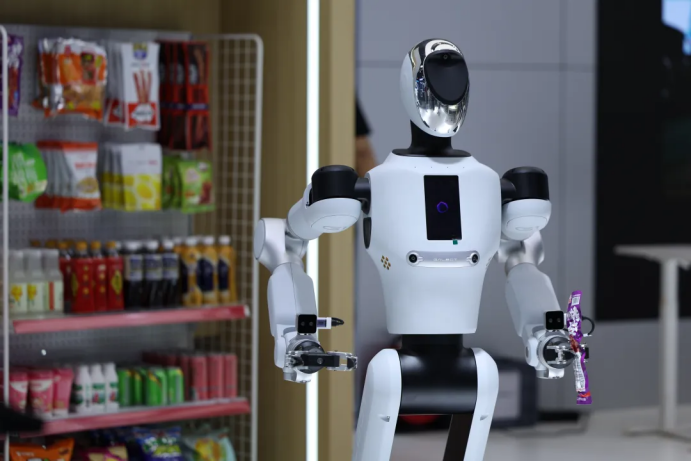
CASBOT W1

Search documents
突破视觉-语言-动作模型的瓶颈:QDepth-VLA让机器人拥有更精准的3D空间感知
机器之心· 2025-11-26 07:07
Core Insights - The article discusses the significant potential of Vision-Language-Action (VLA) models in robotic manipulation, highlighting the introduction of QDepth-VLA, which enhances 3D spatial perception and reasoning capabilities through Quantized Depth Prediction [2][4][34]. Group 1: Model Limitations and Challenges - Despite advancements in semantic understanding and instruction following, VLA models struggle with spatial perception, particularly in fine-grained or long-duration multi-step tasks, leading to positioning errors and operational failures [5][6]. - The gap between 2D visual semantic understanding and 3D spatial perception has prompted researchers to explore various methods to integrate 3D information into VLA models, categorized into three main approaches: direct injection of 3D features, 3D feature projection, and auxiliary 3D visual prediction tasks [5][6]. Group 2: QDepth-VLA Methodology - QDepth-VLA introduces a mechanism that combines Quantized Depth Prediction with a hybrid attention structure, allowing the model to maintain semantic consistency while enhancing 3D spatial perception and action decision-making [8][34]. - The method consists of three main components: high-precision depth annotation using Video-Depth-Anything, a Depth Expert module for structured depth token prediction, and a hybrid attention mechanism to manage information flow across modalities [11][13][14]. Group 3: Experimental Validation - Comprehensive evaluations of QDepth-VLA were conducted in both simulated environments (Simpler and LIBERO) and real-world settings, demonstrating significant performance improvements in various object manipulation and multi-step tasks [18][19]. - In the Simpler simulation, QDepth-VLA achieved an average success rate increase of 8.5% and 3.7% compared to the baseline model Open π0 [20]. - In the LIBERO simulation, QDepth-VLA outperformed the 3D-CAVLA model by approximately 2.8% [26]. - Real-world experiments showed QDepth-VLA's superior performance in pick-and-place tasks, with a 20% improvement in basic tasks and a 10% enhancement in more challenging scenarios [30]. Group 4: Ablation Studies - Ablation studies indicated that the depth supervision and hybrid attention mechanisms are crucial for QDepth-VLA's high performance, with significant drops in success rates when these components were removed [31][32]. Group 5: Future Directions - Future research will focus on enhancing the model's spatial understanding capabilities, with potential developments in future spatial structure prediction and more efficient depth representation learning [35][36]. - The integration of enhanced 3D geometric perception and action consistency into CASBOT's product line is anticipated, supporting various applications in both domestic and industrial settings [35][36].


跳街舞、打拳击、当服务员......数百款机器人亮相WAIC“秀绝技”
Hua Er Jie Jian Wen· 2025-07-27 12:33
Core Insights - The 2025 World Artificial Intelligence Conference (WAIC) in Shanghai showcased over 150 humanoid robots, marking the largest collective display of humanoid robots in China to date, indicating a shift from mere exhibition to practical applications in various sectors [1] - The event highlighted advancements in humanoid robots, which are now capable of performing tasks such as cooking, sorting materials, and security inspections, demonstrating their potential as real-world "producers" rather than just performers [1] Group 1: Humanoid Robot Innovations - The Galbot by Galaxy General, a quadruped robot, received the "Treasure of the Museum" title for its practical applications, including precise sorting and self-correction capabilities in a simulated automotive factory [3] - Star Motion Era introduced three versatile robots: L7, capable of dancing and sorting packages; XHAND1, a dexterous robotic hand; and Q5, a humanoid service robot that can provide guidance and perform various tasks [5] - The "Jueying X30" from Cloud Deep Technology showcased its ability to perform high-risk inspections, highlighting the feasibility of quadruped robots in replacing human labor in hazardous environments [7] Group 2: Market Trends and Orders - The humanoid robot industry is expected to transition from a technology-driven phase to a commercial phase by the second half of 2025, with market sentiment shifting towards orders and deliveries [15] - Significant orders were placed during WAIC, including a 124 million yuan order from China Mobile and various contracts from automotive manufacturers for material handling and assembly tasks [15] - The industry is experiencing rapid growth, with estimates suggesting an average growth rate of 50% to 100% in the first half of the year, driven by the increasing frequency of new robot releases [15]