
L7

Search documents
理想汽车,失去了节奏感
商业洞察· 2026-03-13 09:17
Core Viewpoint - Li Auto has faced a significant decline in performance in 2025, marking a critical turning point for the company as it struggles to adapt to the shifting market dynamics in the electric vehicle sector [5][11]. Group 1: Performance Decline - In 2025, Li Auto delivered 406,343 vehicles, a year-on-year decrease of 18.8%, achieving only 63.48% of its adjusted sales target of 640,000 units [7][9]. - The company's total revenue for the year was 112.3 billion yuan, down 22.3% year-on-year, with vehicle sales revenue dropping 23.0% to 106.7 billion yuan [9]. - Net profit plummeted to 1.1 billion yuan, a staggering 85.8% decline from 8 billion yuan in 2024, while vehicle gross margin fell from 19.8% to 17.9% [9][10]. Group 2: Strategic Challenges - 2025 is characterized as a year of strategic pain for Li Auto, with the decline in the range-extended vehicle market and difficulties in transitioning to pure electric vehicles creating dual pressures [11][12]. - The domestic pure electric vehicle market saw sales of 7.877 million units in 2025, a 24.4% increase, while range-extended vehicle sales only grew by 6.0%, a drastic drop from 70.9% growth in 2024 [12][13]. - Li Auto's L series, which forms the backbone of its sales, experienced significant declines, with L9 sales nearly halving and L8 sales dropping by 66.8% year-on-year [14][17]. Group 3: Transition to Pure Electric - The market trend indicates a permanent decline in the range-extended vehicle segment, making the pure electric market a crucial battleground for Li Auto [18][19]. - Li Auto has invested in core areas such as battery technology and charging infrastructure, with 3,907 self-built supercharging stations and 21,651 charging piles by the end of 2025 [21][23]. - Despite having a solid cash reserve of 101.2 billion yuan, Li Auto faces challenges in brand perception and competition in the pure electric segment, particularly against established players like Tesla and NIO [23][24].



理想汽车-W:Await redesigned L9 amid lingering challenges-20260313
Zhao Yin Guo Ji· 2026-03-13 01:24
Investment Rating - The report maintains a HOLD rating for Li Auto Inc. with a target price of US$18.00 for ADS and HK$70.00 for H-share, reflecting a slight upside potential of 1.0% for ADS and a minor downside of (0.2%) for H-share from current prices [3]. Core Insights - Li Auto is viewed as a strong company with potential for recovery due to its solid cash position, but the transition to an AI device company is expected to take time. The redesigned L9's outlook remains uncertain amid increased competition in the large SUV market [1][8]. - The company is projected to incur a net loss in the first half of FY26, and even with a successful launch of the L9, the valuation may still appear unattractive based on FY26 earnings estimates [1][8]. Financial Summary - Revenue projections show a significant increase from RMB 123.9 billion in FY23 to RMB 144.5 billion in FY24, followed by a decline to RMB 112.3 billion in FY25, before recovering to RMB 130.7 billion in FY26 and RMB 153.8 billion in FY27 [2][12]. - Gross margin is expected to decrease from 22.2% in FY23 to 20.5% in FY24, further declining to 18.7% in FY25, before slightly recovering to 17.6% in FY26 and 18.2% in FY27 [2][12]. - The net profit is forecasted to drop significantly from RMB 11.7 billion in FY23 to RMB 8.0 billion in FY24, then to RMB 1.1 billion in FY25, before rebounding to RMB 3.4 billion in FY26 and RMB 7.7 billion in FY27 [2][12]. Earnings Performance - In 4Q25, Li Auto's revenue exceeded prior forecasts by approximately 1%, with a gross profit margin increase of 1.5 percentage points to 17.8% quarter-over-quarter, attributed to better-than-expected performance from the i6 model and year-end supplier rebates [8]. - The company achieved a net profit of RMB 7 million in 4Q25, indicating a slight recovery despite ongoing challenges [8]. Sales Volume and Market Outlook - The sales volume target for FY26 has been revised down from over 500,000 units to approximately 490,000 units, reflecting a 20% year-over-year increase. The management anticipates vehicle gross profit margin to be around 5% in 1Q26 due to inventory clearance and tax benefits [8]. - The redesigned L9 and new i9 models are considered critical for the company's performance in the competitive large SUV market in China, with expectations of average monthly sales of over 10,000 units for the L9 [8].
理想汽车:安全边际极高、短期阵痛明确
数说新能源· 2026-02-28 02:08
Core Data Overview - Total deliveries for 2025 reached 406,300 units, a year-on-year decrease of 18.8% [2] - Annual target was set at 640,000 units, achieving a completion rate of 63% [2] - Cumulative deliveries surpassed 1.54 million units [2] - Q3 single-quarter deliveries were 93,200 units, down 39% year-on-year [2] - Q4 single-quarter deliveries were 109,200 units, down 31% year-on-year [2] Financial Highlights - Revenue for the first three quarters of 2025 was 83.54 billion yuan, a year-on-year decline of 16.6% [2] - Net profit for the first three quarters was 1.12 billion yuan, down 75.2% year-on-year [2] - Q3 single-quarter revenue was 27.4 billion yuan, a decrease of 36.2% year-on-year [2] - Q3 single-quarter net profit was -624 million yuan, ending an 11-quarter streak of profitability [2] - Overall gross margin for Q3 was 16.3%, with vehicle gross margin at 15.5% [2] - R&D expenses for Q3 were 3 billion yuan, an increase of 15% year-on-year [2] - Full-year R&D guidance for 2025 is set at 12 billion yuan, with AI investment expected to exceed 6 billion yuan [2] Asset and Cash Flow Analysis - Total assets as of September 30, 2025, were 153.12 billion yuan [2] - Total liabilities were 79.92 billion yuan [2] - Debt-to-asset ratio stood at 52.2%, the lowest among new forces [2] - Cash and cash equivalents amounted to 51.11 billion yuan [2] - Short-term loans were 6.32 billion yuan, while long-term loans were 3.14 billion yuan [2] - Total interest-bearing debt was approximately 9.5 billion yuan [2] - Net cash position was approximately 41.6 billion yuan [2] Business Model and Core Barriers - The company employs an extreme efficiency system with a platform-based approach and low SKU count, achieving a commonality rate of 60%-70% across models L6/L7/L8/L9 [4] - The order-based and direct sales model results in a channel inventory coefficient of 0.2-0.3, significantly lower than the industry average of 1.5+ [4] - Cost control measures include a market expense ratio of approximately 0.6% and a sales management expense ratio of 8%-10%, compared to the industry average of 12%-18% [4] - The company targets annual sales of 700-1,000 units per store, compared to the industry average of 300-500 units [4] Competitive Landscape - The company positions itself against Tesla as an AI benchmark, focusing on the Chinese family market while Tesla targets a global audience [5] - In comparison to Huawei, the company aims to avoid direct competition by leveraging family scenarios and cost efficiency [5] - Against BYD, the company maintains a strategy of not pursuing full vertical integration or low pricing, focusing instead on the 300,000-500,000 yuan family market [5] - The company anticipates that 80% of traditional automakers will exit the market due to lack of AI, data, and efficiency [5] Future Outlook - For 2026, the company expects deliveries of 500,000-550,000 units and a return to profitability with a net profit of 1.5-2 billion yuan [6] - Gross margin is projected to recover to 18%-20% [6] - The company aims to maintain a moderate increase in debt ratio while remaining safe [6] - By 2027-2028, the company anticipates stabilizing with a pure electric vehicle ratio of 30%-40% and annual sales of 600,000-700,000 units [6]

“卖得不好”的门店开始关闭 理想汽车进入转型阵痛期
Guo Ji Jin Rong Bao· 2026-01-28 13:26
Core Viewpoint - Li Auto, once a leader among new energy vehicle manufacturers, is facing unprecedented pressure due to declining sales, operational inefficiencies, and strategic misalignment [2][6][9]. Store Closures - Li Auto has denied rumors of closing 100 stores but is indeed shutting down underperforming locations, with some already closed due to poor sales performance [3][4]. - The closure of stores is part of a strategy to eliminate low-efficiency outlets, with a focus on consolidating resources into core locations [4]. Production Capacity Issues - The Changzhou factory, with a capacity exceeding 500,000 vehicles per year, is experiencing uneven production, with some lines frequently halted due to low orders, while others operate at full capacity [5]. - The disparity in production reflects a mismatch between product offerings and market demand, leading to significant underutilization of capacity [5][9]. Sales Decline - Li Auto's projected total deliveries for 2025 are 406,300 units, representing an 18.81% decline from 2024, and falling short of the adjusted annual target of 640,000 units [7]. - The company has lost its position among the top three in the new energy vehicle market, with a significant drop in market share in the 200,000 yuan and above segment [7][9]. Strategic Shifts - Li Auto is shifting its focus back to range-extended vehicles, particularly the new L9 model, while attempting to streamline its product offerings and improve operational efficiency [9][10]. - The company is also implementing a "Hundred Cities Star Plan" to expand into lower-tier markets with a light-asset model, aiming to balance cost control and volume growth [4][9]. Competitive Landscape - The competitive environment for range-extended vehicles has intensified, with rivals like XPeng and Xiaomi entering the market with larger battery capacities, putting pressure on Li Auto's offerings [9]. - The company’s strategic misalignment and product diversification have weakened its competitive edge, necessitating a comprehensive adjustment across various operational fronts [9][10].
“卖得不好”的门店开始关闭,理想汽车进入转型阵痛期
Guo Ji Jin Rong Bao· 2026-01-28 13:10
Core Viewpoint - Li Auto, once a leader among new energy vehicle manufacturers, is facing unprecedented pressure due to declining sales, operational inefficiencies, and strategic misalignment [1][6]. Store Closures - Li Auto has denied rumors of closing 100 stores but is indeed shutting down underperforming locations, with some stores already closed due to poor sales performance [2][3]. - The closure of stores is attributed to low sales and unfavorable locations, with some stores reporting annual operating costs nearing 5 million yuan and conversion rates below 5% [3]. Production Capacity Issues - The production status at Li Auto's Changzhou factory reflects significant operational challenges, with a stark contrast in production efficiency between different vehicle models [4]. - The factory has a capacity of over 500,000 vehicles per year, but production is uneven, leading to frequent line stoppages and workforce issues [4]. - The imbalance in production capacity is exacerbated by a mismatch between product offerings and market demand, particularly for range-extended models [4]. Sales Decline - Li Auto's sales have significantly declined, with a projected annual delivery of 406,300 vehicles in 2025, down 18.81% from 2024 [6]. - The company has dropped out of the top three in the new energy vehicle market, with a substantial decrease in market share in the 200,000 yuan and above segment [6][7]. - The shift in product strategy towards pure electric vehicles has not yielded the expected results, with flagship models experiencing poor sales [6][7]. Strategic Adjustments - To address these challenges, Li Auto plans to refocus on range-extended vehicles, particularly the new L9 model, while also optimizing production and distribution strategies [7][8]. - The company aims to streamline its product offerings and enhance financing options to stimulate sales and manage inventory [7][8]. - 2026 is seen as a critical year for Li Auto to stabilize its market position and improve its competitive edge in both range-extended and pure electric segments [8].
首付4.59万元买特斯拉,4.99万元买小米YU7……车企开打“金融战”,推7年低息购车,销售员:让更多人“上车”
Mei Ri Jing Ji Xin Wen· 2026-01-27 23:01
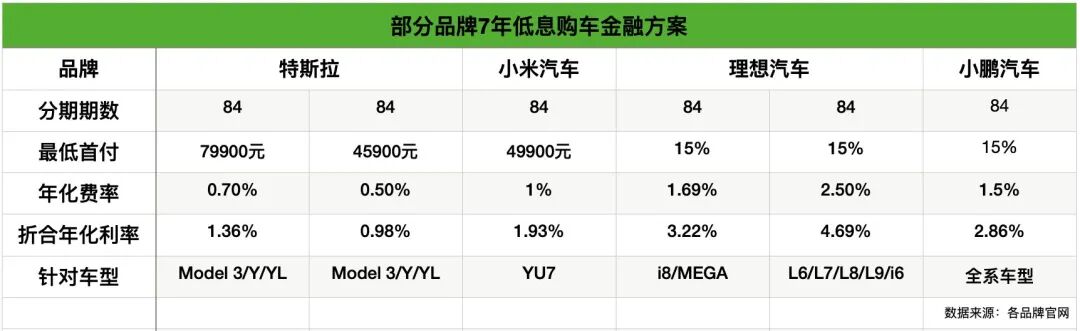
Core Viewpoint - The introduction of 7-year low-interest financing plans by various electric vehicle manufacturers aims to stimulate market demand amid a competitive landscape and inventory pressure, although the actual benefits and impacts on industry dynamics remain to be validated [1][10]. Financing Plans Overview - Multiple brands, including Tesla, Xiaomi, Li Auto, and Xpeng, have launched 7-year low-interest financing options, extending traditional auto loan periods by 2 to 3 years [1]. - Monthly payments have significantly decreased due to longer loan terms, with Xiaomi's YU7 starting at 2,593 yuan, Xpeng's models at 1,355 yuan, Li Auto at 2,578 yuan, and Tesla's Model 3/Y/Y L at 1,918 yuan [1]. Brand-Specific Financing Details - Tesla offers two different 7-year financing plans with varying down payment requirements, where a lower down payment (around 15%) has an annual interest rate of 0.7% and an effective annual rate of 1.36% [4]. - Xiaomi's plan requires a minimum down payment of 20%, with an annual interest rate of 1% and an effective annual rate of 1.93% [5]. - Li Auto's financing varies by model, with some models offering interest-free payments for the first three years, while others have rates of 2.5% and 4.69% [5]. - Xpeng's plan applies to all models, requiring a minimum down payment of 15% with an annual interest rate of 1.5% and an effective annual rate of 2.86% [6]. Market Dynamics and Consumer Behavior - Sales personnel from various brands express differing opinions on the financing options, with some recommending shorter 5-year plans due to lower total interest payments compared to the 7-year options [7][9]. - The overall sentiment among sales staff is that the 7-year low-interest plans are designed to lower the barrier for consumers to purchase vehicles, although the effectiveness of these plans is still uncertain [9][10]. Industry Trends and Predictions - Recent data indicates a significant decline in retail and wholesale volumes in the passenger vehicle market, with a 28% year-on-year drop in retail sales and a 35% decrease in wholesale volumes [10]. - Investment firms predict a continued downturn in the Chinese passenger vehicle market, with expected declines in retail sales and overall vehicle sales in 2026 [10].

理想一线工人收入赶超日德的承诺,悬了
阿尔法工场研究院· 2026-01-27 00:06
Core Viewpoint - 2026 is a critical year for Li Auto, as the company faces significant challenges in production capacity and market performance, particularly with declining orders for key models L7 and L8, leading to reduced operational efficiency and worker income [2][26]. Group 1: Production and Workforce Situation - Li Auto's Changzhou factory has a comprehensive production capacity exceeding 500,000 vehicles per year, but currently, production lines for models L7 and L8 are underutilized due to a decrease in orders, resulting in workers experiencing reduced working days and income [5][17]. - Workers in the second production area report a shift to a "three days on, four days off" schedule, indicating a significant drop in production activity, which has led to concerns about income stability among employees [3][4][17]. - In contrast, the third production area, which focuses on the i6 model, remains busy, producing at least 700 units daily, highlighting disparities in production demand across different models [7][13]. Group 2: Market Performance and Sales - In 2025, Li Auto's total sales dropped to 406,000 units, a 19% year-on-year decline, making it the only new energy vehicle company to experience a sales decrease, with significant drops in the sales of L7 and L8 models [15][26]. - The company is adjusting its product strategy by refocusing on range-extended and high-end models, while limiting new electric vehicle launches to enhance market positioning and efficiency [21][22]. Group 3: Financial and Strategic Adjustments - Li Auto has over 51.1 billion yuan in cash reserves and plans to invest approximately 8.3 billion yuan in research and development, indicating a strong financial foundation to support strategic shifts [26]. - The company is undergoing organizational changes, merging product lines and integrating key departments to streamline operations and improve manufacturing efficiency [22][26]. Group 4: Future Outlook - The upcoming changes in production rhythm and strategic adjustments are seen as essential for Li Auto to regain market competitiveness and improve worker conditions, with 2026 being pivotal for the company's recovery and growth [27].
理想常州工厂春节前现反差:增程产线闲置,纯电车间忙碌
Ju Chao Zi Xun· 2026-01-23 10:50
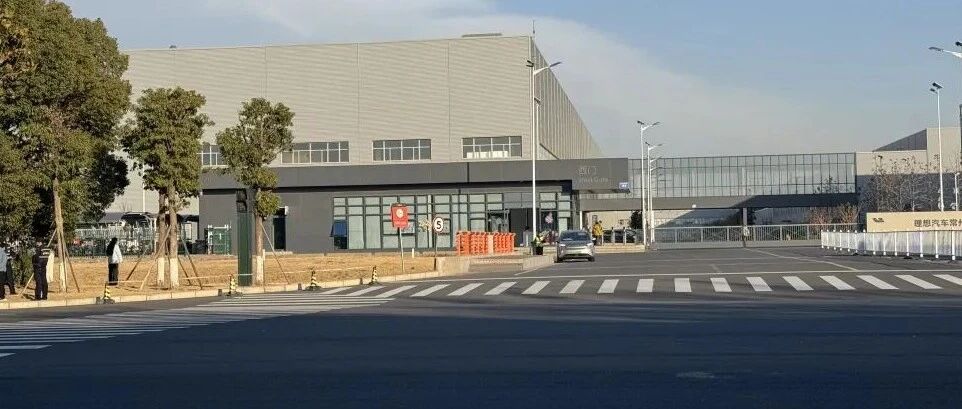
Core Viewpoint - Li Auto is experiencing a stark contrast in production at its Changzhou base, with significant declines in sales of its range-extended models while its pure electric models are seeing increased production and demand [2] Group 1: Production and Sales Performance - The production area for range-extended models L7 and L8 is quiet, with workers on a "three days on, four days off" schedule for nearly a month, leading to a sharp decline in income [2] - In contrast, the production line for the pure electric model i6 is operating at full capacity with a double shift, achieving a daily output of over 700 units [2] - In 2025, Li Auto's total sales volume dropped by 19% year-on-year, with retail sales of the L7 and L8 models plummeting by 66% and 79% respectively, losing market share to competitors like AITO and Leap Motor [2] Group 2: Financial Performance - Li Auto delivered a total of 406,300 vehicles in 2025, only achieving 63% of its revised sales target, and ended the third quarter with a net loss of 624 million yuan, marking the end of 11 consecutive profitable quarters [2] Group 3: Strategic Adjustments - In response to the declining performance, Li Auto has initiated a strategic adjustment, returning to a startup management model, focusing on range-extended and high-end markets, and streamlining the L series models [2] - The company plans to launch a new version of the L9 equipped with its self-developed M100 chip [2] - 2026 is identified as a critical year for the company to improve production line operations and fulfill salary commitments, with the success of this strategic transformation pending market validation [2]

评论理想第一产品线负责MEGA/L789, 第二产品线负责i系列和L6
理想TOP2· 2026-01-06 16:46
Core Viewpoint - The restructuring of Li Auto's product lines aims to enhance decision-making efficiency and product consistency by shifting from a matrix organization to a more streamlined approach, with clear accountability for product lines [1][2]. Group 1: Product Line Adjustments - Li Auto will reorganize its product lines into two main categories: one led by "Old Tang" for MEGA, L9, L8, and L7, and another led by Li Xinyang for the i series and L6 [1]. - The transition from Huawei's IPD model to Toyota's CE model is intended to address issues of resource allocation and decision-making speed within the automotive industry [1][2]. - The i8 series will continue to be iterated upon and will not be discontinued, with a focus on adjusting models priced between 300,000 to 400,000 and potentially introducing a model above 500,000 [1]. Group 2: Leadership and Responsibility - There has been a significant imbalance in the responsibilities and powers of product line leaders, with the expectation that they will now have more authority to influence their respective product lines [2]. - The current restructuring does not appear to designate a single individual as the overall responsible party for value delivery across the brand, sales, and product departments [2]. - The division of responsibilities between Old Tang and Li Xinyang is seen as a move towards balancing their roles, with Old Tang focusing on higher-priced models and Li Xinyang on lower-priced models [5][7]. Group 3: Market Positioning and Strategy - The new product line structure reflects a strategic alignment with market demographics, where Old Tang is perceived to better understand older consumers and Li Xinyang is more attuned to younger buyers [4][6]. - The division aims to minimize internal competition while ensuring that both leaders have overlapping responsibilities that foster collaboration rather than conflict [7].
消息称理想汽车第二产品线总裁张骁将离职 理想ONE、L9定义者
Feng Huang Wang· 2025-12-24 22:30
Core Insights - Zhang Xiao, the president of the second product line at Li Auto, is set to leave the company, raising concerns about the future planning of the mid-to-high-end product line [2][1] - Zhang has been with Li Auto since May 2016 and played a significant role in the product definition of key models such as Li ONE and L9 [1][2] - The company has structured its product lines based on price ranges, with Zhang responsible for the second product line covering models priced between 300,000 to 400,000 yuan [1] Company Structure - Li Auto has three main product lines: - The first product line, overseen by Tang Jing, targets models priced above 400,000 yuan (MEGA, L9) [1] - The second product line, managed by Zhang Xiao, includes key models like L8 and L7, and the upcoming i8 [1] - The third product line, led by Li Xinyang, focuses on models priced below 300,000 yuan (L6, i6) [1] Impact of Departure - Zhang's departure may impact the operational pace of the second product line, which is crucial for the company's mid-to-high-end offerings [2][1]