
ChatGPT 5.2 Pro

Search documents
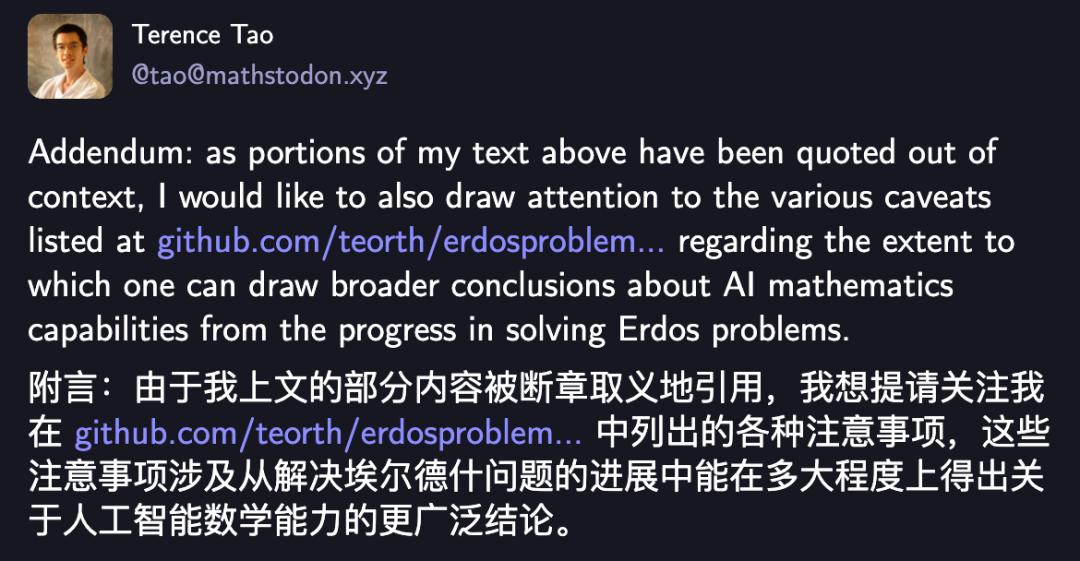
AI又要颠覆数学?陶哲轩紧急发声:停止造神
3 6 Ke· 2026-01-12 01:49
Core Viewpoint - The article discusses the exaggerated claims regarding AI's ability to solve complex mathematical problems, particularly in relation to Erdős problems, and emphasizes the need for a more nuanced understanding of AI's contributions in mathematics [1][2]. Group 1: AI's Capabilities in Mathematics - AI's achievements in solving certain mathematical problems are often overstated, leading to misconceptions that AI can independently innovate or replace human mathematicians [2][4]. - The difficulty level of problems solved by AI varies significantly, making direct comparisons misleading; some problems are much easier than others, which can skew perceptions of AI's capabilities [2][3]. - Many problems labeled as "unsolved" may have been previously addressed in literature, leading to potential misattributions of "first solutions" to AI [3][10]. Group 2: Evaluation of AI Contributions - AI's contributions can be categorized into several types, including generating complete or partial solutions, conducting literature reviews, and formalizing proofs [6][12]. - Specific examples illustrate that AI has successfully provided solutions for certain problems, but these often require validation against existing literature to confirm their novelty [8][10]. - The process of formalizing AI-generated proofs can introduce risks, such as the potential for misinterpretation or the introduction of unverified axioms [4][12]. Group 3: The Role of Human Mathematicians - Human mathematicians remain essential for formulating deep questions, creating new concepts, and integrating results into the broader knowledge network of mathematics [12]. - The future of mathematics may involve a collaborative relationship where humans guide AI in exploring mathematical landscapes, rather than AI acting as an independent entity [12].

2026年度策略会年度策略报告巡礼之科技篇
2025-12-17 15:50
Summary of Key Points from the Conference Call Industry Overview - The computer industry is expected to see overall performance improvement in 2025, with profit growth outpacing revenue growth, primarily due to cost-cutting measures by software companies [1][4][5] - Large-cap companies are performing better than small and mid-cap companies, demonstrating stronger cyclical resilience and earlier recovery times [1][5] - Public fund holdings in the computer sector are approximately 2.6%, indicating a significant underweight position compared to the standard allocation of 5% to 6% [1][6] AI Technology and Market Trends - AI technology is entering enterprise-level applications and integrating with software, which is expected to create a long-term bullish market lasting 2 to 3 years, although the exact timing remains uncertain [1][7] - Deepseek is driving AI technology development with its free and open-source model, offering a cost of $1-2 per million tokens, significantly lower than competitors like OpenAI and Gemini [1][8] - GPT-5.2 Pro is positioned for the enterprise market, priced at $168 per million tokens, making it suitable for large enterprises and significantly reducing costs in legal services [1][10][11] Market Dynamics and Financial Performance - The overall return in the computer sector is expected to be in the mid-range of 10% to 15%, with some stocks potentially reaching returns of 40% to 60%, although operational challenges remain [3] - The AI computing power industry chain is anticipated to face supply shortages in various segments, particularly in storage and optical components [4][27] - The rapid growth in token consumption is expected to drive demand for computing cards by 3 to 5 times [2][19] Investment Opportunities and Risks - The scaling law remains effective, with North American cloud vendors expected to reach a peak in capital expenditure in 2025 and 2026, while China will follow a year later [1][18] - Alibaba plans to invest 380 billion RMB in computing power over the next three years, potentially increasing investment to ensure sustained growth [1][18] - The enterprise-level AI deployment is rapidly advancing, with significant cost reductions in private deployments [1][16] Emerging Technologies and Innovations - The development of domestic chips is progressing, with new generations supporting FP8 precision, marking a significant year for domestic computing cards in large model inference [4][20] - The AI programming landscape is seeing AI-generated code accounting for 30% to 40% of total code volume, impacting the IT industry significantly [15] - Liquid cooling technology is at a pivotal point, with expectations for market share growth and improved profitability for companies involved [36] Future Outlook - The AI computing power industry is expected to remain in a high-growth phase, with demand outpacing supply in 2026, particularly in optical components [27] - The integration of AI technologies into various sectors is anticipated to drive significant changes and create new investment opportunities [24] - The IDC industry is facing challenges due to pricing pressures from excess supply but is seeing strong demand growth, particularly in the domestic market [37] Conclusion - The computer and AI sectors are poised for significant growth driven by technological advancements and market dynamics, with investment opportunities emerging in various segments, particularly in enterprise applications and computing power infrastructure [1][24][27]