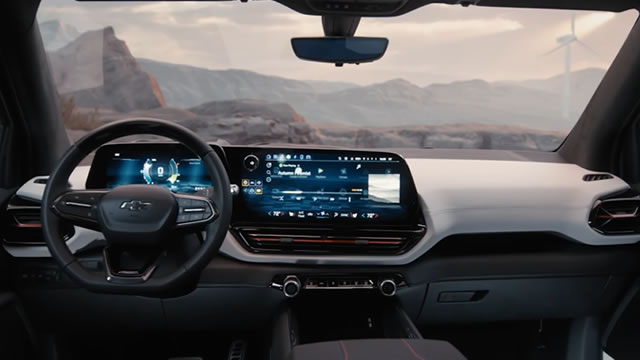
Chevrolet Trax

Search documents
GM to invest US$600 in its South Korean operations
Yahoo Finance· 2026-03-26 09:29
Core Viewpoint - General Motors Company plans to invest US$ 600 million in GM Korea to upgrade production equipment and introduce new models, reflecting confidence in the subsidiary's performance and competitiveness [1][3]. Investment Details - The new investment of US$ 600 million is double the US$ 300 million announced last December, indicating a shift in strategy after previous speculation about exiting vehicle manufacturing in South Korea due to import tariffs [2]. - The investment will enhance GM Korea's capabilities as a strategic manufacturing hub for small and compact SUVs [3]. Performance Metrics - In the previous year, GM Korea's sales decreased by 7.5% to 462,310 units, with domestic sales dropping over 39% to 15,094 units, while exports fell by 6% to 447,216 units [4]. - The company produces models such as the Chevrolet Trax and Trailblazer, primarily for export to the US [4]. Management Perspective - GM Korea's CEO, Hector Villarreal, stated that the investment reflects the success of Korean-made products in global markets and highlights efforts to strengthen manufacturing operations for profitability since 2018 [5].

General Motors (GM) Q4 Adjusted EPS Beats at $2.51 as Company Hikes Dividend 20%, Adds $6B Buyback
Yahoo Finance· 2026-03-11 07:20
Group 1 - General Motors Company (NYSE:GM) reported Q4 adjusted earnings per share (EPS) of $2.51, exceeding Wall Street's expectations of $2.20, despite a slight revenue miss at $45.29 billion [1][7] - The company announced a 20% increase in its quarterly dividend to 18 cents per share and authorized a new $6 billion stock repurchase program to enhance stock value [1][7] - In 2025, GM faced over $7.2 billion in special charges due to a strategic pullback from electric vehicles and operations in China, leading to a reported net loss for Q4, although core North American operations remained profitable [2] Group 2 - For 2026, GM provided optimistic guidance, forecasting adjusted EBIT between $13 billion and $15 billion and EPS in the range of $11 to $13, with a goal to return North American adjusted profit margins to between 8% and 10% [3] - The 2026 outlook includes a 15% tariff on vehicles imported from South Korea, with ongoing trade negotiations being monitored that could affect entry-level models like the Chevrolet Trax [3] - GM operates through three segments: GM North America, GM International, and GM Financial, focusing on designing, building, and selling trucks, crossovers, cars, and automobile parts worldwide [4]
GM(GM) - 2025 Q4 - Earnings Call Transcript
2026-01-27 14:32
Financial Data and Key Metrics Changes - The company reported total revenue of $45 billion for Q4 2025, down approximately 5% year-over-year, primarily due to disciplined production and dealer inventory management [19] - EBIT adjusted was $12.7 billion for the full year, with adjusted automotive free cash flow of $10.6 billion, resulting in a year-end cash balance of $21.7 billion [16][19] - The company achieved a total return of 54% for investors in 2025 [5] Business Line Data and Key Metrics Changes - North America delivered EBIT adjusted of $2.2 billion with margins of 6.1% [23] - GM Financial's full-year EBIT adjusted was $2.8 billion, within guidance, and paid dividends of $1.5 billion to GM [25] - The company led the industry in full-size pickups and SUVs, with strong performance in crossovers [5][7] Market Data and Key Metrics Changes - The U.S. market share reached its highest level in a decade, marking the fourth consecutive year of market share growth [5] - New energy vehicle sales in China reached nearly 1 million units in 2025, representing over half of total sales in the region [25] - The company expects total U.S. SAAR to be in the low 16 million unit range for 2026 [27] Company Strategy and Development Direction - The company is focused on maintaining a strong balance sheet while investing in growth, with planned capital expenditures of $10-$12 billion annually [17][27] - The strategy includes onshoring production to meet demand for internal combustion engine (ICE) vehicles and enhancing supply chain resiliency [31] - The company is committed to EVs, with plans to reduce costs and improve profitability through new technologies and operational efficiencies [9][23] Management's Comments on Operating Environment and Future Outlook - Management expressed confidence in achieving EBIT adjusted margins in North America of 8%-10% in 2026, supported by improved EV profitability and warranty expense trends [32] - The company anticipates a benefit of $1 billion-$1.5 billion related to right-sizing EV capacity [29] - Management acknowledged uncertainties in the regulatory environment but remains optimistic about future cash flows and profitability [32] Other Important Information - The company incurred $3.1 billion in gross tariff costs for 2025, which was below the predicted range [21] - The company plans to increase its quarterly dividend rate by 20% and has authorized a new share repurchase program of $6 billion [19][18] - The company is expanding its Super Cruise business into international markets and expects to grow OnStar services significantly [10][32] Q&A Session Summary Question: Pricing Assumptions - Management indicated that pricing is expected to be flat to up, primarily reflecting the annualization of 2025 pricing without significant increases planned [37][38] Question: Product Portfolio Dynamics - Management confirmed that the current portfolio is well-positioned, with a strong ICE lineup and plans for hybrid vehicles in key segments [40][41] Question: Inventory Discipline and Cash Flow - Management stated that inventory discipline will continue, contributing to stronger cash generation, with no significant buildup anticipated [47][48] Question: Industrial Bank Approval Impact - Management highlighted that the Industrial Bank will provide a complementary funding source, potentially lowering the cost of funds [51][52] Question: EV Volume Declines and ICE Demand - Management noted uncertainty in EV demand but is prepared to maximize ICE production to meet market needs [90][92] Question: North America Margin Guidance - Management clarified that the North America margin guidance reflects improvements in EV profitability and regulatory costs, contributing to overall EBIT expectations [78][80] Question: Memory Chip Supply and Pricing - Management confirmed that there are no current issues with memory chip supply, and the team is actively managing the situation [82][83]
GM to invest US$300m in South Korean operations
Yahoo Finance· 2025-12-17 09:13
Core Viewpoint - General Motors is reaffirming its commitment to South Korea by investing US$ 300 million to upgrade its manufacturing operations at GM Korea, despite previous concerns over tariffs impacting production [1][2]. Investment and Production Plans - The US$ 300 million investment will focus on producing the next-generation Chevrolet Trax and Trailblazer, although no specific timeline for the investment has been provided [4]. - GM Korea's existing five-year investment roadmap includes the recent opening of the Cheongna Proving Ground Virtual Engineering Lab, enhancing its role as a global engineering hub [4]. Market Context and Sales Performance - The US government recently reduced tariffs on South Korean imports from 25% to 15%, aligning them with other major exporters, which positively influenced GM's decision to invest in South Korea [3]. - GM Korea's domestic sales fell by 39% to 13,952 units in the first eleven months of 2025, while exports decreased by 6.5% to 395,858 units, amid increasing competition [3]. Strategic Initiatives - GM Korea plans to introduce GMC and Buick brands in South Korea in 2026, alongside Chevrolet and Cadillac, to strengthen its domestic sales [5]. - The company aims to expand its sales and service networks in South Korea and offer a broader vehicle portfolio featuring advanced technologies like Super Cruise [5]. Long-term Vision - GM Korea's CEO highlighted that achieving profitability in 2024 is a significant milestone, and the company is focused on building a sustainable foundation through its normalization plan established in 2018 [5]. - Over the past 20 years, GM has produced 13.3 million vehicles in Korea and sold 2.5 million domestically, establishing GM Korea as a key player in the South Korean automotive industry [5].
Trump's South Korea tariff cuts are major boost for Hyundai and GM
CNBC· 2025-12-03 21:23
Core Insights - Hyundai Motor and General Motors are poised to benefit significantly from the reduction of U.S. tariffs on vehicle imports from South Korea, decreasing from 25% to 15% [3][4]. Group 1: Tariff Impact - Hyundai is the largest U.S. importer of vehicles from South Korea, followed by GM, both of which have incurred substantial tariff costs this year, with Hyundai reporting 1.8 trillion won ($1.2 billion) in Q3, up from 828 billion won ($565 million) in Q2 [2][4]. - GM's tariff costs from South Korea and Mexico are projected to be between $3.5 billion and $4.5 billion in 2025, with expectations of reducing these costs to around $1 billion or less by 2026 [4][5]. Group 2: Sales and Production - Hyundai aims to increase local production in the U.S. to over 80% of its vehicle sales by 2030, up from approximately 40% currently, while still importing nearly 1 million vehicles from South Korea this year [8][10]. - GM is expected to import about 422,000 vehicles from South Korea in 2025, marking a 3.6% increase from over 407,000 units last year, with a focus on entry-level crossovers produced in South Korean plants [10][11]. Group 3: Economic Partnership - The U.S. and South Korea have strengthened their economic partnership, with South Korea committing to invest $350 billion in the U.S. over several years, which is seen as beneficial for domestic jobs and industry [6][7]. - The recent trade agreement follows a period of tension due to an immigration raid at a battery plant in Georgia, jointly owned by Hyundai and LG Energy Solution, where about 475 workers were arrested [13][14].


These Analysts Revise Their Forecasts On General Motors After Q2 Results
Benzinga· 2025-07-23 17:13
Core Insights - General Motors Company reported second-quarter adjusted earnings per share of $2.53, exceeding the analyst consensus estimate of $2.40, with quarterly sales reaching $47.12 billion, surpassing the expected $45.57 billion [1][3] Group 1: Financial Performance - The company affirmed its FY25 adjusted earnings per share guidance of $8.25-$10.00, compared to the analyst estimate of $9.17 [3] - General Motors plans to offset at least 30% of the $4 billion–$5 billion gross tariff impact [3] - Following the earnings announcement, General Motors shares increased by 6.9%, trading at $52.26 [3] Group 2: Market Position and Product Development - General Motors continues to lead the industry in full-size trucks and SUVs, with significant advancements in design and technology in new crossover SUVs like Chevrolet Trax, Buick Envista, and GMC Acadia, resulting in record demand and revenue growth [2] Group 3: Analyst Ratings and Price Targets - B of A Securities analyst John Murphy maintained a Buy rating on General Motors, lowering the price target from $65 to $62 [8] - Wells Fargo analyst Colin Langan maintained an Underweight rating, raising the price target from $34 to $38 [8] - Citigroup analyst Michael Ward maintained a Buy rating and raised the price target from $59 to $61 [8]

GM Trims Outlook, Halts Buyback Amid Tariffs: Sell the Stock Now?
ZACKS· 2025-05-02 13:50
Core Viewpoint - General Motors (GM) has revised its 2025 earnings forecast downward due to potential new U.S. auto tariffs, estimating a cost impact of $4-$5 billion [1][3][4]. Financial Outlook - GM now expects adjusted EBIT for 2025 to be between $10 billion and $12.5 billion, down from a previous range of $13.7 billion to $15.7 billion [4]. - Net income attributable to shareholders is projected to fall to between $8.2 billion and $10.1 billion, compared to earlier guidance of $11.2 billion to $12.5 billion [4]. - Adjusted automotive free cash flow is now expected to be in the range of $7.5 billion to $10 billion, lower than the previous forecast of $11 billion to $13 billion [4]. Impact of Tariffs - A significant factor in the downward revision is a projected $2 billion business hit from South Korea, where several key models are assembled [5]. - GM's CEO has indicated that tariff-related challenges will create significant disruption in the auto industry [2]. Stock Buyback and Analyst Revisions - GM has temporarily suspended its share buyback program until there is more clarity on the tariff impact, with $4.3 billion in repurchase capacity remaining [6]. - Analysts have begun to lower their EPS forecasts for GM for 2025, with further cuts anticipated [6]. Tariff Defense Strategy - GM aims to offset up to 30% of expected tariff-related costs through "self-help initiatives," including increasing U.S.-based vehicle and battery production [7]. - The company has increased its U.S. direct purchases by 27% since 2019, with over 80% of U.S.-built vehicle content meeting USMCA standards [8]. Market Performance - Year-to-date, GM shares have declined by 15%, which is better than Harley-Davidson's 23% drop, while Ford has seen a 2.8% increase [10]. - GM's stock trades at a forward price-to-sales (P/S) ratio of 0.25, significantly below the industry average of 2.19, indicating it may be undervalued [13]. Long-term Strategy - GM is progressing with its long-term electric vehicle (EV) strategy, being the 2 EV seller in the U.S. and achieving variable profit positive status for its EV lineup by late 2024 [16]. - The company ended the first quarter with $20.7 billion in cash and cash equivalents, indicating solid financial health [17].