CodeMender

Search documents
OpenAI首个GPT-5找Bug智能体:全自动读代码找漏洞写修复
3 6 Ke· 2025-10-31 02:25
Core Insights - OpenAI has launched Aardvark, an AI-driven "white hat" agent designed to automatically identify and fix security vulnerabilities in large codebases [1][3] - Aardvark has demonstrated a 92% identification rate for known vulnerabilities and can locate issues that arise under complex conditions [3][12] - Other tech giants like Anthropic, Google, and Microsoft have also released similar AI security tools in October, indicating a growing trend in AI-driven code security solutions [14][19] Group 1: Aardvark's Functionality - Aardvark operates as an agentic security researcher, continuously analyzing source code repositories to identify vulnerabilities, assess exploitability, determine risk levels, and propose targeted fixes [4] - It utilizes a workflow that includes threat modeling, vulnerability discovery, sandbox validation, Codex patch generation, manual review, and pull request submission [5][10] - Aardvark integrates seamlessly with GitHub and existing development processes, providing actionable security insights without hindering development efficiency [10] Group 2: Performance and Testing - Internal testing has shown that Aardvark can identify not only security vulnerabilities but also logical flaws, incomplete fixes, and privacy risks [11] - Aardvark has been tested in various internal and partner projects, achieving a 92% identification rate in benchmark tests against "golden repositories" [12] - The tool has also been applied to multiple open-source projects, successfully identifying and disclosing numerous vulnerabilities, with 10 of them receiving CVE identifiers [12] Group 3: Industry Context - The recent surge in AI-driven security tools is a response to the increasing complexity and volume of vulnerabilities in enterprise-level codebases, which traditional debugging methods struggle to address [19] - The alignment in release timing among major tech companies suggests a collective recognition of the need for AI to enhance vulnerability discovery and remediation processes [14][19] - The growing reliance on AI for security tasks is seen as essential for ensuring software safety and mitigating enterprise risks in an era of escalating cyber threats [19]

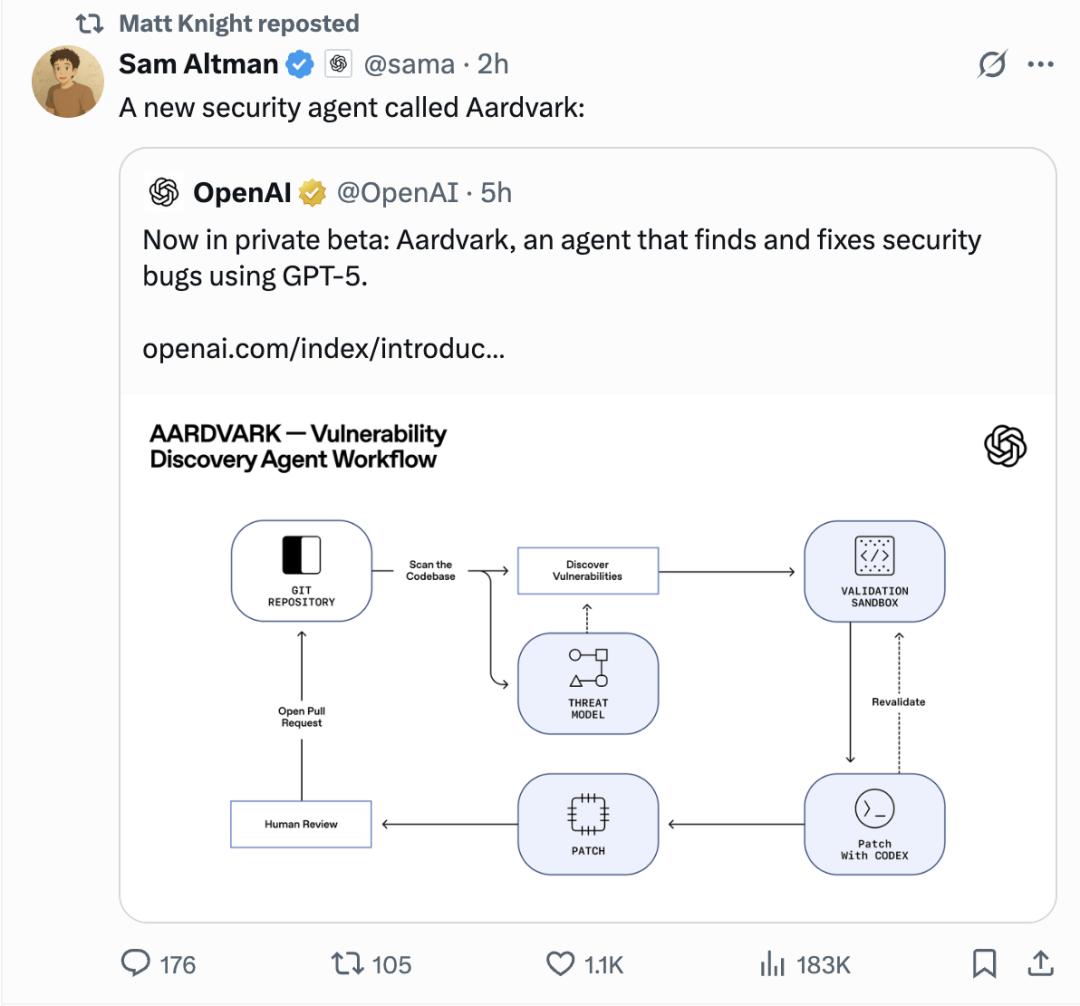
OpenAI首个GPT-5找Bug智能体:全自动读代码找漏洞写修复
量子位· 2025-10-31 00:58
Core Insights - OpenAI has launched Aardvark, an AI-driven "white hat" agent designed to automatically identify and fix security vulnerabilities in large codebases [2][3][4] - Aardvark has demonstrated a 92% identification rate for known vulnerabilities, showcasing its effectiveness in complex conditions [4][19] - Major tech companies like Anthropic, Google, and Microsoft have also introduced similar AI security agents in October, indicating a growing trend in AI-driven code security solutions [7][24][32] Group 1: Aardvark's Functionality - Aardvark operates as an agentic security researcher, continuously analyzing source code repositories to identify vulnerabilities, assess exploitability, determine risk levels, and propose targeted fixes [9] - It utilizes a workflow that includes threat modeling, vulnerability discovery, sandbox validation, Codex repair, manual review, and pull request submission [11] - The integration with GitHub and Codex allows Aardvark to provide actionable security insights without disrupting development efficiency [15] Group 2: Industry Trends - The release of Aardvark coincides with similar announcements from other tech giants, highlighting a collective push towards AI-enhanced code security [23][24] - Anthropic's Claude Sonnet 4.5 and Google's CodeMender have shown superior performance in vulnerability detection compared to previous models, indicating rapid advancements in AI capabilities [28][29] - The increasing complexity of enterprise networks and the rise in cyber threats necessitate AI solutions for efficient vulnerability management [32][34] Group 3: Market Implications - The simultaneous launch of multiple AI security tools suggests a competitive landscape where companies aim to address the growing demand for automated vulnerability detection and remediation [32][34] - The observation that companies are creating both vulnerability-generating and vulnerability-fixing agents raises questions about the sustainability and ethics of such business models [35]
谷歌 DeepMind 推出 CodeMender:自动修复代码的智能代理
AI前线· 2025-10-18 05:11
Core Insights - Google DeepMind has launched CodeMender, an AI-driven intelligent agent designed to automatically detect, fix, and strengthen software vulnerabilities, aiming to reduce the time developers spend on identifying and addressing security issues [1][4] - CodeMender combines automated vulnerability discovery with AI-based repair and validation, contributing 72 verified patches to open-source projects in the past six months, with some projects exceeding 4 million lines of code [1][2] Group 1 - Traditional vulnerability detection methods, such as static analysis and fuzzing, require significant manual verification and remediation, which CodeMender seeks to improve upon [1] - The system generates multiple repair candidates when a vulnerability is detected and validates these patches through automated testing to ensure they resolve the issue without introducing new errors [1][4] - Early repair cases include fixing a heap buffer overflow related to XML stack processing and addressing an object lifecycle management vulnerability [2] Group 2 - The community response to CodeMender has been largely positive, with comments highlighting the impressive nature of automated repairs and the importance of the verification layer for trust [3] - Discussions on platforms like Reddit indicate concerns about the future impact of such automation on cybersecurity, with users speculating on the potential for hackers to exploit similar models [4] - DeepMind emphasizes that all patches generated by CodeMender will undergo human review before formal integration, with reliability and transparency being core principles of the project [4]


X @Demis Hassabis
Demis Hassabis· 2025-10-07 13:19
AI Security & Development - CodeMender 是一个新的 AI Agent,可以自动修复关键软件漏洞 [1] - AI 有望大幅提升开发者生产力和安全性 [1]
DeepMind发布代码修复AI智能体CodeMender,实现「被动响应」与「主动防御」一体化
机器之心· 2025-10-07 07:00
Core Viewpoint - The article discusses the introduction of CodeMender, an AI agent developed by DeepMind, designed to automatically repair critical software vulnerabilities while ensuring that the fixes do not introduce new issues, emphasizing the importance of rigorous validation in AI-driven code security solutions [2][10]. Group 1: CodeMender Overview - CodeMender employs a comprehensive approach to address software vulnerabilities, balancing both passive response and proactive defense by immediately patching new vulnerabilities and rewriting existing code to eliminate systemic flaws [4]. - In the past six months, DeepMind has uploaded 72 security patches to open-source projects, with some patches encompassing up to 4.5 million lines of code [5]. - By automating the creation and application of high-quality security patches, CodeMender allows developers to focus on building quality software rather than spending time on vulnerability detection [6]. Group 2: Developer Reactions - The release of CodeMender has sparked discussions among developers, with some highlighting its ability to ensure that fixes do not disrupt other functionalities, marking a significant advancement in automation [8]. - Concerns have been raised that CodeMender could potentially disrupt income streams related to quality assurance, security audits, and bug bounty programs [8]. Group 3: AI Vulnerability Reward Program - Google has recently launched a reward program specifically targeting vulnerabilities in AI products, with bug hunters having earned over $430,000 since the initiative began two years ago [9]. Group 4: CodeMender's Mechanism - CodeMender operates using the latest Gemini deep thinking model, enabling it to automatically debug and repair complex vulnerabilities while ensuring that modifications are logically sound and do not cause additional problems [12]. - The agent utilizes a variety of tools, including debuggers and source code browsers, to accurately identify root causes and design patches [14]. - Advanced program analysis techniques, such as static and dynamic analysis, are employed to systematically examine code patterns and identify vulnerabilities [18]. Group 5: Case Studies - In one case, CodeMender identified a root cause related to stack management in XML parsing, leading to a patch that modified only a few lines of code [15]. - Another instance showcased CodeMender's ability to create a non-trivial patch addressing complex object lifecycle issues, demonstrating its capability to enhance security by rewriting existing code [17]. Group 6: Future Developments - All patches generated by CodeMender undergo human review before submission to upstream projects, ensuring reliability and quality [24]. - DeepMind plans to share further technical papers and reports in the coming months, with the goal of eventually making CodeMender available as a tool for all developers to enhance software security [24].