DROID数据集

Search documents
分析了102个VLA模型、26个数据集和12个仿真平台
自动驾驶之心· 2025-07-22 02:18
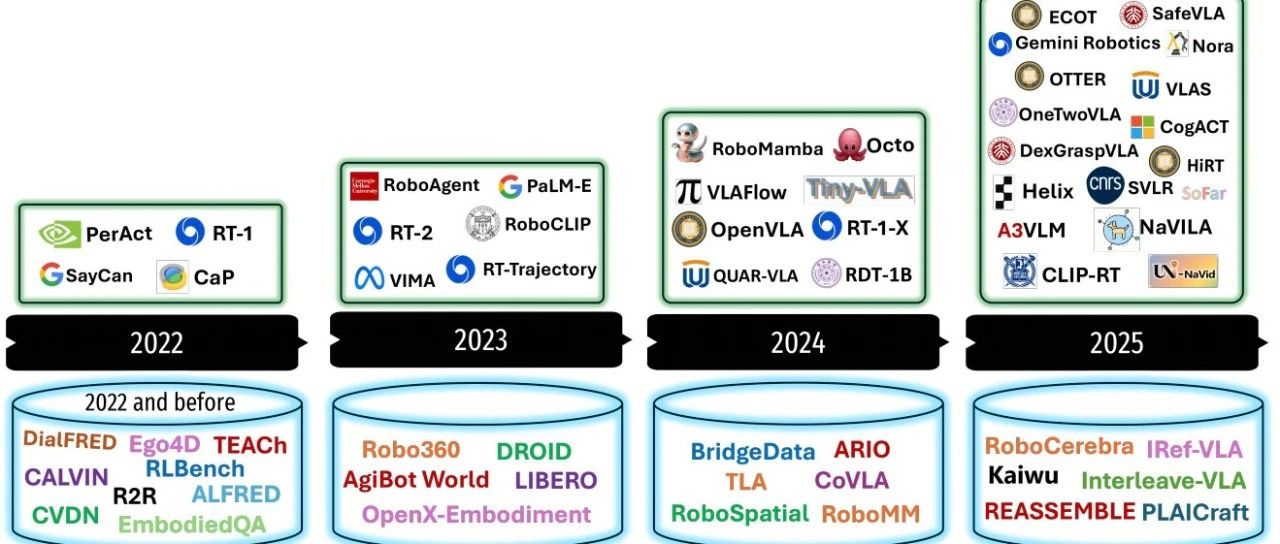
Core Viewpoint - The article discusses the transformative breakthrough of Visual-Language-Action (VLA) models in robotics, emphasizing their integration of visual perception, natural language understanding, and embodied control within a unified learning framework. It highlights the development and evaluation of 102 VLA models, 26 foundational datasets, and 12 simulation platforms, identifying current challenges and future directions for enhancing robotic autonomy and adaptability [3][4][6]. Group 1: VLA Models and Framework - VLA models represent a new frontier in robotic intelligence, enabling robots to perceive visual environments, understand natural language commands, and execute meaningful actions, bridging the semantic gap between various modalities [7][9]. - The architecture of VLA models integrates visual, language, and proprioceptive encoders into a diffusion backbone network to generate control commands, facilitating end-to-end processing of multimodal inputs [11][12]. - The development of effective VLA models relies on large-scale, diverse multimodal datasets and realistic simulation platforms, which are crucial for training models to robustly understand language instructions and perceive visual environments [5][30]. Group 2: Datasets and Evaluation - The article outlines the evolution of VLA datasets, noting that early datasets focused on discrete decision-making in constrained environments, while recent datasets incorporate richer sensory streams and longer task durations, addressing the need for complex multimodal control challenges [21][22][29]. - A comprehensive benchmarking strategy is proposed to evaluate datasets based on task complexity and modality richness, highlighting the need for new datasets that integrate high task difficulty with extensive multimodal inputs [24][28]. - The analysis reveals a gap in current VLA benchmarks, particularly in combining long-duration, multi-skill control with diverse multimodal integration, indicating a promising direction for future dataset development [29][43]. Group 3: Simulation Tools - Simulation environments are critical for VLA research, enabling the generation of large-scale, repeatable, and richly annotated data that surpasses physical world limitations [30][31]. - Various advanced simulation platforms, such as AI2-THOR and NVIDIA Isaac Sim, provide high-fidelity physical effects and customizable multimodal sensors, essential for developing robust VLA models [32][33]. - The integration of simulation tools with VLA datasets accelerates the collaborative development of control algorithms and benchmark datasets, ensuring advancements in multimodal perception are effectively evaluated before deployment in real robotic platforms [30][33]. Group 4: Applications and Challenges - VLA models are categorized into six broad application areas, including manipulation and task generalization, autonomous mobility, human assistance, and interaction, showcasing their versatility across various robotic tasks [34][35]. - The article identifies key challenges in VLA model architecture, such as tokenization and vocabulary alignment, modality fusion, and cross-entity generalization, which need to be addressed to enhance model performance and adaptability [39][40][41]. - Data challenges are also highlighted, including task diversity, modality imbalance, annotation quality, and the trade-off between realism and scale in datasets, which hinder the development of robust general-purpose VLA models [42][43].

分析了102个VLA模型、26个数据集和12个仿真平台
具身智能之心· 2025-07-20 01:06
Core Viewpoint - The article discusses the transformative breakthrough of Visual-Language-Action (VLA) models in robotics, emphasizing their integration of visual perception, natural language understanding, and embodied control within a unified learning framework. It highlights the development and evaluation of 102 VLA models, 26 foundational datasets, and 12 simulation platforms, identifying current challenges and future directions for enhancing robotic autonomy and adaptability [3][4][6]. Group 1: VLA Models and Framework - VLA models represent a new frontier in robotic intelligence, enabling robots to perceive visual environments, understand natural language commands, and execute meaningful actions, bridging the semantic gap between various modalities [7][9]. - The architecture of VLA models integrates visual, language, and proprioceptive encoders into a diffusion backbone network, facilitating the generation of control commands [11][12]. - The evaluation of VLA architectures reveals a rich diversity in core component algorithms, with visual encoders predominantly based on CLIP and SigLIP, and language models primarily from the LLaMA family [16]. Group 2: Datasets and Training - High-quality, diverse training datasets are crucial for VLA model development, allowing models to learn complex cross-modal correlations without relying on manually crafted heuristics [17][22]. - The article categorizes major VLA datasets, noting a shift towards more complex, multimodal control challenges, with recent datasets like DROID and Open X-Embodiment embedding synchronized RGBD, language, and multi-skill trajectories [22][30]. - A benchmarking analysis maps each major VLA dataset based on task complexity and modality richness, highlighting gaps in current benchmarks, particularly in integrating complex tasks with extensive multimodal inputs [30][31]. Group 3: Simulation Tools - Simulation environments are essential for VLA research, generating large-scale, richly annotated data that exceeds physical world limitations. Platforms like AI2-THOR and Habitat provide realistic rendering and customizable multimodal sensors [32][35]. - The article outlines various simulation tools, emphasizing their capabilities in generating diverse datasets for VLA models, which are critical for advancing multimodal perception and control [35][36]. Group 4: Applications and Evaluation - VLA models are categorized into six broad application areas, including manipulation and task generalization, autonomous mobility, human assistance, and interaction, showcasing their versatility across different robotic tasks [36][37]. - The selection and evaluation of VLA models focus on their operational skills and task generalization capabilities, using standardized metrics such as success rate and zero-shot generalization ability [39][40]. Group 5: Challenges and Future Directions - The article identifies key architectural challenges for VLA models, including tokenization and vocabulary alignment, modality fusion, cross-entity generalization, and the smoothness of manipulator movements [42][43][44]. - Data challenges are also highlighted, such as task diversity, modality imbalance, annotation quality, and the trade-off between realism and scale in datasets, which hinder the robust development of general VLA models [45][46].