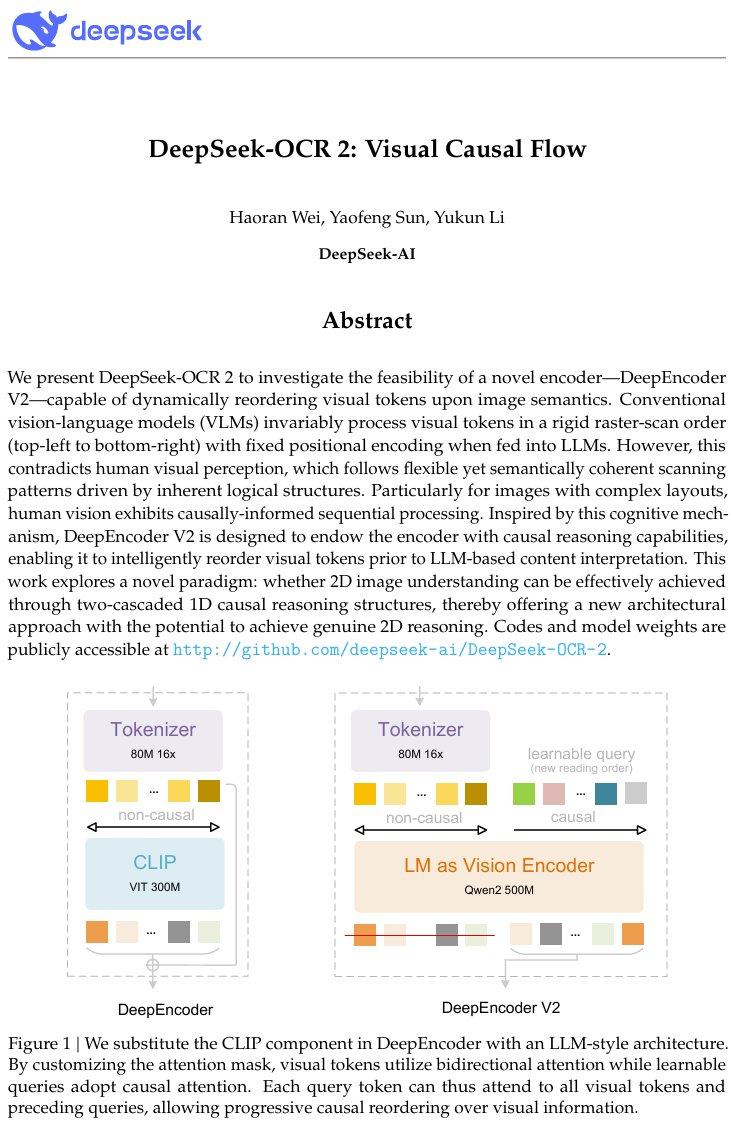
DeepEncoder V2

Search documents
突发!DeepSeek又“崩”了!
证券时报· 2026-03-31 12:45
DeepSeek连续三天发生服务异常。 3月31日17时,"DeepSeek(深度求索)又崩了"再次冲上热搜。DeepSeek官网服务状态页面显示,3月29日至31日, DeepSeek旗下服务连续三天出现不同程度异常,涉及网页对话、App及API等。故障分别持续约1小时48分、10小时13分和1 小时3分。根据官方状态页记录,三次故障均已修复,目前所有服务恢复稳定运行。 据经济观察报报道,一位模型技术社区负责人表示,从2026年2月至今,DeepSeek走过了多个预期发布窗口,仍未正式发布 V4,就在市场期待这一模型新品空降时,等来的却是DeepSeek成立以来最长的一次服务中断。 多名国产模型供应商人士推断:此次只有DeepSeek面向C端的产品服务中断,或与模型迭代过程中进行灰度测试有关。 前述技术社区负责人认为,DeepSeek已经为测试V4准备好了相关基础设施。3月初,DeepSeek网页端作出更新显示,代码能 力与上下文处理均有增强,业内猜测这可能是DeepSeek V4在作隐身测试。 一名与多家模型厂商合作的供应商对DeepSeek的隐身测试有个人理解:DeepSeek V4要在4月正式发布前, ...


速递 | DeepSeek更新了:OCR 2重构底层逻辑:AI看图终于懂“人话”了
未可知人工智能研究院· 2026-01-28 04:04
Core Insights - The article discusses the launch of DeepSeek's OCR 2 model, which fundamentally redefines AI's approach to image understanding by implementing a "Visual Causal Flow" that mimics human reading patterns [4][29] - The model significantly enhances performance and efficiency, achieving a nearly 4% improvement in accuracy and reducing processing costs by over 80% [8][9][29] Technical Innovation - The core innovation, "Visual Causal Flow," allows the AI to prioritize information based on logical reading patterns, improving efficiency compared to traditional OCR models [4][6] - The introduction of DeepEncoder V2 enables dynamic rearrangement of visual data based on semantic meaning, enhancing the model's ability to understand complex documents [6][9] Performance and Efficiency - OCR 2 maintains an accuracy rate of over 91% when processing complex documents, a significant improvement in a mature field [8] - The model reduces the number of visual tokens required for processing from thousands to just over a hundred, drastically cutting costs [9][10] Commercial Applications - Three high-value application scenarios are identified: 1. Financial automation for invoice and receipt processing, which can significantly reduce costs for accounting firms [13] 2. Intelligent contract review, which can streamline legal workflows and potentially replace junior legal assistants [14] 3. Smart document management for digitizing historical records in government and healthcare sectors, aligning with national digitalization initiatives [15] Competitive Landscape - The introduction of open-source OCR 2 disrupts the existing market dominated by major players like AWS and Google, lowering the barriers for small and medium enterprises to access high-precision OCR technology [17][19] - The competition will intensify, benefiting technology-driven players while challenging traditional service providers reliant on API calls [20] Long-term Strategy - DeepSeek's overarching strategy focuses on optimizing "information compression" and "efficient reasoning" across its various models, aiming to reduce inference costs significantly [21][22] - The ultimate goal is to develop a unified multimodal encoder that can process text, images, audio, and video in a cohesive manner, enhancing overall efficiency [23][24] Summary and Actionable Insights - Key takeaways include the technological advancements of OCR 2, its application in various high-value sectors, and the potential for significant commercial opportunities [29] - Companies are encouraged to explore the capabilities of OCR 2 and consider integrating it into their operations to capitalize on the current technological window [29]
DeepSeek-OCR 2重磅发布:AI学会“人类视觉逻辑”,以因果流解读图片
华尔街见闻· 2026-01-27 09:56
Core Viewpoint - DeepSeek has launched the DeepSeek-OCR 2 system, which utilizes the DeepEncoder V2 method to enable AI to understand images in a human-like logical sequence, potentially transforming document processing and complex visual understanding applications [1][12]. Group 1: Technical Innovations - The DeepEncoder V2 method allows AI to dynamically rearrange image segments based on their meaning, rather than following a rigid left-to-right scanning approach, mimicking human visual perception [1][5]. - DeepSeek-OCR 2 achieved a score of 91.09% in the OmniDocBench v1.5 benchmark, representing a 3.73% improvement over its predecessor [1][10]. - The model maintains high accuracy while controlling computational costs, with visual token counts limited to between 256 and 1120, aligning with Google’s Gemini-3 Pro [2][8]. Group 2: Performance Metrics - In practical applications, the model demonstrated a reduction in repetition rates, decreasing from 6.25% to 4.17% for online user logs and from 3.69% to 2.88% for PDF data processing, indicating its high practical maturity [2][10]. - The reading order edit distance metric improved significantly from 0.085 to 0.057, validating the effectiveness of the logical reordering capabilities of DeepEncoder V2 [10]. Group 3: Architectural Changes - The architecture of DeepEncoder V2 replaced the original CLIP components with a compact LLM-style architecture (Qwen2-0.5B), introducing learnable query vectors known as "causal flow tokens" [6][8]. - The design retains a bidirectional attention mechanism for visual tokens while employing a causal attention mechanism for causal flow tokens, allowing for intelligent reordering of visual information [7][8]. Group 4: Future Implications - The release of DeepSeek-OCR 2 signifies not only an upgrade in OCR performance but also a significant exploration of architecture, suggesting a promising path towards unified multimodal encoders capable of feature extraction across images, audio, and text [12].
DeepSeek发布DeepSeek-OCR 2 让AI学会“人类视觉逻辑”
Zhi Tong Cai Jing· 2026-01-27 07:53
Core Insights - DeepSeek has launched the new DeepSeek-OCR2 model, which utilizes the innovative DeepEncoder V2 method to dynamically rearrange image components based on their meaning, enhancing visual understanding beyond traditional left-to-right scanning methods [1][2] - The model significantly outperforms traditional visual-language models (VLM) in processing complex layouts, achieving a score of 91.09% on the OmniDocBench v1.5 benchmark, which is a 3.73% improvement over its predecessor [1] Group 1 - The DeepSeek-OCR2 model maintains high accuracy while controlling computational costs, with visual token counts limited between 256 and 1120, aligning with Google’s Gemini-3Pro [2] - In practical applications, the model shows a reduction in repetition rates of 2.08% for online user logs and 0.81% for PDF pre-training data, indicating high practical maturity [2] Group 2 - The release of DeepSeek-OCR2 represents not only an upgrade in OCR performance but also significant architectural exploration, validating the potential of using language model architectures as visual encoders [2] - The DeepEncoder V2 architecture inherits advancements from the LLM community, such as mixture of experts (MoE) architecture and efficient attention mechanisms [2]