
EAST实验装置

Search documents
全球商业化核聚变装置首次实现百秒运行
Xin Lang Cai Jing· 2026-01-08 13:10
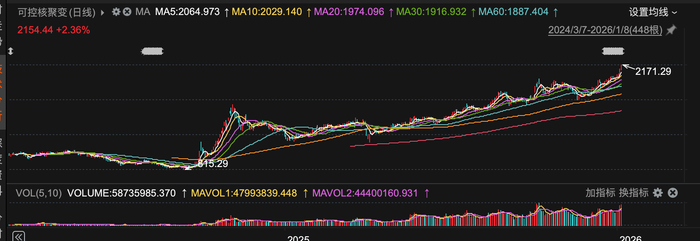
Core Insights - The latest development in the nuclear fusion sector is marked by the successful operation of the world's first fully high-temperature superconducting tokamak, Honghuang 70, which achieved a stable long-pulse plasma operation for 120 seconds during its 5319th experiment [1][2][3]. Company Developments - Energy Singularity, the company behind Honghuang 70, claims that this experiment demonstrates the device's reliability and stability for long-pulse operation, validating the engineering feasibility of high-temperature superconducting tokamaks [1][2]. - The Honghuang 70 device is noted for being the first commercial nuclear fusion device developed by a private company, with a domestic production rate exceeding 96% [5]. - Future plans include the development of a compact high-temperature superconducting tokamak prototype, Honghuang 170, aimed at achieving the lowest cost for net energy gain from deuterium-tritium fusion [4][5]. Industry Trends - The nuclear fusion sector is experiencing a surge in interest, as evidenced by a 2.36% increase in the controllable nuclear fusion index as of January 8, with a cumulative increase of 52.5% for the year [7]. - Over 70% of stocks in the controllable nuclear fusion sector saw gains, with several companies reaching their daily limit up [8][9]. - The successful experiment is expected to prompt a reevaluation of the maturity and commercialization timeline of fusion technology by international capital and industry [14]. Technological Context - Nuclear fusion is considered the "ultimate energy" source due to its abundant raw materials and lack of pollution emissions [15]. - The high-temperature superconducting tokamak is highlighted as the only fusion energy solution that meets the criteria of scientific robustness, engineering feasibility, and commercial cost-effectiveness [15]. - Current fusion technology routes include magnetic confinement fusion, with tokamaks being a prominent design, often referred to as "artificial suns" [15][16].

186亿,“人造太阳”最大单轮融资来了
3 6 Ke· 2025-09-05 03:19
Group 1: Core Insights - Google has signed an unprecedented power purchase agreement with Commonwealth Fusion Systems (CFS) to procure 200 megawatts of electricity from its first commercial fusion plant, ARC, marking the largest fusion energy purchase agreement globally [1] - CFS has raised a total of $2.663 billion in its B round financing, setting a record for the largest single round of financing in the fusion sector, with notable investors including Google, Nvidia, and Bill Gates' Breakthrough Energy Ventures [1][2] - CFS's total funding has surpassed $3 billion, accounting for one-third of the global fusion industry's total financing, and its valuation has reached approximately $8 billion [1] Group 2: Technological Advancements - The 2020s have seen significant advancements in fusion technology, including high-temperature superconductors and AI control systems, which have reduced the size and cost of fusion devices [5] - CFS's innovative high-temperature superconducting magnet technology has allowed for a significant reduction in the size of fusion reactors, from "the size of a stadium" to 1/60 of that size [14][15] Group 3: Market Dynamics - Major tech companies are investing in fusion energy due to the increasing energy demands of data centers, which are projected to double by 2030, driven primarily by AI [10] - The global push for carbon neutrality has created a favorable environment for fusion energy, as it offers a stable, zero-carbon power source [10][11] Group 4: Global Competition - The race for fusion energy is intensifying globally, with various companies exploring different fusion approaches, such as Helion's magnetic inertial fusion and TAE Technologies' efforts in the field [16][17] - China is also making significant strides in fusion research, with its EAST facility achieving a world record for sustained plasma operation, and plans for a domestic fusion engineering experimental reactor [19][20] Group 5: Future Outlook - The fusion industry is optimistic about achieving commercial viability by the mid-2030s, with over 70% of private companies believing that fusion can achieve grid connection by then [18] - The path to commercialization is expected to be challenging, requiring breakthroughs in technology, engineering, and supply chain management [23][24]