高温超导托卡马克

Search documents
核聚变产业进度分享
2026-03-30 05:15
Summary of Fusion Industry Conference Call Industry Overview - The conference call focused on the **nuclear fusion industry**, particularly advancements in high-temperature superconducting tokamaks and other fusion technologies [1][2][3]. Key Points and Arguments Technological Advancements - High-temperature superconducting tokamaks are identified as a **deterministic trend**, with magnetic field strength improvements potentially leading to a **fourfold increase** in device performance, significantly reducing size and cost [1]. - The **superconducting magnet** is a core value component, accounting for **40%-50%** of total investment, with **REBCO high-temperature superconducting tape** being the most critical cost item [1][13]. - The **stellarator route** shows potential for long-pulse steady-state operation, especially with breakthroughs in domestic 3D manufacturing technology, positioning it as a potential competitor to tokamaks [1]. Commercialization Progress - Overseas private companies have ambitious goals for power generation by **2030**, which may be overly optimistic, while the domestic **BEST device** is expected to achieve plasma discharge around **2028-2029** [1][2][12]. - The evolution of the technical path follows a clear sequence: **plasma discharge** -> **deuterium-tritium combustion experiments (BEST/ITER)** -> **demonstration reactors (DEMO)** -> **commercial power plants** [1][3]. Key Projects and Timelines - The period from **2026 to 2029** is anticipated to be a peak for nuclear fusion device tenders, with projects like **BEST** and **Honghuang 170** expected to reach scales of **1 billion to 10 billion** [1][12]. - The **BEST project** has already released over **2 billion yuan** in tenders, with future tenders expected to reach several billion [12]. Industry Dynamics - Domestic capabilities in high-precision component manufacturing and a low-cost industrial chain provide a competitive advantage in areas such as magnets, vacuum chambers, heating, and cryogenic systems [1][10]. - The **commercialization potential** of various routes, including the stellarator, is highlighted, with the latter benefiting from the advantages of tokamak technology while also presenting unique engineering challenges [5][8]. Investment and Financing Environment - Domestic private fusion companies have secured financing in the range of **hundreds of millions to billions**, often backed by government support [11]. - The optimistic timelines proposed by U.S. commercial fusion companies may contain elements of **bubble** due to the challenges of execution and the complexity of fusion systems [12]. Additional Important Insights - The **Lawson criterion**, which measures the ability to maintain fusion reactions, is a critical standard for evaluating technology routes, with traditional low-temperature superconducting tokamaks currently being the most mature [5][6]. - The **REBCO tape** is a significant cost driver within the superconducting magnet category, with domestic companies actively developing this technology [14]. - The potential for shared systems across different fusion technologies, such as superconducting magnets and heating systems, indicates a level of interoperability that could benefit the industry as a whole [14]. This summary encapsulates the key discussions and insights from the conference call, providing a comprehensive overview of the current state and future prospects of the nuclear fusion industry.
全球首个!上海“人造太阳”又破纪录了 | 国家未来产业地图
Xin Lang Cai Jing· 2026-02-02 10:52
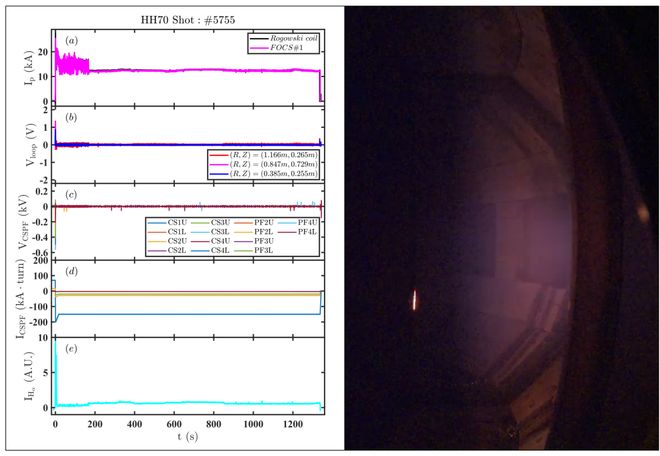
Core Insights - The article discusses the recent advancements in controlled nuclear fusion technology, specifically highlighting the achievements of the commercial company Energy Singularity with its "Honghuang 70" high-temperature superconducting tokamak, which successfully achieved a steady-state long pulse plasma operation lasting 1337 seconds [1][4]. Group 1: Company Achievements - Energy Singularity's "Honghuang 70" is the first commercially developed tokamak to achieve a long pulse plasma operation exceeding 1000 seconds, marking a significant milestone in nuclear fusion research [1][4]. - The tokamak's recent experiments have demonstrated the effectiveness of AI-based plasma feedback control technology, which has improved plasma operation capabilities [8]. - The company aims to develop the "Honghuang 170," a compact high-temperature superconducting tokamak, which is intended to be the world's lowest-cost device capable of achieving net energy gain from deuterium-tritium fusion [8][9]. Group 2: Technical Details - The "Honghuang 70" was built with over 96% domestic components and represents a significant step in China's nuclear fusion capabilities, being the first fully superconducting tokamak developed by a commercial entity [9]. - The tokamak's performance is evaluated based on key physical parameters, including plasma current, temperature, density, and the fusion triple product, which is crucial for determining the feasibility of achieving ignition conditions [4][5]. - The article notes that the current mainstream technology for controlled nuclear fusion is the tokamak, with other notable devices like EAST and "Chinese Circulation No. 3" also utilizing this technology [10]. Group 3: Industry Context - Shanghai has positioned nuclear fusion energy as a key focus area for technological advancement and future industry development, with a relatively complete and diverse technological route for the nuclear fusion industry chain [11]. - Other companies in the sector, such as Xinghuan Fusion and Honghu Fusion, are exploring different routes within magnetic confinement fusion, indicating a competitive landscape in China's nuclear fusion industry [11].

全球商业化核聚变装置首次实现百秒运行
Xin Lang Cai Jing· 2026-01-08 13:10
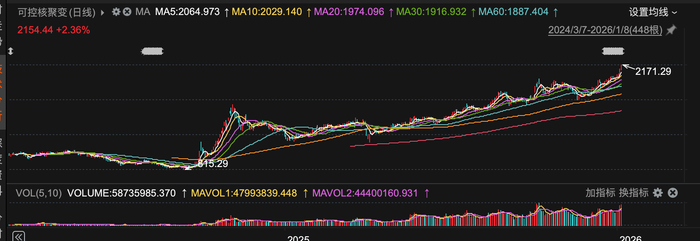
Core Insights - The latest development in the nuclear fusion sector is marked by the successful operation of the world's first fully high-temperature superconducting tokamak, Honghuang 70, which achieved a stable long-pulse plasma operation for 120 seconds during its 5319th experiment [1][2][3]. Company Developments - Energy Singularity, the company behind Honghuang 70, claims that this experiment demonstrates the device's reliability and stability for long-pulse operation, validating the engineering feasibility of high-temperature superconducting tokamaks [1][2]. - The Honghuang 70 device is noted for being the first commercial nuclear fusion device developed by a private company, with a domestic production rate exceeding 96% [5]. - Future plans include the development of a compact high-temperature superconducting tokamak prototype, Honghuang 170, aimed at achieving the lowest cost for net energy gain from deuterium-tritium fusion [4][5]. Industry Trends - The nuclear fusion sector is experiencing a surge in interest, as evidenced by a 2.36% increase in the controllable nuclear fusion index as of January 8, with a cumulative increase of 52.5% for the year [7]. - Over 70% of stocks in the controllable nuclear fusion sector saw gains, with several companies reaching their daily limit up [8][9]. - The successful experiment is expected to prompt a reevaluation of the maturity and commercialization timeline of fusion technology by international capital and industry [14]. Technological Context - Nuclear fusion is considered the "ultimate energy" source due to its abundant raw materials and lack of pollution emissions [15]. - The high-temperature superconducting tokamak is highlighted as the only fusion energy solution that meets the criteria of scientific robustness, engineering feasibility, and commercial cost-effectiveness [15]. - Current fusion technology routes include magnetic confinement fusion, with tokamaks being a prominent design, often referred to as "artificial suns" [15][16].