Eve语音助手

Search documents
a16z 终于把 AI 的投资逻辑说清楚了,真正值钱的,只剩这三条路
3 6 Ke· 2026-01-20 11:46
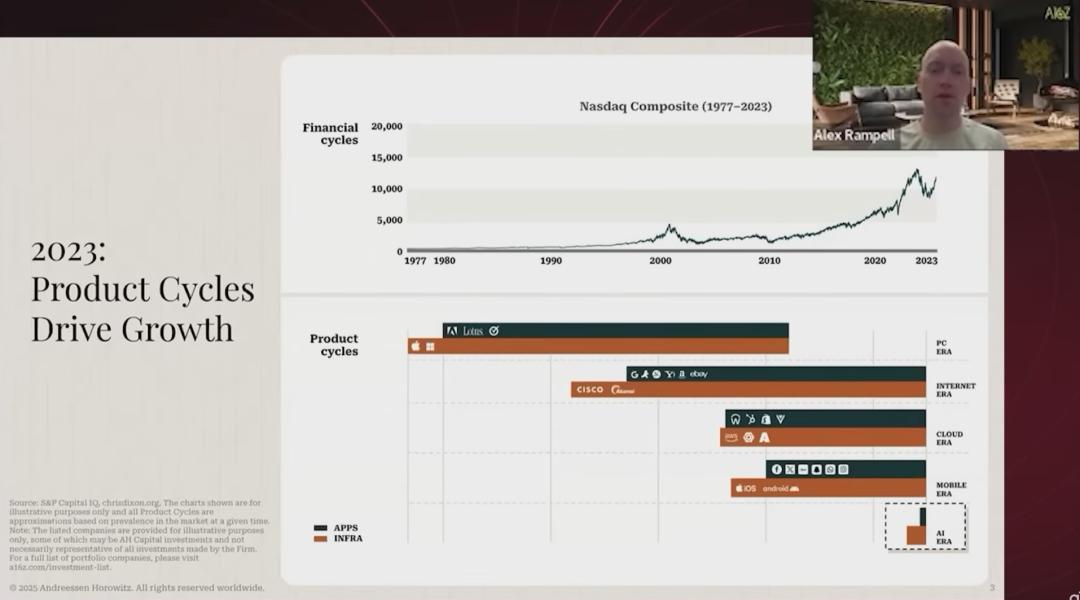
Core Insights - The article discusses the transformative impact of AI on various industries, emphasizing the need for sustainable business value as technology matures. It highlights the shift in competitive advantages towards application and data layers in a landscape where software can be rapidly replicated [1][4][19]. Investment Directions - Three promising investment areas are identified: 1. AI-native transformation of traditional software 2. Software replacing labor 3. Value reconstruction based on exclusive data [1][8][19]. AI and Human Needs - The article posits that AI aligns with the fundamental human desires to be "richer and lazier," which is driving its adoption across sectors. Approximately 15% of adults globally use ChatGPT weekly, indicating its integration into daily life [2][4][5]. Product Lifecycle and Market Dynamics - Historical product cycles reveal that infrastructure companies pave the way for application teams to develop real products. The current AI boom is seen as a continuation of this trend, with significant revenue growth in the software sector attributed to AI [2][4]. AI-native Transformation - Traditional software is undergoing AI-native transformation, creating investment opportunities. Companies like Mercury exemplify this shift by providing integrated banking and accounting services for startups [8][10]. Labor Replacement by Software - AI's potential to replace labor is highlighted as a significant market opportunity. Software can now perform up to 90% of core job functions, making it a viable alternative to human employees [9][10]. Data as a Competitive Advantage - The article emphasizes the importance of proprietary data as a competitive barrier. Companies that can create unique data ecosystems will have a significant edge in the market [15][19][20]. "Walled Garden" Concept - The "walled garden" concept is introduced, where companies like OpenAI transition from providing foundational models to developing end-user applications, creating exclusive data value [19][20]. Case Studies of Unique Data Value - Examples such as Flight Aware and Ancestry.com illustrate how companies leverage unique data to create competitive advantages. These firms have built proprietary databases that are difficult for competitors to replicate [20][21][22]. Market Expansion through AI - AI is seen as a tool to expand market opportunities, particularly in sectors like legal services, where it can lower the barriers for lawyers to take on more cases [11][14][25]. Conclusion - The article concludes that the future of AI will not only involve replacing human labor but also enhancing human efficiency, creating new job roles, and establishing strong data-driven business models [16][24].