围墙花园

Search documents
a16z终于把AI的投资逻辑说清楚了!真正值钱的,只剩这三条路
创业邦· 2026-01-21 10:19
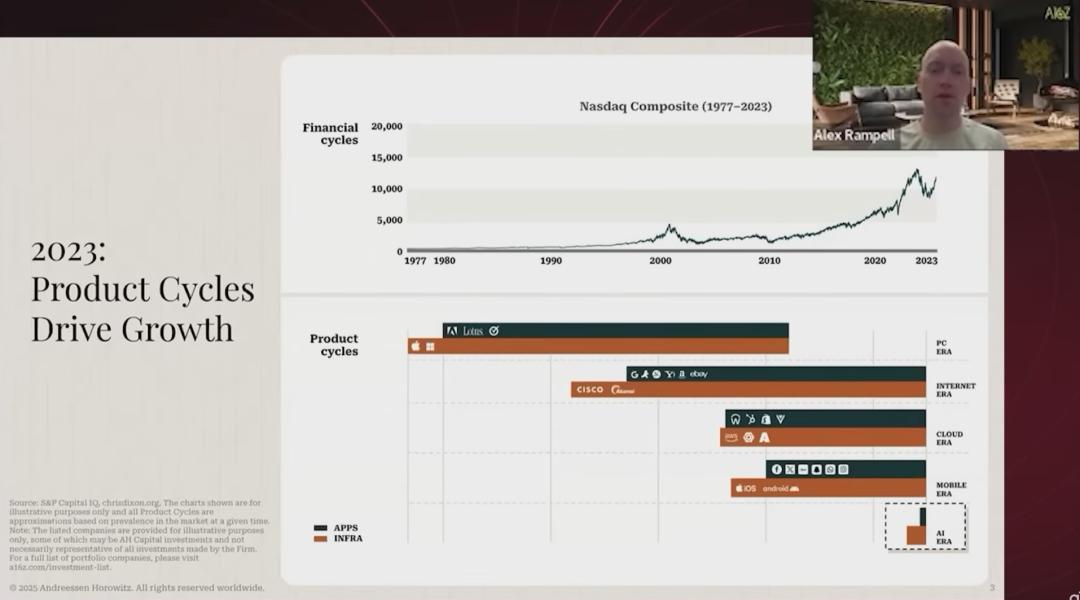
Core Insights - The article discusses the transformative impact of AI on various industries, emphasizing the need for sustainable business value as technology matures [5][7] - It highlights three key investment areas in AI: the native transformation of traditional software, the replacement of labor by software, and the reconstruction of value based on exclusive data [6][7] Investment Directions - Traditional software is undergoing a native transformation to incorporate AI, creating significant investment opportunities [18] - Software is increasingly replacing labor, representing a much larger market potential, as AI can perform up to 90% of core job functions [19][21] - The concept of "walled gardens" is crucial, where companies create exclusive data assets that provide competitive advantages [30][32] AI and Human Needs - AI meets the fundamental human desires of becoming wealthier and lazier, which is driving its adoption and integration into daily life [8][15] - The growth of AI applications is evident, with approximately 15% of adults globally using ChatGPT weekly, indicating a shift in user behavior [11] Product Lifecycle and Market Dynamics - Historical product cycles show that infrastructure companies pave the way for application teams to develop actual products, with AI now being the primary source of new revenue in software [9][11] - Companies that successfully integrate AI into their operations can achieve rapid revenue growth, as seen in examples like RAMP [15] Competitive Advantages - The true competitive barriers in the AI landscape are shifting towards application and data layers, as foundational AI models become increasingly standardized [18][28] - Companies that can build and maintain unique data advantages will be better positioned in the market, as seen in the legal sector with firms like Eve [21][25] Data as a Competitive Barrier - Exclusive data assets create significant competitive advantages, as demonstrated by companies like Flight Aware and Ancestry.com, which leverage unique datasets to enhance their offerings [33][35] - The transformation of public data into proprietary assets through AI can exponentially increase value, as companies learn to monetize previously free resources [39][40]


a16z 终于把 AI 的投资逻辑说清楚了,真正值钱的,只剩这三条路
3 6 Ke· 2026-01-20 11:46
Core Insights - The article discusses the transformative impact of AI on various industries, emphasizing the need for sustainable business value as technology matures. It highlights the shift in competitive advantages towards application and data layers in a landscape where software can be rapidly replicated [1][4][19]. Investment Directions - Three promising investment areas are identified: 1. AI-native transformation of traditional software 2. Software replacing labor 3. Value reconstruction based on exclusive data [1][8][19]. AI and Human Needs - The article posits that AI aligns with the fundamental human desires to be "richer and lazier," which is driving its adoption across sectors. Approximately 15% of adults globally use ChatGPT weekly, indicating its integration into daily life [2][4][5]. Product Lifecycle and Market Dynamics - Historical product cycles reveal that infrastructure companies pave the way for application teams to develop real products. The current AI boom is seen as a continuation of this trend, with significant revenue growth in the software sector attributed to AI [2][4]. AI-native Transformation - Traditional software is undergoing AI-native transformation, creating investment opportunities. Companies like Mercury exemplify this shift by providing integrated banking and accounting services for startups [8][10]. Labor Replacement by Software - AI's potential to replace labor is highlighted as a significant market opportunity. Software can now perform up to 90% of core job functions, making it a viable alternative to human employees [9][10]. Data as a Competitive Advantage - The article emphasizes the importance of proprietary data as a competitive barrier. Companies that can create unique data ecosystems will have a significant edge in the market [15][19][20]. "Walled Garden" Concept - The "walled garden" concept is introduced, where companies like OpenAI transition from providing foundational models to developing end-user applications, creating exclusive data value [19][20]. Case Studies of Unique Data Value - Examples such as Flight Aware and Ancestry.com illustrate how companies leverage unique data to create competitive advantages. These firms have built proprietary databases that are difficult for competitors to replicate [20][21][22]. Market Expansion through AI - AI is seen as a tool to expand market opportunities, particularly in sectors like legal services, where it can lower the barriers for lawyers to take on more cases [11][14][25]. Conclusion - The article concludes that the future of AI will not only involve replacing human labor but also enhancing human efficiency, creating new job roles, and establishing strong data-driven business models [16][24].
苹果失去“围墙花园”,现在是时候大力卖出了!
美股研究社· 2025-03-31 11:04
Core Viewpoint - Apple's stock price has declined over 11% this year and nearly 7% in the past month, primarily due to the weakening of its ecosystem moat, which is impacting its financial performance [1]. Group 1: Sales and Financial Performance - iPhone 16 sales have dropped significantly, with a year-on-year decline of 21% in the Chinese market during the second quarter [2]. - The services segment, which has been a key growth driver for Apple, is now facing serious risks due to the weakening ecosystem [3][6]. - The company's forward PE ratio has fluctuated, with a notable increase to 29.94 for 2024, indicating a high valuation despite declining fundamentals [4]. Group 2: Competitive Landscape - Competitors are innovating beyond Apple, which is lagging in the AI space and facing challenges with its new features [5]. - Analysts express concerns over Apple's ability to maintain its default search engine arrangement with Google, which is valued at approximately $20 billion annually, representing 20% of its service revenue [8][7]. Group 3: Revenue Risks - The total service revenue is around $100 billion, with the Google search deal and app store fees potentially at risk, totaling about $50 billion, which constitutes 50% of service revenue [12][13]. - The EU's requirement for Apple to allow third-party app stores could further threaten its revenue streams and ecosystem integration [10][11]. Group 4: Valuation Concerns - Apple's high valuation is increasingly difficult to justify given the risks to its service revenue, with a current non-GAAP PE ratio of 30.54, significantly higher than the industry median of 22.10 [13]. - The expected price drop of approximately 27.63% is suggested if the stock were to trade at the industry median PE ratio [15]. Group 5: Long-term Outlook - Despite the challenges, Apple remains a strong brand with a loyal customer base, which may help mitigate some risks [15]. - The potential for a rebound in iPhone sales exists due to a delayed upgrade cycle, but the company faces significant threats to its ecosystem that could impact future revenue growth [16][17].