Exynos 2800

Search documents
三星,推迟1.4nm
半导体芯闻· 2026-03-26 10:51
Core Viewpoint - Samsung Electronics is set to complete the design of its next-generation mobile application processor (AP) "Exynos 2800" by the end of this year, utilizing a 2nm process technology to ensure stability in development and yield [1][2]. Group 1: Exynos 2800 Development - The Exynos 2800, codenamed "Vanguard," is being developed with a target for tape-out by the end of this year, which marks the completion of the chip design and the handover for manufacturing [1]. - The design of Exynos 2800 will follow the naming convention based on existing mountain names, continuing from previous models like Exynos 2500 to 2700 [1]. Group 2: Process Technology - Exynos 2800 will utilize Samsung's most advanced 2nm process technology, specifically an improved version of the second-generation 2nm process (SF2P+) [2]. - The SF2P process offers a 12% performance increase, a 25% reduction in power consumption, and an 8% decrease in area compared to the first-generation 2nm process (SF2) [2]. - The decision to focus on the SF2P+ process instead of aggressively pursuing the 1.4nm process (SF1.4), which has been delayed by about two years, reflects a strategic shift towards optimizing yield stability [2]. Group 3: Industry Insights - Industry insiders indicate that it is no longer realistic for Samsung to continue annual advancements in process technology for mobile APs, leading to a focus on Design Technology Co-Optimization (DTCO) as a viable alternative [3].

三星电子加速GPU自主化布局,2027年Exynos芯片将搭载自研图形IP
Huan Qiu Wang· 2025-12-26 03:11
Core Insights - Samsung Electronics is advancing its self-developed graphics processing unit (GPU) with a target to integrate its proprietary graphics IP into the Exynos 2800 application processor by 2027, marking a significant step in its core chip technology autonomy [1][3] Group 1: Development Strategy - The current mid-to-high-end mobile application processors utilize the Xclipse GPU, which is based on AMD's RDNA architecture. Transitioning to fully self-developed GPUs will reduce reliance on external partners and enhance Samsung's autonomy in GPU functionality upgrades and feature iterations [3] - Samsung's self-developed GPU will initially target smartphones and gradually expand into consumer electronics and smart devices such as smart glasses and robots, while also covering automotive system-on-chip (SoC) scenarios [3] Group 2: Market Expansion - The company plans to enter the artificial intelligence application-specific integrated circuit (AI ASIC) market, aiming to build a multi-domain, all-scenario technology application ecosystem [3]
三星将自研GPU
半导体行业观察· 2025-12-26 01:57
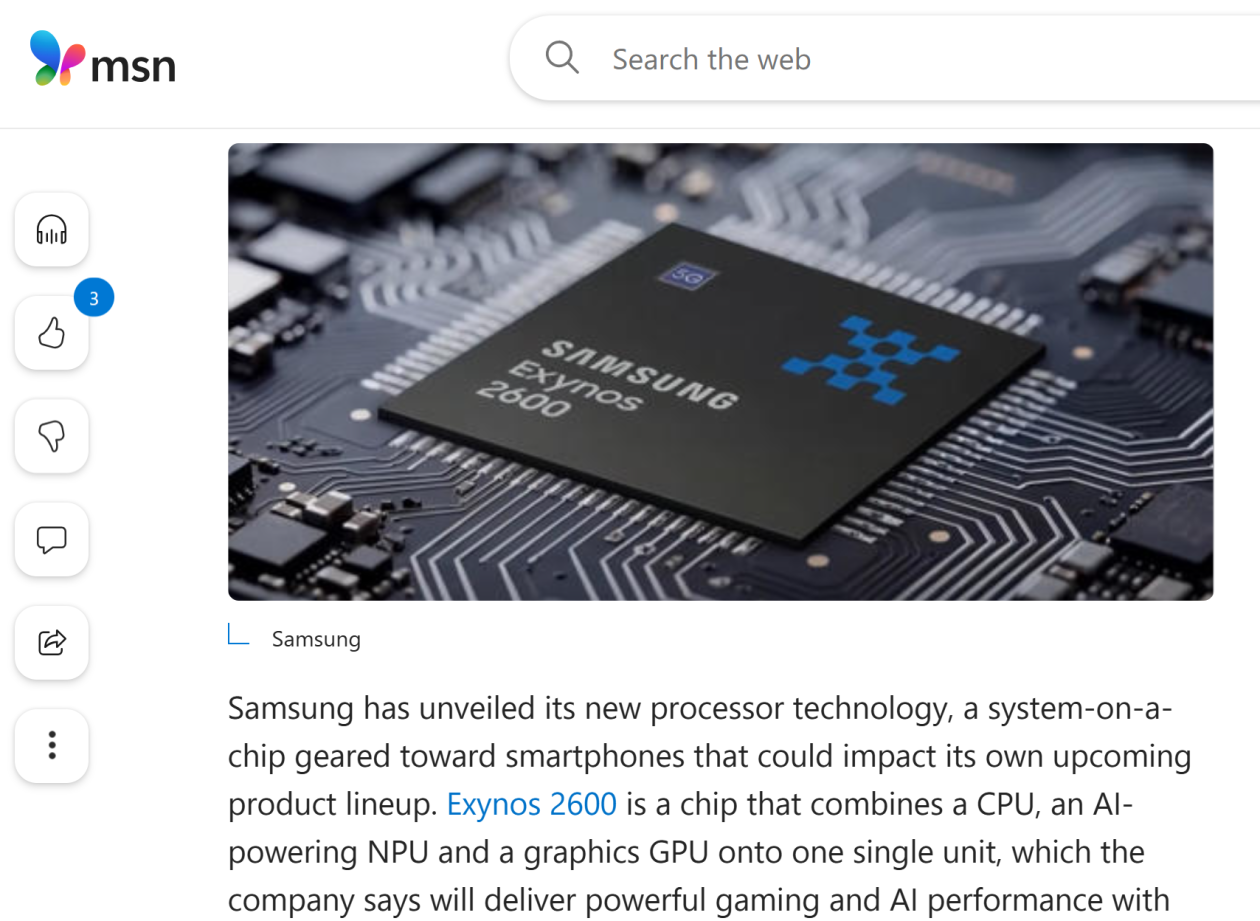
Core Viewpoint - Samsung Electronics plans to release the Exynos 2800 application processor (AP) in 2027, featuring a self-developed graphics processing unit (GPU) that is crucial for AI computing and graphics processing in mobile devices [1][3]. Group 1: GPU Development and Market Position - Samsung's internalization of GPU development is driven by the increasing importance of GPUs in the AI era, which are essential for graphics and AI computations in devices [2][4]. - The company aims to ensure a timely supply of customized GPUs optimized for Galaxy smartphones and other devices, enhancing its competitiveness in the IT sector [2][3]. - Samsung's self-designed GPU architecture positions it among "fabless AI semiconductor" companies, with plans to integrate the proprietary GPU into various applications, including smart glasses and autonomous vehicles [2][5]. Group 2: Strategic Partnerships and Talent Acquisition - Samsung has established a technical partnership with AMD to acquire core GPU architecture technology, recognizing the need to reduce reliance on external suppliers [3][4]. - The company has focused on recruiting GPU experts, with salaries for these positions ranging from 300 million to 1 billion Korean Won, indicating a significant investment in talent acquisition [2][5]. Group 3: Future Applications and Market Strategy - The self-developed GPU will be integrated into Samsung's AI ecosystem, starting with AI smartphones and expanding to key platforms like autonomous vehicle infotainment systems and humanoid robots [5]. - Samsung's semiconductor division is making strides in design capabilities, with recent contracts for AI chip supplies to Tesla and Apple, indicating a growing presence in the semiconductor market [5].