
ForeFlight

Search documents
波音复苏现曙光
Bei Jing Shang Bao· 2025-07-30 15:19
Core Viewpoint - Boeing is showing signs of recovery as quarterly losses narrow significantly and sales revenue increases, following a series of positive developments that are restoring investor confidence [1][3]. Financial Performance - Boeing's Q2 revenue reached $22.75 billion, up 35% from $16.87 billion in the same period last year [3]. - The net loss for Q2 was $612 million, a substantial improvement from a loss of $1.439 billion in the previous year [3]. - The company consumed only $200 million in cash over three months, far below analysts' expectations of $1.8 billion [3]. - The commercial airplanes division saw an 81% revenue increase to $10.87 billion, while the defense and space division grew 10% to $6.6 billion [3]. Orders and Deliveries - Boeing's order volume surged to 625 aircraft in the first half of the year, with a backlog of $619 billion, including $522 billion worth of over 5,900 commercial aircraft orders [3]. - In Q2, Boeing received 455 new commercial aircraft orders, including significant orders from Qatar Airways and British Airways [3]. - Commercial aircraft deliveries increased by 63% year-over-year, totaling 280 aircraft in the first half of the year, the highest since 2018 [4]. Production and Operational Improvements - Boeing has increased the monthly production rate of the 737 Max to 38 units, adhering to FAA limits set after a safety incident [4]. - The company aims to achieve positive cash flow by Q4 and has sold part of its digital aviation solutions business for $10.55 billion to alleviate financial pressure [7][8]. Challenges and Strategic Moves - Boeing has faced significant challenges, including safety incidents and labor strikes, leading to a net loss of $11.82 billion in 2024 [5]. - The company has been forced to seek additional funding sources due to ongoing losses, which have totaled $35.685 billion since 2019 [8]. - Boeing's reliance on foreign suppliers for 80% of its commercial aircraft and components poses ongoing risks, especially in light of tariff issues affecting deliveries to China [6][8].


航空航天与国防板块引领Q2全球并购回暖,下半年有望继续发力
智通财经网· 2025-07-28 02:05
Group 1 - The core viewpoint of the article highlights a significant rebound in M&A activity in the aerospace, defense, and government services sectors, driven by large transactions and strategic buyers, while financial sponsors are retreating due to tightening credit conditions [1][2] - Global M&A transaction volume increased by 13% in Q2 compared to the previous quarter, primarily due to a 180% rise in large transactions valued over $1 billion, while medium-sized transactions (under $100 million) also grew by 18% [2] - Strategic acquirers, particularly public companies, regained dominance in the market, with U.S. acquisitions of public companies increasing by 75% and global acquisitions rising by 64% [2] Group 2 - The aerospace and defense sectors led the growth in global M&A activity, with transaction values increasing by 24% and 55% respectively [2] - Aerospace transactions in the U.S. grew by 27% year-over-year, while defense transactions increased by 37% [2] - The aerospace components sub-sector remained the most active, with maintenance, repair, and overhaul services following closely, showing a 50% revenue growth [3] Group 3 - Notable transactions in Q2 included Boeing's divestiture of its digital aviation solutions business valued at $10.55 billion and Motorola Solutions' proposed acquisition of Silvus Technologies for $4.4 billion [4] - In the government technology sector, significant transactions included HIG Capital's acquisition of Converge Technology Solutions for $910 million and Leidos' acquisition of Kudu Dynamics for $300 million [6] Group 4 - The public valuation of the industry remains strong, with government service companies like Booz Allen and Leidos having an enterprise value to EBITDA multiple of 11.0 times, while diversified engineering companies hover around 13.8 times [8] - Aerospace original equipment manufacturers have particularly high valuations, with expected P/E ratios exceeding 20 times for companies like Safran, Rolls-Royce, and GE Aerospace, reflecting investor confidence in long-term aerospace demand [8] Group 5 - Strategic investors, especially well-capitalized public companies, are expected to continue leading the transaction process in the second half of 2025, with aerospace and defense assets, particularly those related to modernization, maintenance, and national security technology, remaining hot targets [8]
波音继续卖资产
Bei Jing Shang Bao· 2025-04-24 15:15
Core Viewpoint - Boeing is facing significant financial challenges and has opted to sell its digital aviation solutions business for $10.55 billion to alleviate financial pressure, while also grappling with the impact of tariffs and declining orders [2][3][4]. Financial Performance - Boeing's revenue for 2024 is projected at $66.5 billion, which is only 65% of its peak revenue of $101.1 billion in 2018 [4]. - The company reported a net loss of $11.829 billion for 2024, marking a significant increase from 2023 and ranking as the second-largest loss in its history, following the pandemic-affected year of 2020 [4]. - Boeing has experienced six consecutive years of losses from 2019 to 2024, accumulating a total net loss of $36 billion [4]. Asset Sale - The sale of the digital aviation solutions business includes assets like Jeppesen and ForeFlight, which provide navigation tools and flight planning services [3]. - Boeing will retain its core digital capabilities related to aircraft and fleet data for commercial and defense clients [3]. - The transaction is expected to be completed by the end of 2025 [3]. Order and Delivery Challenges - Boeing's net orders for commercial aircraft in 2024 are only 287, with 169 cancellations, primarily affecting the 737 Max series [4]. - The company aims to deliver between 20 to 30 737 aircraft in April and approximately 400 aircraft for the entire year [6]. Tariff Impact - The U.S. government's imposition of "reciprocal tariffs" has led to increased costs for Boeing, particularly affecting its supply chain for the 787 Dreamliner, which relies on international components [5][6]. - China has announced a significant increase in tariffs on U.S. imports, including Boeing aircraft, which will rise from 5% to nearly 40% starting April 10, 2025 [8]. - As a result of these tariffs, Chinese airlines have begun to suspend the acceptance of new Boeing aircraft deliveries [8][9]. Market Response - The CEO of Ryanair has indicated that if tariffs lead to increased prices for Boeing aircraft, the airline may consider delaying aircraft deliveries [7]. - Boeing's CEO has acknowledged the impact of the trade war on Chinese orders and mentioned the possibility of seeking alternative buyers if Chinese airlines do not accept the aircraft due to high tariffs [9][10].
Boeing Preps For A Rough Q1 Takeoff - But $10.55 Billion Cash Deal Could Provide A Soft Landing
Benzinga· 2025-04-22 18:48
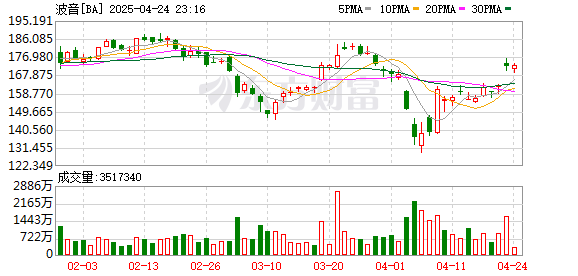
Core Insights - Boeing is facing significant challenges, with shares down nearly 7% year-to-date and an 11% drop in the past month, while Wall Street forecasts a $1.25 per-share loss for the first quarter [1][2] - The company announced a $10.55 billion all-cash deal to sell parts of its Digital Aviation Solutions business to Thoma Bravo, which includes key assets like Jeppesen and ForeFlight, expected to close by the end of 2025 [2][3] - This asset sale is part of Boeing's strategy to focus on core businesses, improve its balance sheet, and maintain an investment-grade credit rating [2][3] Financial Performance - Boeing's stock has been under pressure, with technical indicators showing a bearish trend despite a slight boost from the recent deal [4] - The average consensus price target for Boeing is $199.68, but recent analyst ratings suggest a target of $146.33, indicating a potential 8.6% downside from current levels [5] Market Sentiment - The recent asset sale is seen as a move to restore investor confidence amid ongoing production setbacks and cash flow issues [3][5] - Technical indicators such as the 20-day, 50-day, and 200-day simple moving averages are signaling negative momentum, with a MACD of negative 2.55 and a Relative Strength Index of 49.22 suggesting the stock is in a neutral position [4]
Boeing to Sell Portions of Digital Aviation Solutions to Thoma Bravo for $10.55 Billion
Prnewswire· 2025-04-22 13:00
Core Transaction Details - Boeing has entered into a definitive agreement to sell parts of its Digital Aviation Solutions business, including Jeppesen, ForeFlight, AerData, and OzRunways, to Thoma Bravo for $10.55 billion in cash [1] - The transaction is expected to close by the end of 2025, pending regulatory approval and customary closing conditions [5] Strategic Focus - Boeing will retain core digital capabilities that utilize aircraft and fleet-specific data for maintenance, diagnostics, and repair services, ensuring continued predictive maintenance insights for customers [2] - The transaction aligns with Boeing's strategy to focus on core businesses, enhance the balance sheet, and prioritize maintaining an investment-grade credit rating [3] Management Insights - Boeing's leadership emphasizes the importance of this transaction in allowing different parts of the digital portfolio to concentrate on their strengths while continuing to meet customer needs [4] - Thoma Bravo expresses confidence in the growth potential of the acquired assets, highlighting the historical significance of Jeppesen in technological innovation within the aerospace and defense industry [4] Employee Transition - Approximately 3,900 employees are involved in Boeing's Digital Aviation Solutions organization, with efforts being made to ensure a smooth transition for employees during the sale [4] Company Backgrounds - Boeing is a leading global aerospace company and a top U.S. exporter, involved in the development, manufacturing, and servicing of commercial airplanes, defense products, and space systems [6] - Thoma Bravo is one of the largest software-focused investors globally, managing over $179 billion in assets and having a strong track record in backing technology companies [7]