Fusion Cloud ERP

Search documents
Oracle Q3 Earnings Beat Estimates, Cloud Growth Fuels Revenues
ZACKS· 2026-03-11 14:35
Core Insights - Oracle reported strong financial results for Q3 fiscal 2026, with non-GAAP earnings of $1.79 per share, exceeding estimates by 5.29% and showing a 21% year-over-year increase in dollar terms [2][11] - Total revenues reached $17.2 billion, surpassing consensus estimates by 1.77% and growing 22% year-over-year, driven by significant growth in cloud infrastructure [3][11] Financial Performance - Cloud Infrastructure revenues surged 84% year-over-year to $4.9 billion, reflecting increased demand for AI workloads and multicloud solutions [5][11] - Total cloud revenues (SaaS plus IaaS) increased 44% year-over-year to $8.9 billion, now accounting for 52% of Oracle's overall revenues [6] - Non-GAAP operating income rose 19% year-over-year to $7.4 billion, with a non-GAAP operating margin of 43% [9] Remaining Performance Obligations - Remaining Performance Obligations (RPO) reached $553 billion, a 325% increase from the previous year, primarily due to large-scale AI contracts [4][11] Strategic Developments - Oracle acquired a 15% equity stake in TikTok U.S., which will impact financial results in Q4 fiscal 2026 [15] - The company deployed over 1,000 embedded AI agents in its applications, enhancing its AI capabilities [16] - Significant customer migrations to Oracle Fusion Cloud solutions were noted, including major organizations in various sectors [17] Guidance and Future Outlook - For Q4 fiscal 2026, Oracle expects total cloud revenue growth between 44% to 48% in constant currency and 46% to 50% in USD [19] - For fiscal 2027, total revenue guidance was raised to $90 billion, reflecting confidence in ongoing AI-driven demand [20]



Oracle Q3 FY26 net income rises 27% as cloud revenue accelerates
Yahoo Finance· 2026-03-11 09:50
Core Insights - Oracle reported a 27% year-on-year increase in net income for Q3 FY26, rising to $3.7 billion from $2.9 billion in the same period last year [1] Financial Performance - Basic earnings per share increased to $1.29 from $1.05, while diluted earnings per share rose to $1.27 from $1.02 [2] - Non-GAAP net income reached $5.2 billion, up 23% in US dollars and 18% in constant currency, with non-GAAP earnings per share at $1.79, representing growth of 21% in US dollars and 16% in constant currency [2] - GAAP earnings per share were $1.27, a 24% increase in US dollars and 16% in constant currency compared to the prior-year quarter [2] Revenue Breakdown - Total revenue for the quarter was $17.2 billion, a 22% increase in US dollars and 18% in constant currency compared to $14.1 billion a year earlier [3] - Cloud revenue reached $8.9 billion, rising 44% in US dollars and 41% in constant currency [3] - Software revenue, excluding cloud, was $6.1 billion, up 3% in US dollars but down 1% in constant currency [4] - Hardware revenue was $714 million, a 2% increase in US dollars and a decline of 2% in constant currency [4] - Services revenue advanced 12% in US dollars to $1.44 billion [4] Cloud Operations - Oracle Cloud Infrastructure (IaaS) generated $4.9 billion in revenue, an 84% increase in US dollars and an 81% increase in constant currency [4] - Cloud applications (SaaS) revenue totaled $4.0 billion, rising 13% in US dollars and 11% in constant currency [5] - Fusion Cloud ERP contributed $1.1 billion, growing 17% in US dollars and 14% in constant currency, while NetSuite Cloud ERP also delivered $1.1 billion, up 14% in US dollars and 11% in constant currency [5] - Oracle Cloud Database (IaaS) revenue expanded by 35%, and revenue from multicloud database services increased by 531% in US dollars [6] Operating Metrics - GAAP operating income for the period was $5.5 billion, while non-GAAP operating income reached $7.4 billion, reflecting a 19% increase year-on-year in US dollars and a 14% rise in constant currency [7] - Total operating expenses were $11.7 billion [7] - Operating cash flow for the trailing twelve months amounted to $23.5 billion, up 13% in US dollars [7] Performance Obligations - Remaining Performance Obligations (RPO) closed the quarter at $553 billion, representing a 325% increase from the previous year and a $29 billion rise from the prior quarter, attributed mainly to large AI-related cloud contracts [8]
Wall Street Breakfast Podcast: Oracle's AI Warning Shot
Seeking Alpha· 2025-12-11 13:27
Oracle - Oracle reported adjusted earnings of $2.26 per share, exceeding the consensus estimate of $1.64, while revenue increased by 14% to $16.06 billion, slightly below expectations [3] - Cloud revenue, which includes infrastructure and applications, rose by 36% to $8 billion, narrowly missing estimates; infrastructure revenue surged by 66% to $4.1 billion, while application revenue grew by 11% to $3.9 billion [3] - A key metric, remaining performance obligations (RPO), surged by 438% to $523 billion, driven by new commitments from major clients like Meta and NVIDIA [4] - Oracle recorded a $2.7 billion pre-tax gain from selling its stake in Ampere, which contributed positively to both GAAP and non-GAAP EPS [5] - The company is shifting towards "chip neutrality," indicating a strategy to work with various CPU and GPU suppliers while continuing to purchase Nvidia GPUs [5] - Analysts noted that Oracle's revenue miss raises concerns about margin compression as revenue growth may slow down [6] SpaceX - Elon Musk confirmed that SpaceX is preparing for a potential IPO, which could occur as early as mid-2026, targeting a valuation between $1 trillion and $1.5 trillion [6][7] - The IPO is expected to support over $30 billion in capital needs for AI-driven projects, including space-based data centers and lunar satellite factories [7] - Musk emphasized that SpaceX has been cash-flow positive for years and primarily uses buybacks for liquidity, with valuation tied to progress on Starlink and Starship [8] Meta - Internal conflicts are emerging within Meta Platforms between the new superintelligence group led by Alexandr Wang and long-standing executives, including product chief Chris Cox and CTO Andrew Bosworth [9][10] - Wang advocates for prioritizing advancements in AI to catch up with competitors like OpenAI and Google, while other executives focus on integrating AI into existing products [11] - Disputes have arisen over resource allocation, with competing teams vying for computing resources to either enhance social media ranking or train AI models [12] - Reports indicate a request for a $2 billion budget cut from Reality Labs to support Wang's team, although Meta's spokesperson disputed this characterization [13]

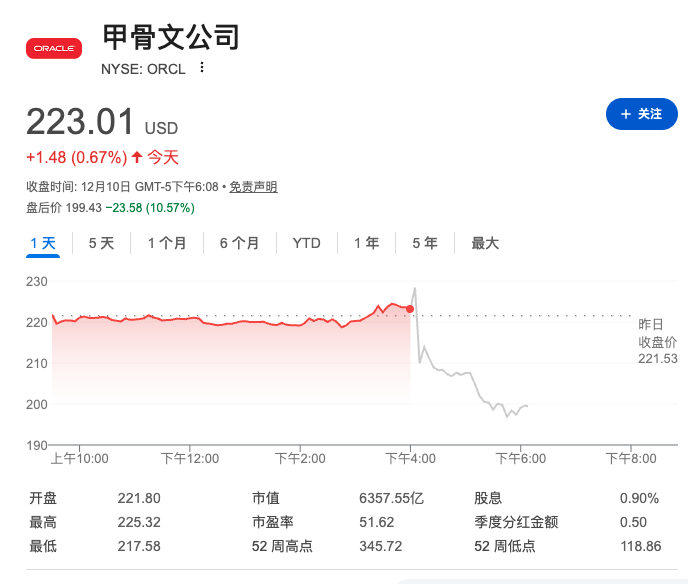
甲骨文业绩不及预期,资本开支比预期多约150亿美元,盘后重挫超10% | 财报见闻
Sou Hu Cai Jing· 2025-12-10 23:21
Core Viewpoint - Oracle's Q2 financial results fell short of analyst expectations, leading to a significant drop in stock price and raising concerns about its ability to convert substantial order backlogs into revenue [3][6][9]. Financial Performance - Remaining Performance Obligation (RPO) increased by 438% year-over-year to $523 billion, exceeding analyst expectations of $519 billion [1]. - Total revenue for Q2 was $16.1 billion, a 14% year-over-year increase, but below the expected $16.21 billion [1]. - GAAP operating income was $4.7 billion, with non-GAAP operating income at $6.7 billion, reflecting a 10% increase year-over-year [1]. - GAAP net income reached $6.1 billion, while non-GAAP net income was $6.6 billion, marking a 57% year-over-year increase [1]. - GAAP earnings per share (EPS) was $2.10, a 91% increase year-over-year, while non-GAAP EPS was $2.26, a 54% increase [1]. Free Cash Flow and Cloud Business - Free cash flow (FCF) for Q2 was -$10 billion, indicating significant cash outflow [2]. - Cloud business revenue (IaaS and SaaS) was $8 billion, a 34% year-over-year increase, but below the expected $8.04 billion [2]. - Cloud infrastructure revenue was $4.1 billion, a 68% year-over-year increase, while cloud applications revenue was $3.9 billion, an 11% increase [4]. Capital Expenditure and Debt - The company plans to increase annual capital expenditures by approximately $15 billion, now expected to reach $50 billion by FY2026 [10]. - Oracle has issued around $18 billion in new investment-grade bonds, with total outstanding debt exceeding $100 billion, making it the largest in debt among investment-grade tech companies [8]. - Adjusted debt could potentially double to about $300 billion by 2028 [8]. Market Concerns and Strategic Direction - Investors are questioning Oracle's ability to convert its large order backlog into revenue amidst rising costs and competition in the AI infrastructure space [6][9]. - The company is under pressure to demonstrate that its significant investments in AI data centers will yield the anticipated revenue growth [6][9]. - Oracle's strategy includes maintaining a "chip neutrality" approach, allowing flexibility in deploying various chips as AI technology evolves [12].
Oracle Q1 Earnings Match Estimates, Cloud Growth Fuels Revenue Rise
ZACKS· 2025-09-10 19:11
Core Insights - Oracle reported first-quarter fiscal 2026 non-GAAP earnings of $1.47 per share, meeting estimates and increasing 6% year over year in USD [1][10] - Revenues rose 12% year over year to $14.9 billion, driven by significant AI cloud contracts [2][10] Revenue Breakdown - Revenues from the Americas increased 15.4% year over year to $9.66 billion, accounting for 64.7% of total revenues [3] - Europe/Middle East/Africa revenues climbed 7.8% to $3.48 billion, contributing 23.3% of total revenues [3] - Asia Pacific revenues increased 4.5% to $1.78 billion, representing 11.9% of total revenues [3] Cloud Revenue Performance - Total cloud revenues surged 28% year over year to $7.2 billion, with cloud infrastructure consumption revenue up 57% [5][10] - Cloud application revenue was $3.8 billion, up 11% year over year [5] - Autonomous Database revenues increased 43% year over year [5] Operating Performance - Non-GAAP operating income was $6.2 billion, up 9% year over year [11] - Total operating expenses increased 14% year over year to $8.69 billion [11] Balance Sheet and Cash Flow - As of August 31, 2025, Oracle had cash and cash equivalents of $11 billion [12] - Operating cash flow was $8.1 billion, up from $7.4 billion in the prior year [12] - Free cash flow was negative $362 million due to $8.5 billion in capital expenditures [12] Future Guidance - For Q2 fiscal 2026, Oracle expects total revenues to grow 12% to 14% in constant currency [15] - Cloud Infrastructure is projected to grow 77% to $18 billion in fiscal 2026 [16] - Capital expenditures are expected to increase to around $35 billion in fiscal 2026 [18]

创·问|PingCAP 刘松:AI 即将重塑数据库,未来为 Agent 而生
3 6 Ke· 2025-07-31 08:31
Core Insights - PingCAP, founded in 2015, is a leading open-source distributed database provider, focusing on delivering stable, efficient, and secure data services to global enterprises, thereby facilitating digital transformation [4][5][29] - The company has served over 4,000 enterprises across more than 45 countries, with its distributed database product TiDB gaining significant traction on GitHub, amassing over 37,000 stars [4][5] - AI is viewed as a transformative force in the database industry, potentially reshaping vendor valuations and competitive dynamics [4][12][40] Group 1: Company Overview - PingCAP's core offerings include open-source distributed database products, solutions, consulting, technical support, and training services [4][5] - The company emphasizes a culture of openness and democratic decision-making, attracting talent from various backgrounds, including seasoned professionals from Oracle and Alibaba [4][5] - The company aims to establish itself as a globally respected foundational software company, leveraging its experience in the highly competitive Chinese market [5][29] Group 2: AI Integration and Industry Trends - AI is perceived as a dual-edged sword, possessing disruptive capabilities while also requiring practical applications and user engagement to realize its full potential [8][9] - The integration of AI with databases is expected to fundamentally change the role of databases, shifting from serving data engineers to supporting intelligent agents [12][22] - The emergence of AI-driven agents necessitates advancements in database technology to enhance interaction and data retrieval accuracy [12][22] Group 3: Market Dynamics and Competition - The database market in China has seen a significant contraction, with a reduction of 64 companies in the past year, intensifying competition among remaining players [5][32] - PingCAP differentiates itself by focusing on product strength and ecosystem development rather than merely being a substitute for traditional database solutions [31][32] - The company has successfully transitioned clients from legacy systems like Oracle and MySQL to its TiDB platform, highlighting its competitive advantages in scalability and mixed-load processing [28][31] Group 4: Globalization and Localization Strategy - PingCAP's global expansion strategy is rooted in its open-source model and cloud capabilities, which have proven effective in building customer trust [35][36] - The company prioritizes local talent and cultural adaptation in its international operations, ensuring effective communication and service delivery [36][38] - The firm aims to leverage its experience in the demanding Chinese market to enhance its offerings and establish a strong presence in international markets [29][35] Group 5: Future Outlook and Technological Evolution - The future of databases is expected to be shaped by the convergence of AI, cloud computing, and open-source technologies, creating new opportunities for innovation [40][42] - Key technological advancements anticipated include the rise of serverless architectures and the integration of AI with database functionalities [42] - The evolving landscape will require databases to effectively support intelligent agents, enhancing their role as knowledge repositories and decision-making tools [22][40]

Oracle (ORCL) Up 17.6% Since Last Earnings Report: Can It Continue?
ZACKS· 2025-07-11 16:30
Core Viewpoint - Oracle's recent earnings report shows strong growth in cloud revenues and overall financial performance, indicating a positive outlook for the company moving forward [2][3][16]. Financial Performance - Oracle reported Q4 fiscal 2025 non-GAAP earnings of $1.70 per share, exceeding estimates by 3.66% and increasing 5% year over year [2]. - Total revenues rose 11% year over year to $15.9 billion, driven by the Oracle Cloud Infrastructure (OCI) business [3]. - Operating income was $7.03 billion, up 5% year over year, with an operating margin of 44%, which contracted by 244 basis points [11]. Revenue Breakdown - Revenues from the Americas increased 12.2% to $10.03 billion, while Europe/Middle East/Africa revenues rose 12.9% to $3.99 billion [4]. - Cloud services and license support revenues grew 14% year over year to $11.7 billion, with total cloud revenues (SaaS plus IaaS) up 27% to $6.7 billion [5][6]. - Cloud Infrastructure (IaaS) revenues surged 52% year over year to $3 billion, while Cloud Application (SaaS) revenues increased 12% to $3.7 billion [6]. Strategic Developments - Oracle's strategic SaaS products are experiencing strong bookings and higher renewal rates, contributing to accelerated growth [5]. - The company is expanding its cloud services, currently operating in 23 cloud regions with plans for an additional 47 [7]. Future Guidance - For Q1 fiscal 2026, Oracle expects total revenues to grow 11-13% in constant currency and 12-14% in USD, with cloud revenues projected to grow 26-30% [15]. - The company anticipates total revenues to reach at least $67 billion in fiscal 2026, reflecting a 16% growth in constant currency [16]. - Capital expenditures are expected to exceed $25 billion in fiscal 2026, up from $21.2 billion, to meet demand [17]. Market Position - Oracle's remaining performance obligations (RPO) grew 56% year over year, indicating strong future revenue potential [13]. - The company has a Zacks Rank 3 (Hold), suggesting an in-line return expectation in the coming months [21].
Oracle Stock Jumps on Q4 Earnings Beat, Upbeat Cloud Forecast
ZACKS· 2025-06-12 15:46
Core Insights - Oracle's stock increased over 7% in after-hours trading following the release of its fourth-quarter fiscal 2025 earnings, which surpassed both revenue and earnings expectations, leading to an upward revision of its annual revenue growth forecast due to strong demand for cloud services driven by artificial intelligence [1][11][20] Financial Performance - The company reported non-GAAP earnings of $1.70 per share, exceeding the Zacks Consensus Estimate by 3.66% and reflecting a 5% year-over-year increase [2] - Total revenues rose 11% year-over-year to $15.9 billion, driven by the Oracle Cloud Infrastructure (OCI) business, and surpassed the Zacks Consensus Estimate by 2.31% [3] - Cloud services and license support revenues increased 14% year-over-year to $11.7 billion, supported by OCI and strategic cloud applications [7] - Total cloud revenues reached $6.7 billion, up 27% year-over-year, with cloud infrastructure revenues surging 52% [8][11] Regional Performance - Revenues from the Americas grew 12.2% year-over-year to $10.03 billion, accounting for 63.1% of total revenues [4] - Europe/Middle East/Africa revenues increased 12.9% year-over-year to $3.99 billion, contributing 25.1% of total revenues [4] - Asia Pacific revenues rose 3.9% year-over-year to $1.87 billion [4] Cloud Business Growth - Oracle's cloud infrastructure business is rapidly expanding to meet the needs of AI startups and other cloud users, competing against larger rivals like Amazon, Google, and Microsoft [5] - The company's strategic back-office SaaS applications achieved annualized revenues of $9.3 billion, up 20% [12] - Cloud database services saw a 31% increase in revenues, with annualized revenues now at $2.6 billion [13] Operating Metrics - Non-GAAP operating income was $7.03 billion, reflecting a 5% year-over-year increase, while operating expenses rose 16% to $8.86 billion [15] - Remaining performance obligations (RPO) increased to $138 billion, up 41% year-over-year, with cloud RPO growing 56% [17] Guidance and Future Outlook - For fiscal 2026, Oracle expects total revenues to grow at least 16% year-over-year, with cloud revenues projected to increase over 40% [20] - Capital expenditures are anticipated to exceed $25 billion in fiscal 2026, up from $21.2 billion in fiscal 2025, to meet growing demand [21] - The company forecasts non-GAAP earnings per share for the first quarter of fiscal 2026 to be in the range of $1.44-$1.48, representing 4-6% growth [19]