数据库软件

Search documents
盘后暴跌超24%!文档数据库平台MongoDBQ4财报强劲!业绩指引欠佳引发AI颠覆软件焦虑!
美股IPO· 2026-03-03 00:45
Core Viewpoint - Despite strong Q4 performance, MongoDB's guidance fell short of market expectations, raising investor concerns about the potential disruption from AI advancements [1][2] Financial Performance - For Q1 of the fiscal year ending in April, MongoDB expects revenue between $659 million and $664 million, with adjusted EPS of $1.15 to $1.19, both below Wall Street's expectations of $662.5 million in revenue and $1.20 in adjusted EPS [2] - The company reported a net profit of $15.5 million for Q4, or $0.18 per share, compared to $15.8 million, or $0.19 per share, in the same period last year [4] - For the entire fiscal year, MongoDB anticipates revenue between $2.86 billion and $2.9 billion, with adjusted EPS of $5.75 to $5.93, slightly above analyst expectations of $2.9 billion in revenue and $5.69 in adjusted EPS [4] Business Segments - MongoDB's cloud database software, Atlas, showed strong performance with a 29% year-over-year revenue growth and an addition of 2,700 new customers, bringing the total to 65,200 [6] - The overall demand across various business segments has been robust, driven by customers adopting more of the company's product lines [6] Management Changes - MongoDB has made adjustments to its executive team, appointing Erica Violini as Chief Customer Officer, while former Chief Revenue Officer Paul Capombassis and former Field Operations President Cedric Pech will be leaving the company [6]



甲骨文收跌近3%,启动500亿美元集资计划,高负债受关注
Ge Long Hui· 2026-02-03 01:32
Group 1 - Oracle has launched a fundraising plan of up to $50 billion, including an initial bond issuance of up to $25 billion, to support its aggressive cloud infrastructure expansion strategy [1][2] - The fundraising will consist of a combination of debt and equity, with the first bond issuance expected to be between $20 billion and $25 billion, planned for a single issuance within 2026 [1] - Oracle aims to transform from a traditional database software provider to a heavy asset cloud infrastructure giant to compete with Amazon Web Services (AWS) and Microsoft Azure [2] Group 2 - Concerns about Oracle's capital expenditure funding sources have been temporarily alleviated, but the company's balance sheet is under scrutiny due to approximately $95 billion in outstanding debt [2] - The large-scale debt expansion raises worries on Wall Street regarding the company's cash flow pressures and financial structure vulnerabilities, especially in a high-interest-rate environment [2] - Notable investor Michael Burry has disclosed a short position against Oracle, criticizing the company's unnecessary heavy asset expansion [2]
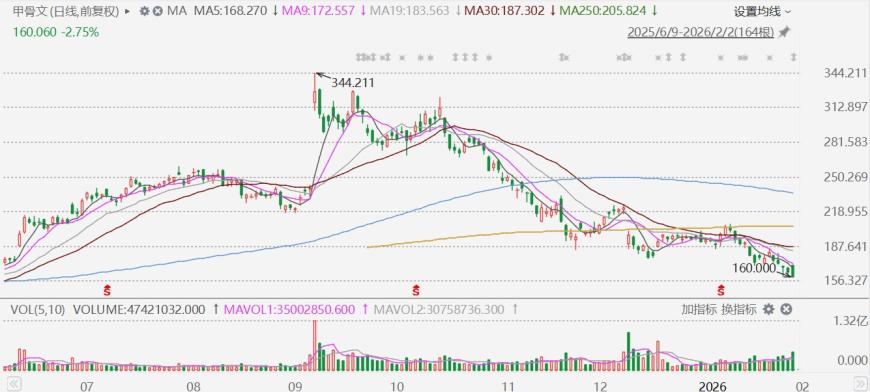
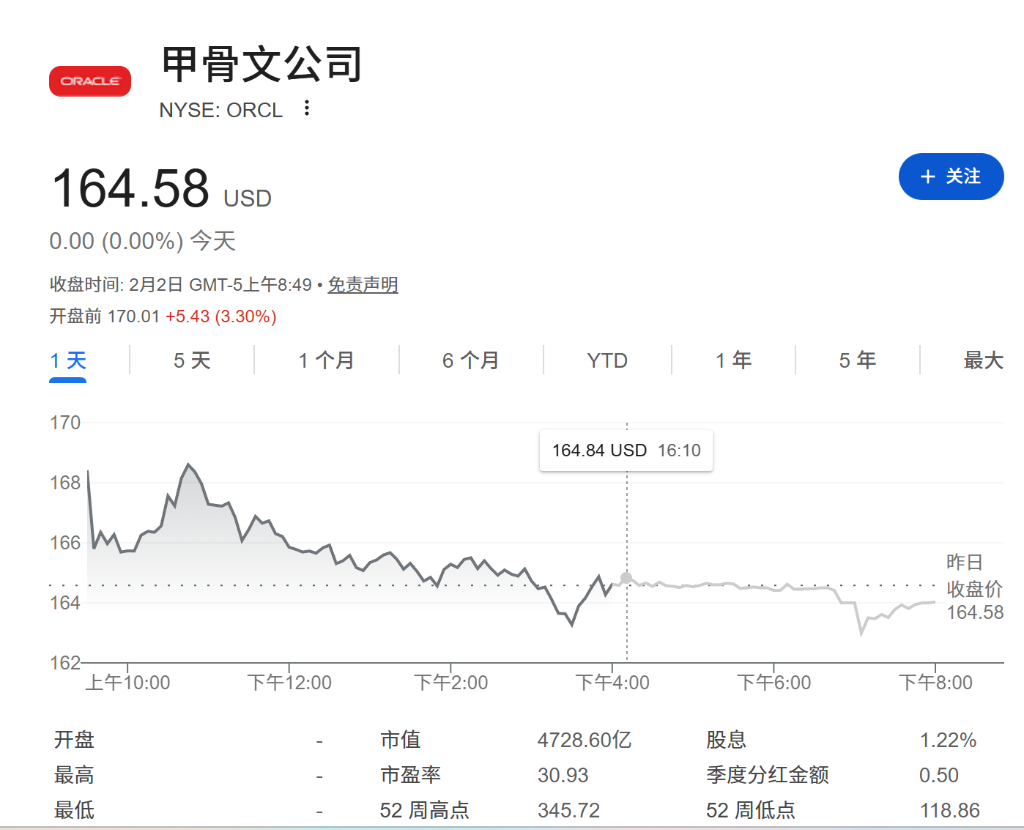
美股异动丨甲骨文收跌近3%,启动500亿美元集资计划,高负债受关注
Ge Long Hui· 2026-02-03 01:24
Group 1 - Oracle has officially launched a fundraising plan of up to $50 billion, including an initial bond issuance of up to $25 billion, to support its aggressive cloud infrastructure expansion strategy [1][2] - The fundraising plan aims to position Oracle as a major player in the cloud infrastructure market, competing with Amazon Web Services (AWS) and Microsoft Azure [2] - Oracle's current outstanding debt is approximately $95 billion, raising concerns about its financial structure and cash flow amid high interest rates [2] Group 2 - The initial bond issuance will be divided into eight parts, expected to be issued within 2026, with the remaining funding gap to be filled through equity-related instruments and common stock issuance [1] - Market concerns regarding Oracle's capital expenditure funding sources have been temporarily alleviated, but skepticism remains about the company's heavy asset expansion strategy [2] - Notably, hedge fund manager Michael Burry has disclosed a short position on Oracle, criticizing its unnecessary heavy asset expansion [2]
甲骨文盘前涨超3%!开启250亿美元债发行,拟分八部分募资,全力冲刺云基建
Hua Er Jie Jian Wen· 2026-02-02 14:55
Core Viewpoint - Oracle has launched a significant financing plan to raise up to $50 billion through a combination of debt and equity to support its aggressive cloud infrastructure expansion strategy, driven by the surging demand for AI capabilities [1][5]. Group 1: Financing Details - Oracle plans to issue between $20 billion and $25 billion in dollar bonds, with the aim of covering half of its annual funding needs through this single bond issuance [3][4]. - The bond issuance will be divided into eight parts, with maturities ranging from 3 to 40 years, and the longest bonds expected to yield approximately 2.25 percentage points above U.S. Treasury rates [4]. - The remaining funding gap will be filled through equity-related instruments and common stock issuance, including a market equity plan of up to $20 billion [7]. Group 2: Business Strategy and Market Position - The core driver for this massive financing is the explosive growth in Oracle's cloud infrastructure business, as the company transitions from a traditional database software provider to a capital-intensive cloud infrastructure giant [5][6]. - The funds raised will specifically be used to build additional data center capacity to meet the substantial contract demands from key clients such as AMD, Meta Platforms, NVIDIA, OpenAI, TikTok, and xAI [5][6]. Group 3: Market Reactions and Concerns - Despite a temporary rise in stock price reflecting short-term optimism about the financing plan, concerns remain regarding Oracle's financial structure and cash flow pressures, especially given its existing debt of approximately $95 billion [3][8]. - Notable short-seller Michael Burry has criticized Oracle for unnecessary heavy asset expansion, highlighting the company's lack of a strong business moat compared to other tech giants and the potential risks if AI demand does not meet expectations [8]. - Analysts have pointed out that while the financing plan alleviates immediate liquidity concerns, Oracle's free cash flow has turned negative, raising questions about the long-term viability of contracts with unprofitable startup clients like OpenAI [8].

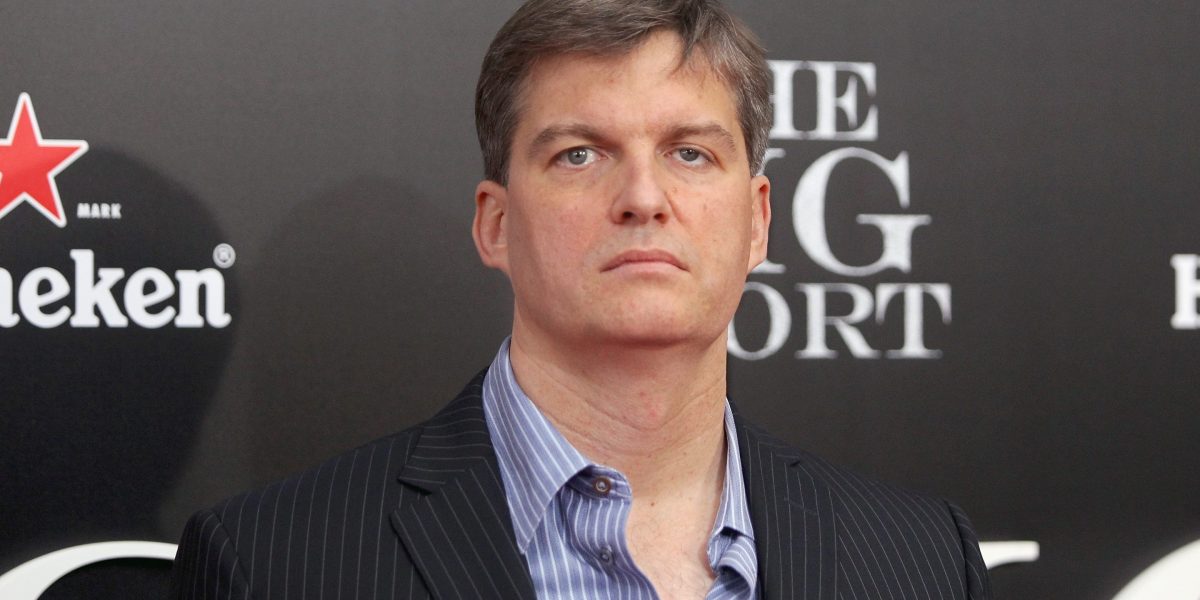
华尔街知名空头做空甲骨文
财富FORTUNE· 2026-01-13 13:03
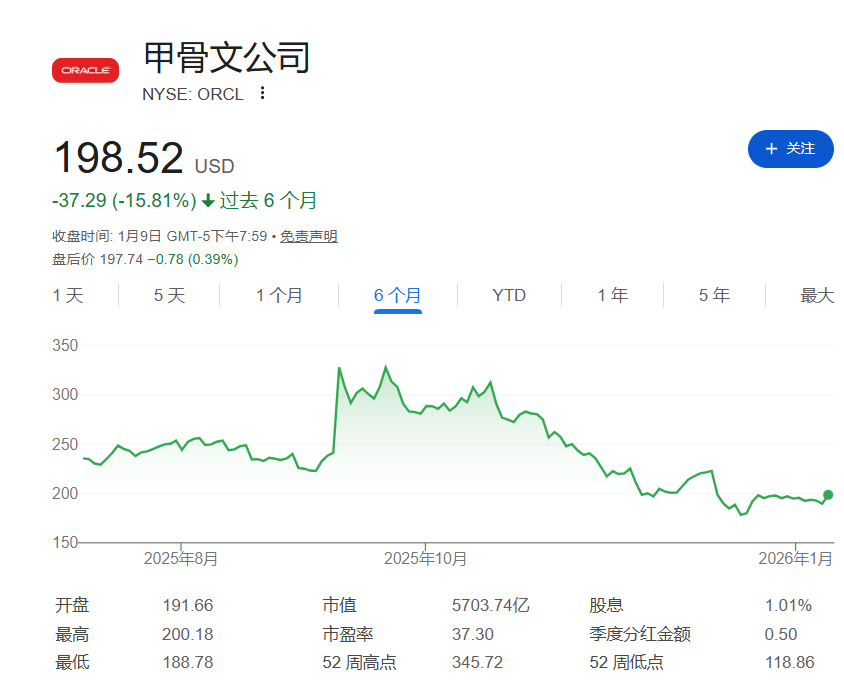
Core Viewpoint - Michael Burry is shorting Oracle Corp. due to concerns over its high debt and unnecessary investments in cloud computing, which he believes are not justified [2][3]. Group 1: Investment Position - Burry holds put options on Oracle and has been shorting the stock directly for the past six months [2]. - He previously disclosed short positions on Nvidia and Palantir Technologies, indicating a broader skepticism towards certain tech stocks [2]. Group 2: Oracle's Financial Situation - Oracle's outstanding debt is approximately $95 billion, making it the largest issuer outside the financial sector in Bloomberg's high-rated index [4]. - The company's stock experienced a significant drop of about 40% from its peak in September, following a brief surge due to optimistic cloud business forecasts [3]. Group 3: Market Sentiment and Comparisons - Burry expresses skepticism about the necessity of Oracle's current investments and its positioning in the market [3]. - He avoids shorting major tech companies like Meta, Alphabet, and Microsoft, believing their core business strengths will remain intact despite potential economic challenges [4]. - Burry views Nvidia as a concentrated target for shorting due to its popularity and perceived overvaluation in the AI sector [5].

Investor Michael Burry reveals options bet against Oracle
Fortune· 2026-01-10 15:41
Core Viewpoint - Michael Burry is betting against Oracle Corp by owning put options, indicating a bearish outlook on the company's future performance [1] Company Overview - Oracle is primarily known for its database software but is aggressively expanding into cloud-computing services, which involves significant capital investment and debt accumulation [2] Investment Concerns - Burry expressed skepticism about Oracle's strategic positioning and investments, suggesting that the company did not need to pursue its current path and questioning the motivations behind these decisions [3] - Oracle's stock experienced volatility, with a notable 36% increase in September due to a positive forecast for its cloud business, but this was followed by a decline as investors became concerned about rising capital expenditures and a growing debt load [4] Debt Situation - Oracle has approximately $95 billion in outstanding debt, making it the largest corporate issuer outside the financial sector in the Bloomberg high-grade index [5] Market Positioning - Burry has chosen not to short larger tech companies with diversified business models, such as Meta Platforms, Alphabet, and Microsoft, as he believes they will manage to absorb losses and remain dominant in their core areas [6][7] - He views Nvidia as a concentrated way to express a bearish sentiment on the AI sector, highlighting its popularity and the relative affordability of its put options compared to other shorts [8]
大空头Burry做空甲骨文:不喜欢其定位和融资
Hua Er Jie Jian Wen· 2026-01-10 05:00
Core Viewpoint - Michael Burry, a well-known investor and the inspiration behind the movie "The Big Short," has disclosed his short position on Oracle through a Substack post, reinforcing his belief that the current AI market is overvalued and in a bubble [1]. Group 1: Short Position and Criticism of Oracle - Burry has directly shorted Oracle in the past six months, criticizing the company's strategic positioning and aggressive investments in AI, suggesting that Oracle is unnecessarily expanding its capital expenditures to compete with cloud giants like Amazon and Microsoft [1]. - He expressed skepticism about Oracle's current investments, questioning their necessity and implying they may be driven by ego rather than sound business strategy [1]. Group 2: Comparison with Other Tech Giants - Burry's rationale for shorting Oracle instead of other tech giants like Microsoft, Alphabet, and Meta is based on the latter's strong core business moats, which provide them with a safety net even if their AI investments fail [2][3]. - In contrast, Oracle's stock price is heavily reliant on a single narrative of surging AI cloud service demand, making it more vulnerable to market fluctuations [3]. Group 3: Financial Concerns and Debt Issues - Oracle's aggressive capital expenditures and deteriorating balance sheet are key factors in Burry's bearish outlook, as the company has incurred approximately $95 billion in outstanding debt, making it one of the largest corporate bond issuers outside the financial sector [6]. - The shift from a "light asset" to a "heavy asset" model has led to significant debt burdens, raising concerns about Oracle's ability to sustain its growth strategy, especially in a high-interest-rate environment [6]. Group 4: Broader Skepticism Towards AI Industry - Burry's short position on Oracle reflects a broader skepticism towards the AI industry, as he questions the sustainability of the current AI hype and pricing models [7]. - He has indicated a willingness to short other AI-related companies, including OpenAI, if their valuations reach unsustainable levels, highlighting his overall bearish sentiment towards the AI sector [7]. Group 5: Market Reaction - Oracle's stock has experienced significant volatility, with a 36% surge last September due to optimistic forecasts for cloud services, followed by a 40% decline from its peak as investor concerns about rising capital expenditures and debt levels grew [6]. - Burry's entry into the short position has intensified market worries regarding Oracle's high-leverage strategy and its long-term viability [6]. Group 6: Oracle's Response - As of the time of reporting, Oracle has not responded to Burry's comments or his short-selling actions [8].
不空Meta、不空微软 “大空头”伯里盯上甲骨文
美股IPO· 2026-01-10 03:34
Core Viewpoint - Notable investor Michael Burry is converting his skepticism about the AI boom into a substantial short position against Oracle Corporation (ORCL.US) [1][3] Group 1: Michael Burry's Position - Burry has disclosed holding put options on Oracle stock, indicating a bearish outlook as the value of these options increases when the underlying asset price declines [3] - He has also directly shorted Oracle over the past six months and previously revealed short positions against AI chip giant Nvidia (NVDA.US) and data company Palantir (PLTR.US) [3] Group 2: Oracle's Financial Situation - Oracle's stock price has experienced significant volatility, having surged 36% in a single day last September due to optimistic forecasts for its cloud business and signals of increased AI demand [4] - However, the stock has since dropped approximately 40% from its September peak by the end of last year, as investor focus shifted to rising capital expenditures and debt associated with data center expansion [4] - The company currently has outstanding debt of about $95 billion, making it the largest corporate bond issuer outside of the financial sector in Bloomberg's high-rated index [4] Group 3: Burry's Investment Strategy - Burry avoids shorting large tech companies with business models extending beyond AI, citing Meta, Alphabet, and Microsoft as examples [5] - He believes these companies will likely manage spending and absorb losses from overcapacity while maintaining dominance in their core businesses [5] - Burry expressed willingness to short OpenAI at a $500 billion valuation, highlighting his broader skepticism regarding the pace and economic viability of AI investments [6]

不空Meta、不空微软 “大空头”伯里盯上甲骨文(ORCL.US)
Zhi Tong Cai Jing· 2026-01-10 01:52
Group 1 - Michael Burry, known for betting against the 2008 financial crisis, is shorting Oracle Corporation (ORCL.US) by holding put options on its stock, indicating skepticism about the company's strategy and investments in cloud computing [1] - Oracle's stock price has experienced significant volatility, dropping approximately 40% from its peak last September, following a surge of 36% due to optimistic forecasts for its cloud business and AI demand [2] - The company currently has an outstanding debt of about $95 billion, making it the largest non-financial corporate bond issuer in Bloomberg's high-rated index [2] Group 2 - Burry avoids shorting larger tech companies like Meta, Alphabet, and Microsoft, as he believes they have diversified business models beyond AI and are likely to manage spending and asset write-downs effectively [2] - He expresses a willingness to short OpenAI at a $500 billion valuation, reflecting broader skepticism about the speed and economic viability of AI development [3] - Burry identifies Nvidia as a primary target for shorting due to its popularity and perceived overvaluation in the AI sector, noting that the cost of shorting Nvidia is relatively low compared to other large short candidates [3]
12月27日外盘头条:泽连斯基预计周日与特朗普会面 现货金银价格再创新高 今年全球并购交易额突...
Xin Lang Cai Jing· 2025-12-26 22:49
Group 1 - Ukrainian President Zelensky is expected to meet with US President Trump on Sunday to discuss sensitive issues, including the future of the Donbas region and the Zaporizhzhia nuclear power plant [4] - Moscow's recent statements raise doubts about the prospects for a final ceasefire agreement [4] Group 2 - Rent prices in major US cities have decreased, marking one of the most tenant-friendly periods in a decade, with median rent in November at $1,693, down approximately 1% year-on-year [7] - The median rent across the US has fallen to $1,367, a decline of 1.1% year-on-year, with expectations for continued low rents until early 2026 [7] Group 3 - Oracle's stock is on track for its worst quarter since 2001, having dropped 30% so far, amid concerns about its ability to support OpenAI with additional server capacity [9][10] - Oracle's quarterly revenue and free cash flow fell below expectations, and the new CFO has requested a capital expenditure of $50 billion for fiscal 2026, a 43% increase from previous plans [10] Group 4 - Target is facing pressure from an activist investor after experiencing nearly a one-third drop in stock price this year and reporting its 12th consecutive quarter of negative or nearly zero sales growth [12] Group 5 - Spot gold and silver prices have reached historic highs, driven by geopolitical tensions and a weakening dollar, with gold surpassing $4,540 per ounce and silver exceeding $77 per ounce [14] Group 6 - Global M&A transaction volume has surpassed $4 trillion for the first time since 2021, with a nearly 50% increase year-on-year, driven by a record number of large deals [16] - The year saw 68 transactions valued at over $10 billion, reshaping various industries and supported by favorable market conditions and financing [16]