
FysicsEval

Search documents
近亿融资落地!飞捷科思发布首个全模态物理AI基础模型-OmniFysics,让机器真正理解世界
创业邦· 2026-02-11 00:07
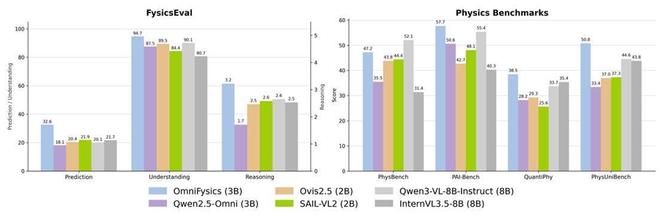
Core Viewpoint - Fysics AI has developed a groundbreaking physical AI model, OmniFysics, which integrates multi-modal understanding and high-fidelity generation capabilities, addressing the cognitive gap in physical perception and enhancing the interaction of AI with the physical world [3][4][6]. Group 1: Company Overview and Funding - Fysics AI recently completed nearly 100 million RMB in Pre-A1 financing, led by Matrix Partners and Oriental Fortune Capital, with participation from other investors [2]. - The company focuses on developing a differentiable physical simulation engine tailored for embodied intelligence, aiming to generate high-quality synthetic data to alleviate the shortage of training data for robots [2][4]. Group 2: OmniFysics Model Features - OmniFysics unifies image, audio, video, and text for cross-modal understanding, integrating high-fidelity voice and image generation capabilities [3][4]. - The model addresses the cognitive gap in physical perception by injecting explicit physical knowledge, reshaping AI's understanding and prediction of physical laws [4][6]. - A dual-core data ecosystem, FysicsAny and FysicsOmniCap, has been established to create a comprehensive dataset of physical attributes and causal relationships, enhancing the model's ability to capture cross-modal physical cues [6][9]. Group 3: Training Paradigm - OmniFysics employs a progressive four-stage training strategy, gradually unlocking multi-modal understanding and generation capabilities, utilizing over 370 million carefully curated instruction-tuning data [17][19]. - The training process integrates physical-enhanced data assets from FysicsAny and FysicsOmniCap, ensuring the model develops a robust understanding of the physical world [17][19]. Group 4: Evaluation and Performance - FysicsEval, a comprehensive evaluation benchmark for physical AI, quantifies the model's capabilities in physical perception, logical reasoning, and understanding of the physical world [20][22]. - OmniFysics has demonstrated superior performance in physical intelligence assessments, outperforming larger models in key metrics, thus validating the effectiveness of its specialized physical data core [26][27]. - The model maintains robust visual multi-modal understanding and excels in audio comprehension, showcasing its versatility across different sensory modalities [30][35]. Group 5: Innovation and Future Implications - OmniFysics establishes a new paradigm for physical AI, proving that compact models can achieve significant physical intelligence without relying solely on parameter scaling [26][40]. - The model's ability to generate images that adhere to physical laws marks a significant advancement in the field, moving beyond traditional semantic alignment to a rigorous standard of physical fidelity [40][41].

飞捷科思发布全球首套真正物理AI基础模型OmniFysics
Huan Qiu Wang Zi Xun· 2026-02-09 11:09
Core Insights - Fysics AI has launched OmniFysics, the world's first all-modal physical AI foundational model that understands "physical laws," achieving a breakthrough in physical perception and reasoning with only 3 billion parameters [1][2] - The model addresses the prevalent issue of "physical hallucinations" in traditional AI, providing a core technological foundation for advancements in embodied intelligence and humanoid robots [1] Technical Innovations - OmniFysics integrates high-quality physical knowledge into its architecture, allowing it to surpass existing open-source models and even outperform some mainstream models with 8 billion parameters in key metrics such as physical prediction and logical reasoning [2] - The model features a unique "dual hub" data ecosystem, with a static hub (FysicsAny) creating a comprehensive physical labeling system for various objects, and a dynamic hub (FysicsOmniCap) enabling precise capture of physical causal relationships through collaborative training with video and audio [2] Evaluation and Benchmarking - Fysics AI has introduced FysicsEval, the first all-dimensional embodied physical perception and logical reasoning evaluation benchmark, which, along with the previously launched FysicsWorld platform, forms a comprehensive intelligent physical evaluation system [12] - This new evaluation framework aims to fill the gap in current physical AI assessments that are disconnected from real-world physics, providing accurate and efficient model diagnostic tools for AI research teams [12] Future Directions - The company aims to continue advancing in the field of physical AI, focusing on practical industry needs and promoting deep integration of technology and applications [12] - The successful launch of OmniFysics signifies a shift from mere "semantic understanding" to a more rigorous "physical reality," establishing a solid foundation for future embodied intelligent agents that can truly understand and interact with the physical world [12]
告别物理幻觉:首个全模态物理AI基础模型OmniFysics问世
Feng Huang Wang· 2026-02-09 05:18
Group 1 - Fysics AI, in collaboration with Fudan University's Cognitive Intelligence Technology Laboratory, has launched the world's first multimodal physical AI foundational model, OmniFysics, aimed at addressing the "physical blindness" issue prevalent in generative AI [1][2] - OmniFysics operates on a lightweight architecture with only 3 billion parameters, incorporating physical perception and causal reasoning mechanisms, allowing it to accurately predict physical parameters such as density and Young's modulus [1] - The model features two unique data ecosystems, "FysicsAny" for static properties and "FysicsOmniCap" for dynamic properties, enabling the identification of physical attributes and understanding of physical causality in audiovisual contexts [1] Group 2 - The technical architecture of OmniFysics employs a four-stage progressive training method, initially training single-modal perception before integrating multimodal capabilities, effectively balancing task specialization and cross-modal collaboration [2] - To validate the model's understanding of physical concepts, the team introduced the FysicsEval evaluation benchmark, which assesses the AI's ability to recognize violations of physical common sense, such as "water flows uphill" [2]