FysicsWorld

Search documents
飞捷科思发布全球首套真正物理AI基础模型OmniFysics
Huan Qiu Wang Zi Xun· 2026-02-09 11:09
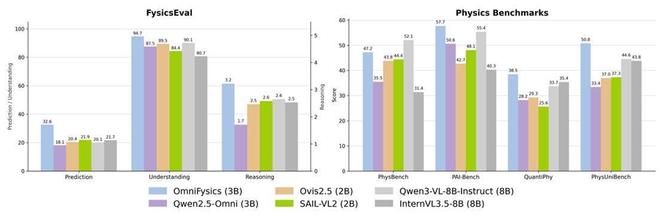
Core Insights - Fysics AI has launched OmniFysics, the world's first all-modal physical AI foundational model that understands "physical laws," achieving a breakthrough in physical perception and reasoning with only 3 billion parameters [1][2] - The model addresses the prevalent issue of "physical hallucinations" in traditional AI, providing a core technological foundation for advancements in embodied intelligence and humanoid robots [1] Technical Innovations - OmniFysics integrates high-quality physical knowledge into its architecture, allowing it to surpass existing open-source models and even outperform some mainstream models with 8 billion parameters in key metrics such as physical prediction and logical reasoning [2] - The model features a unique "dual hub" data ecosystem, with a static hub (FysicsAny) creating a comprehensive physical labeling system for various objects, and a dynamic hub (FysicsOmniCap) enabling precise capture of physical causal relationships through collaborative training with video and audio [2] Evaluation and Benchmarking - Fysics AI has introduced FysicsEval, the first all-dimensional embodied physical perception and logical reasoning evaluation benchmark, which, along with the previously launched FysicsWorld platform, forms a comprehensive intelligent physical evaluation system [12] - This new evaluation framework aims to fill the gap in current physical AI assessments that are disconnected from real-world physics, providing accurate and efficient model diagnostic tools for AI research teams [12] Future Directions - The company aims to continue advancing in the field of physical AI, focusing on practical industry needs and promoting deep integration of technology and applications [12] - The successful launch of OmniFysics signifies a shift from mere "semantic understanding" to a more rigorous "physical reality," establishing a solid foundation for future embodied intelligent agents that can truly understand and interact with the physical world [12]

AI 真能看懂物理世界吗?FysicsWorld:填补全模态交互与物理感知评测的空白
机器之心· 2025-12-28 04:44
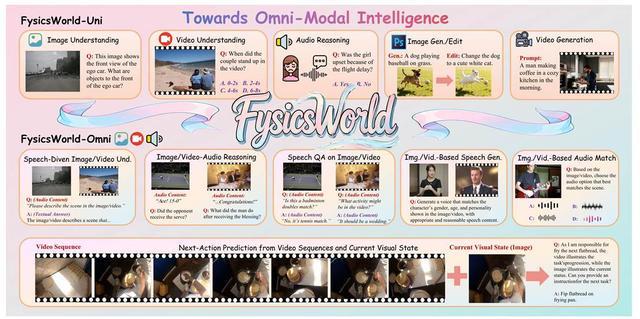
Core Insights - The article discusses the rapid paradigm shift in multimodal large language models, focusing on the development of unified full-modal models capable of processing and generating information across various modalities, including language, vision, and audio [2][4] - The driving force behind this shift is the complexity of the real physical world, where humans have historically relied on multimodal information to understand and interact with their environment [3] - A new benchmark called FysicsWorld has been introduced to evaluate models' capabilities in understanding, generating, and reasoning across multiple modalities in real-world scenarios [4][10] Summary by Sections Introduction to Multimodal Models - Multimodal models are evolving from simple combinations of visual and textual data to more complex integrations that include audio and other sensory modalities [12] - There is a growing expectation for these models to accurately understand and interact with complex real-world environments [12] FysicsWorld Benchmark - FysicsWorld is the first unified benchmark designed to assess models' abilities in multimodal tasks, covering 16 tasks that span various real-world scenarios [6][10] - The benchmark includes a cross-modal complementarity screening strategy to ensure that tasks require genuine multimodal integration, avoiding reliance on single-modal shortcuts [8][23] Evaluation Framework - The evaluation framework of FysicsWorld is comprehensive, covering tasks from basic perception to high-level interactions, ensuring a thorough assessment of models' capabilities [15][17] - The benchmark aims to address the limitations of existing evaluation systems, which often focus on text-centric outputs and lack real-world applicability [16] Performance Insights - Initial evaluations using FysicsWorld reveal significant performance gaps among current models, particularly in tasks requiring deep cross-modal reasoning and interaction in real-world contexts [31] - The results indicate that while models have made progress in basic multimodal tasks, they still struggle with complex scenarios that require robust integration of multiple sensory inputs [31][34] Future Directions - The article emphasizes the need for further advancements in cross-modal integration, dynamic environment understanding, and physical constraint reasoning to achieve true full-modal intelligence [35] - FysicsWorld serves as a critical tool for researchers to map and improve models' capabilities in real-world multimodal interactions [36]

飞捷科思智能科技发布全球首个物理AI测试基准平台
Huan Qiu Wang Zi Xun· 2025-12-19 09:45
Core Insights - Fysics AI and Fudan University's CITLab launched FysicsWorld, the world's first unified multimodal evaluation benchmark for real-world physics, aimed at addressing the significant "specialization" issue in AI and evolving AI from "screen-based interlocutors" to "real-world actors" [1][2] Group 1: FysicsWorld Overview - FysicsWorld represents a shift from traditional AI assessments, which are often limited to text or single-modal evaluations, to a comprehensive real-world testing environment that includes 16 categories of complex tasks involving visual, auditory, and linguistic integration [4][5] - The benchmark includes tasks that require AI to integrate visual cues, auditory signals, and physical knowledge for deep reasoning, such as predicting sound characteristics from silent video footage or inferring object movement from noisy audio [5][8] Group 2: Innovative Features - FysicsWorld introduces a unique "anti-cheating" mechanism that prevents AI from achieving high scores through guessing, requiring simultaneous use of multiple sensory inputs to solve problems [6][7] - This cross-modal complementary screening strategy ensures that only AI models with genuine multimodal integration capabilities can pass the tests, thereby enhancing the reliability of the evaluation [7] Group 3: Implications for AI Development - The release of FysicsWorld highlights the shortcomings of current top AI models in understanding complex real-world scenarios and human interactions, indicating the direction for the next generation of AI evolution [8] - Fysics AI aims to leverage its new physical simulation engine, Fysics, to develop leading physical intelligence technologies and products, facilitating the rapid application of embodied intelligence and humanoid robotics in various industries [8]