GR2102注射液

Search documents
公司问答丨智翔金泰:GR2102注射液目前处于Ⅰ期临床试验阶段
Ge Long Hui A P P· 2025-12-01 09:13
Core Viewpoint - The company Zhixiang Jintai is currently conducting Phase I clinical trials for its monoclonal antibody GR2102, which targets respiratory syncytial virus (RSV) [1] Group 1 - The GR2102 injection is in the Phase I clinical trial stage [1] - Investors are inquiring about the commercialization timeline for GR2102 [1]

国内外药企竞相布局合胞病毒疫苗
Bei Jing Shang Bao· 2025-10-13 15:39
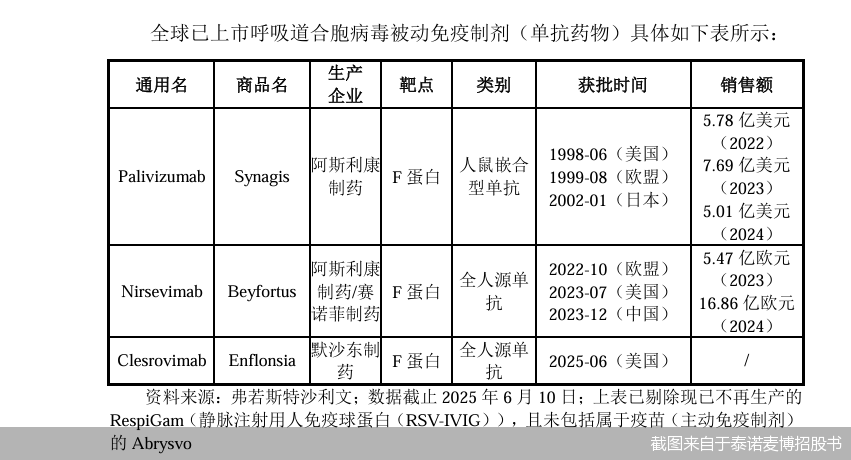
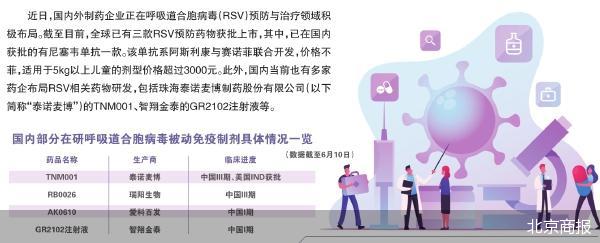
Core Insights - The pharmaceutical industry is actively developing and launching products for the prevention and treatment of Respiratory Syncytial Virus (RSV), with three RSV prevention drugs already approved globally, including the monoclonal antibody Nirsevimab, developed by AstraZeneca and Sanofi [1][3][4] Group 1: Market Overview - The World Health Organization (WHO) has prioritized RSV prevention products for global development [3] - The market for passive immunization agents against RSV for infants aged 0-1 in China is projected to grow at a compound annual growth rate (CAGR) of 78.4%, reaching 2.99 billion yuan by 2028, and further growing at a CAGR of 23.68% to 6.99 billion yuan by 2032 [3] Group 2: Approved Products - Three RSV prevention drugs have been approved globally: Palivizumab by MedImmune, Clonrava by Merck, and Nirsevimab by AstraZeneca and Sanofi [3][4] - Nirsevimab is the first long-acting monoclonal antibody approved for RSV prevention, with approvals from the European Medicines Agency (EMA) in 2022 and the U.S. Food and Drug Administration (FDA) in 2023, and is set to be available in China in December 2023 [4] Group 3: Pricing and Administration - Nirsevimab is priced at 2,369 yuan for infants under 5 kg and 3,677 yuan for those over 5 kg [4] - Palivizumab requires monthly injections during the RSV season, making it less suitable for widespread use due to its high cost and limited target population [4] Group 4: Ongoing Research and Development - Domestic companies are actively developing RSV-related products, with Tanomab's TNM001 injection showing significant progress in clinical trials [5][6] - TNM001 is a recombinant human monoclonal antibody targeting the RSV F protein, designed to neutralize the virus and prevent cell fusion [5] - Other companies, including RuYang Biotech and Aikobaf, are also in the clinical stages of developing RSV treatments [6]

进口单抗最高超3000一针!呼吸道合胞病毒进入高发期,国内外药企竞相布局
Bei Jing Shang Bao· 2025-10-13 12:13
Core Insights - The Respiratory Syncytial Virus (RSV) is experiencing a surge in infections, particularly among infants and the elderly, leading to increased public health concerns and discussions on social media [1][3] - Currently, there are limited treatment options for RSV, with only one monoclonal antibody, Nirsevimab, approved for use in China, while several other pharmaceutical companies are actively developing RSV-related therapies [1][5] Industry Overview - RSV is a leading cause of respiratory infections in children under five globally, with no specific antiviral treatments available, primarily relying on symptomatic care [1][4] - The global market for passive immunization against RSV in infants is projected to grow significantly, with an estimated compound annual growth rate (CAGR) of 78.4% from 2024 to 2028, reaching approximately 2.99 billion yuan [5] Drug Development - Three RSV preventive drugs have been approved globally: Palivizumab, Nirsevimab, and Clesrovimab, with Nirsevimab being the only one currently available in China [5][6] - Nirsevimab is priced at over 3,000 yuan for children weighing over 5 kg, with two formulations available based on weight [6] - Domestic companies like TaenoMabo are developing their own RSV treatments, such as TNM001, which is currently in clinical trials [7][8] Market Demand - The demand for effective RSV prevention and treatment is expected to rise due to the increasing population of infants and the aging population in China, highlighting a significant market opportunity [8] - Companies are encouraged to focus on innovation and differentiation in drug development to meet diverse patient needs and improve drug accessibility [8]