GROOT N1机器人基础模型

Search documents
英伟达 Q1 440亿,指引450亿
小熊跑的快· 2025-05-28 23:14
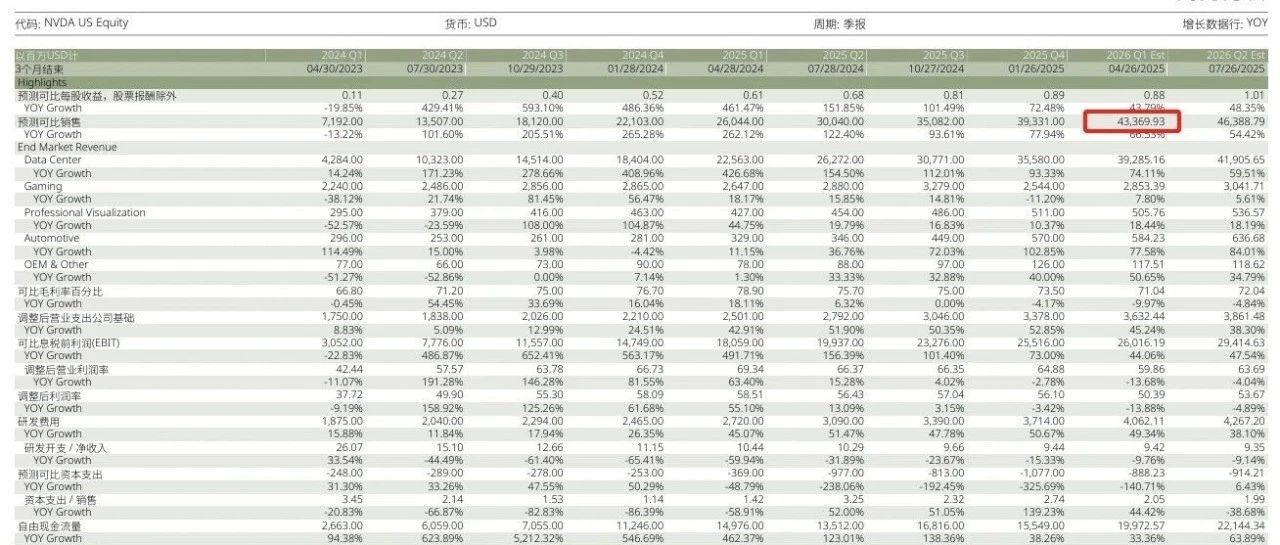
Core Viewpoint - The company reported strong Q1 results with significant revenue growth driven by data center and AI-related businesses, despite facing challenges from export restrictions on H20 products. Group 1: Financial Performance - Q1 revenue reached $44 billion, exceeding expectations of $43.4 billion, with a year-over-year growth of 69% [1] - Non-GAAP net profit was $18.775 billion, up 26% year-over-year but down 15% quarter-over-quarter, primarily due to $4.5 billion in expenses related to H20 [1] - Data center revenue was $39 billion, reflecting a 73% year-over-year increase [1] - Q2 revenue is projected to be around $45 billion, with a potential loss of $8 billion in H20 revenue due to export restrictions [1] Group 2: Business Segments - Data center business in Q1 generated $39.112 billion, a 73% increase year-over-year, slightly below market expectations [1] - Gaming and AI PC business revenue was $3.763 billion, up 42% year-over-year and 48% quarter-over-quarter, surpassing market expectations [1] - Professional visualization revenue reached $509 million, showing a 19% year-over-year increase [1] - Autonomous driving and robotics business generated $567 million, a 72% increase year-over-year [2] Group 3: Technological Developments - Blackwell contributed nearly 70% of data center computing revenue, nearing completion of the transition from Hopper [3] - GB200 supports data center workloads with the lowest cost per inference token, with Microsoft deploying thousands of Blackwell GPUs [3] - The first quarter saw a recovery in networking business with a 64% quarter-over-quarter revenue growth, reaching $5 billion [3] Group 4: Strategic Initiatives - The company is collaborating with Foxconn to build a 1 million square foot factory for AI supercomputers in Houston [4] - A similar factory is being constructed by Wistron in Fort Worth, Texas, to support these investments [4] - The company has made substantial long-term procurement commitments, indicating a deep investment in the future of AI manufacturing in the U.S. [4]