
H20

Search documents
Fidelity Blue Chip Growth Is Down 11.67% in 2026. What Comes Next Depends on This.
Yahoo Finance· 2026-03-31 12:20
Core Insights - Fidelity Blue Chip Growth ETF (FBCG) has experienced an 11.67% decline year to date as of late March 2026, which is more significant than the 8.42% drop in the Nasdaq 100 (QQQ) during the same timeframe [1] Group 1: Fund Overview - FBCG is an actively managed ETF launched in June 2020, with $5.4 billion in assets under management and an expense ratio of 57 basis points [2] - The fund focuses on high-conviction large-cap growth companies that Fidelity's managers believe possess durable earnings power [2] Group 2: Portfolio Composition - The fund has a concentrated portfolio with significant holdings in mega-cap companies, including NVIDIA (15.68%), Apple (9.49%), Alphabet (8.42%), and Amazon (7.76%), which collectively drive a substantial portion of daily returns [3] - Despite a recent drawdown, the fund has delivered a total return of 17.37% over the past year, indicating volatility in sentiment due to macroeconomic conditions [3] Group 3: Macro Environment and Risks - U.S. export control policies toward China, particularly regarding AI chip trade, are expected to be a major macro force affecting FBCG in the next year [4] - NVIDIA, the fund's largest holding, has excluded any Data Center compute revenue from China in its Q1 FY2027 guidance, reflecting the impact of export restrictions [4] - The company has incurred a $4.5 billion inventory charge in Q1 FY2026 and anticipates an additional $8 billion in lost revenue in Q2 FY2026 due to these constraints [4] Group 4: Market Conditions - Easing of export licensing requirements could potentially unlock new revenue streams for NVIDIA, while further tightening could negatively impact the fund's top holdings, including Amazon's AWS and Alphabet's cloud services [5] - Rising Treasury yields, currently at 4.42%, have increased by 0.38% in the past month, which compresses valuation multiples for growth stocks, including those in FBCG's portfolio [7] - If yields stabilize or decrease, the pressure on valuations may ease; however, if they approach the 12-month high of 4.58%, continued multiple compression is expected [7]

真正的杀招来了!英伟达联手韩国,黄仁勋直言次品卖给中国
Xin Lang Cai Jing· 2026-03-28 22:53
(来源:燕财局) 美国芯片巨头英伟达CEO黄仁勋,再次"口出狂言"。 据美媒Punchbowl News于3月19日报道,黄仁勋在采访中明确表示:"等所有美国企业都用上Vera Rubin,我们就该考虑让Blackwell进入中国市场竞争了。" Vera Rubin是英伟达下一代、最先进的AI芯片,计划2026年下半年推出;Blackwell是当前一代AI芯片, 目前被禁止对华出口。 说白了,就是先确保美国本土用上最顶级的芯片,再申请将被淘汰的次品卖给中国,以保住在中国的市 场份额。 1、联合韩国,把中企当冤大头 此前,英伟达已多次为中国市场推出"专供版"芯片(如H100、H800、H20),这些芯片均是在美方要 求下,对性能进行了不同程度的削减。 据过往经验,即便英伟达之后对华出口次级芯片,很有可能会同样进行削减。 而且自2025年10月起,英伟达已和韩国达成合作,向其提供26万颗完整的Blackwell芯片,帮助其构建 国家级的AI算力底座。 3月16日,英伟达还与韩国新世界集团达成合作,投资数十亿美元搭建韩语大模型;在无人驾驶领域亦 有深度合作。 与对华明令禁止的态度不同,美国商务部高度重视并支持对韩合 ...

Nvidia Just Delivered an Update on Its Future in China. Here's What You Need to Know.
Yahoo Finance· 2026-03-02 12:30
Core Insights - Nvidia has established itself as a leader in the AI chip market, benefiting from early entry and continuous innovation, leading to significant revenue growth [1][2] - The company reported record revenue exceeding $215 billion in the latest fiscal year, although its growth was hindered by restrictions on sales to China [2][4] - The U.S. government imposed export controls on advanced AI chips to China in 2022, which affected Nvidia's sales strategy and resulted in a billion-dollar charge due to unsold inventory [5][6] Group 1: Nvidia's Market Position - Nvidia's GPUs are highly sought after for AI development, giving the company a competitive edge in the technology sector [1] - The company generated 13% of its revenue from China in the 2025 fiscal year, indicating the importance of this market despite initial export controls [4] Group 2: U.S. Export Controls and Strategy - The U.S. government halted exports of advanced AI chips to China due to security concerns, prompting Nvidia to create a lower-power chip, the H20, for that market [5] - Nvidia's strategy included selling more advanced chips in other markets while maintaining a presence in China, which is estimated to have a market value of $50 billion annually [5][6] - After negotiations, Nvidia received approval to sell H200 chips in China, agreeing to allocate 25% of sales to the U.S. [6]
日本专家谈中国的AI数据中心投资
日经中文网· 2026-03-01 00:33
Core Viewpoint - The article discusses the mismatch between supply and demand in data centers, particularly in China, highlighting concerns about over-investment in AI-focused data centers and the implications of government strategies like "East Data West Computing" [1][5]. Group 1: Data Center Utilization and Investment - The low utilization rate of data centers in China is primarily due to mismatched investment scale and layout, with private cloud service providers like Alibaba, Tencent, and Baidu maintaining strong revenue despite this issue [3][4]. - Many data centers, driven by local governments and built on a supply-first basis, do not meet the low-latency access requirements of AI demand concentrated in coastal regions, resulting in utilization rates of only 20% to 30% [4][5]. Group 2: Government Strategies and Network Latency - The "East Data West Computing" strategy aims to build data centers in inland areas with abundant renewable energy to handle coastal AI demands, but the current low utilization rates and network latency issues present significant challenges [5][6]. - While there is potential for policy measures to improve utilization rates, the severe network latency makes it difficult for these facilities to support real-time AI processing needs [5][6]. Group 3: AI Semiconductor Competitiveness - Chinese AI semiconductors are rapidly catching up, with Huawei's "Ascend 910B" competing with Nvidia's "A100," but there remains a gap in power efficiency and software maturity, indicating a continued reliance on Nvidia for cutting-edge AI models [6][7]. Group 4: Global Data Center Investment Trends - Globally, there is a similar mismatch between AI demand and electricity supply locations, leading to cases where completed data centers cannot operate due to power supply issues [8][9]. - The withdrawal of investment companies from Oracle's data center projects highlights the challenges in financing and the need for solid demand support and high-certainty financing for AI data center projects [9].

A股重要信息回顾:浙江2026年“4+1”专项基金、新增能耗、新增工业用地支持民间投资项目比重不低于80%力争科技贷款余额超4.2万亿元,特斯拉中国3月31日前下单主力车型可享5年零息方案Model3额外享8000元保险补贴
Jin Rong Jie· 2026-02-26 08:46
Company Insights - Nvidia reported its Q4 and full-year financial results for FY2026, with total revenue approximately 14,834 million RMB, exceeding expectations for both revenue and net profit, and announced an upcoming collaboration with OpenAI, with H20 generating around 400 million RMB in China [1] - Tesla China introduced a car loan scheme, offering a zero-interest option for the Model 3, Model Y, and Model Y L for orders placed by March 31, with an additional insurance subsidy of 8,000 RMB for the Model 3 [1] - Samsung Electronics officially launched the third-generation AI smartphone Galaxy S26 series, with the Galaxy S26 Ultra featuring a built-in privacy display, starting at a price of 9,999 RMB for the domestic version [1] - Yanghe Brewery recently established Jiangsu Yanghe Biotechnology Co., Ltd., with a registered capital of 100 million RMB, fully owned by Yanghe Brewery [1] - Haitai Technology stated on its interactive platform that it has received small batch orders from humanoid robot clients, with the related products yet to be delivered and confirmed for revenue, and the order amount is relatively low compared to the company's future total revenue [1] Industry Insights - The Zhejiang government released the "8+4" economic policy system for 2026, aiming for the "4+1" special fund and new energy consumption and industrial land to support private investment projects with a target of at least 80%, and striving for a technology loan balance exceeding 4.2 trillion RMB [1] - The Shandong Provincial Government issued measures to implement a more proactive and open talent policy, guiding universities and enterprises to establish AI industry innovation classes and a joint training mechanism for graduate students in the AI field [1] - The Zimbabwe Ministry of Mines announced an immediate suspension of all raw mineral and lithium concentrate exports, leading to a nearly 2% increase in the lithium mining index on the A-share market on February 26, with stocks like Keli Yuan and Jinyuan shares hitting the daily limit [1] - Guangzhou is planning to build a 10 square kilometer deep cooperation zone for the horse industry with Hong Kong, preparing over 10,000 acres for development, aiming to create a world-class horse industry hub that serves the Bay Area, radiates nationwide, and connects globally [1] - The State Administration for Market Regulation's Special Equipment Bureau is soliciting opinions on the "15th Five-Year Plan for the Development of Special Equipment Safety and Energy Saving" draft, with feedback due by March 28, 2026 [1]
Nvidia still hasn't sold its U.S.-approved China AI chips — and it's worried local AI rivals could take over
CNBC· 2026-02-26 08:23
Core Viewpoint - Nvidia has not yet recovered its sales in China despite some easing of U.S. restrictions, and the company is concerned about increasing competition from Chinese rivals [1][2]. Group 1: Sales and Revenue - Nvidia's CFO stated that while small amounts of H200 semiconductor products were approved for China, the company has not generated any revenue from these sales [1]. - China previously accounted for at least 20% of Nvidia's data center revenue [2]. - Sales have stalled due to security scrutiny in both the U.S. and China, despite efforts from Nvidia's CEO to lobby for better conditions [5]. Group 2: Competition and Market Dynamics - Rising competition from Chinese companies is a significant concern for Nvidia, as these competitors are making progress and could disrupt the global AI industry in the long term [6]. - Recent IPOs of Chinese AI chipmakers and language model developers have led to increased expectations that they could serve as alternatives to U.S. technology, resulting in stock surges for companies like MiniMax and Moore Threads [7]. - Although Chinese AI companies are slightly behind the U.S. in capabilities, their products are generally much cheaper [8]. Group 3: Future Outlook - Analysts suggest that there could be a scenario where a majority of the global population relies on a Chinese tech stack within the next five to ten years [9].
英伟达全年净利润超8000亿,中国H20收入4亿
Guan Cha Zhe Wang· 2026-02-26 06:25
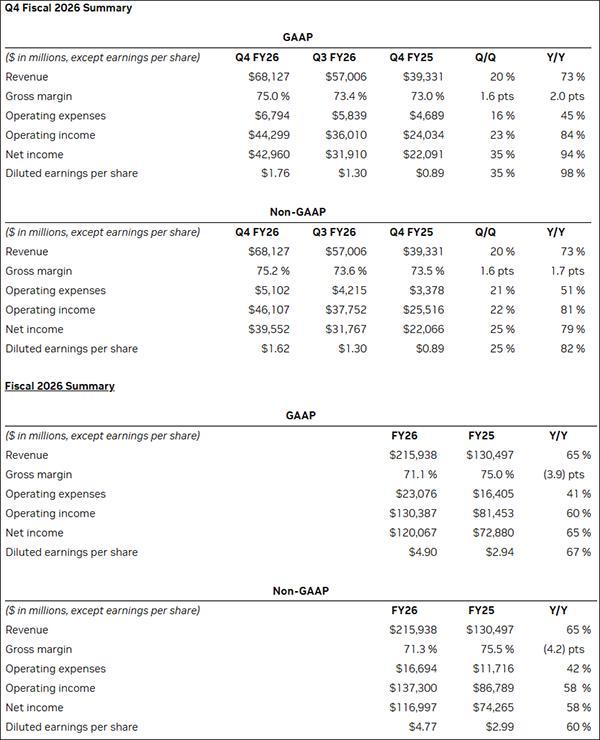
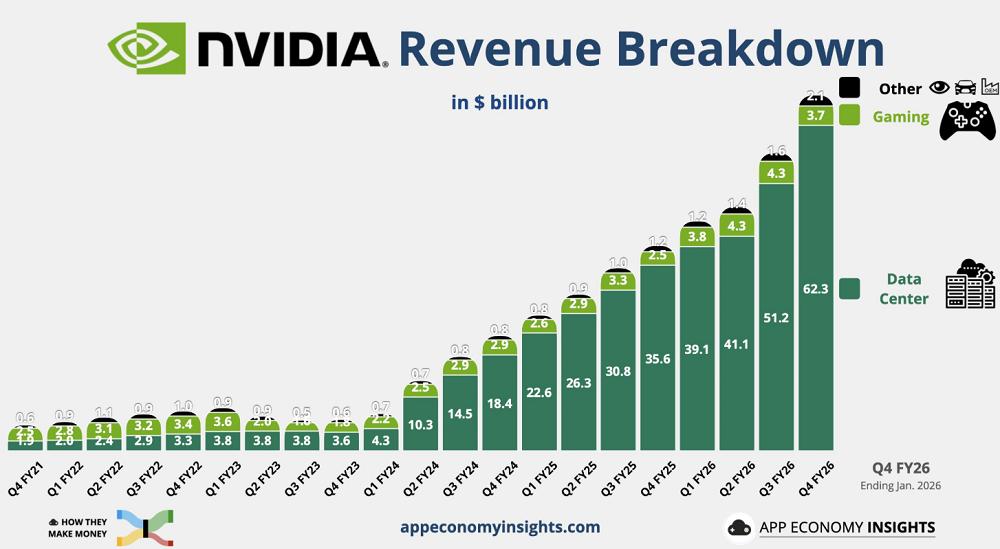
Core Viewpoint - Nvidia reported strong financial results for Q4 FY2026 and the entire fiscal year, exceeding Wall Street expectations with significant revenue and profit growth driven primarily by its data center segment, which is heavily focused on AI technology [1][2]. Financial Performance - Q4 FY2026 revenue reached $68.1 billion, a 73% year-over-year increase and a 20% quarter-over-quarter increase [2] - Non-GAAP net income for Q4 FY2026 was $39.6 billion, reflecting a 79% year-over-year growth [2] - For the full fiscal year 2026, Nvidia's revenue was $215.9 billion, up 65% from the previous year, with net income also increasing by 65% to $120.1 billion [2] Gross Margin and Operating Expenses - Q4 FY2026 GAAP gross margin was 75.0%, while non-GAAP gross margin was slightly higher at 75.2% [2] - Operating expenses for Q4 FY2026 were $5.1 billion (non-GAAP), a 51% increase year-over-year [2] - For the full fiscal year, GAAP gross margin was 71.1%, down from 75.0% the previous year, while non-GAAP gross margin was 71.3% [2] Data Center Segment - Data center revenue for Q4 FY2026 was $62.3 billion, representing a 75% year-over-year increase and accounting for over 91% of total sales [1][2] - The company emphasized the growing demand for AI computing, with significant investments from clients driving future growth [3] Future Outlook - Nvidia projects Q1 FY2027 revenue to be around $78 billion, with expected GAAP and non-GAAP gross margins of 74.9% and 75.0%, respectively [3] - The outlook does not include revenue from data center computing business in China, which remains uncertain [3]
14834亿,英伟达炸裂年报:日赚超20亿,中国H20收入4亿,黄仁勋爆料Groq和OpenAI
3 6 Ke· 2026-02-26 04:44
芯东西2月26日报道,今天,英伟达公布了截至今年1月25日的2026财年第四季度财报以及2026财年全年业绩。本财季,英伟达营收和净利润双 双超越华尔街预期,营收达681.3亿美元(约合人民币4680.2亿元),同比增长73%,环比增长20%;净利润(非GAAP)达395.5亿美元(约合 人民币2716.9亿元),同比增长79%,环比增长25%。 2026财年全年,英伟达营收达到2159.4亿美元(约合人民币14834.0亿元),同比增长65%;净利润则达到1200.8亿美元(约合人民币8248.9亿 元),同比增长65%。 英伟达创始人兼CEO黄仁勋判断,Agentic AI的拐点已经到来,企业对Agent的采用率正在飙升,"在这个AI的新世界里,算力就是营收,没有 算力,就无法生成Token,而没有Token,就无法实现营收增长"。这几乎在说"算力就是金钱"。 黄仁勋透露:"我们正与OpenAI继续努力达成合作协议,并相信我们即将达成协议。"黄仁勋还给GTC大会预热,剧透将在GTC期间展示英伟 达将如何使用Groq的技术来扩展其架构。 英伟达CFO Colette Kress称,自ChatGPT诞生以来, ...
14834亿!英伟达炸裂年报:日赚超20亿,中国H20收入4亿,黄仁勋爆料Groq和OpenAI
Xin Lang Cai Jing· 2026-02-26 02:48
Core Viewpoint - Nvidia's recent financial report indicates a significant increase in revenue and net profit, driven by the rising demand for AI computing power, which CEO Jensen Huang describes as directly linked to revenue generation [3][26][45]. Financial Performance - For Q4 FY26, Nvidia reported revenue of $68.13 billion (approximately RMB 468.02 billion), a year-over-year increase of 73% and a quarter-over-quarter increase of 20% [3][34]. - The net profit (non-GAAP) for the same quarter was $39.55 billion (approximately RMB 271.69 billion), reflecting a 79% year-over-year growth and a 25% quarter-over-quarter growth [3][26]. - For the entire FY26, Nvidia's revenue reached $215.94 billion (approximately RMB 1483.40 billion), up 65% year-over-year, with net profit at $120.08 billion (approximately RMB 824.89 billion), also a 65% increase [3][26][39]. Business Segments - The Compute & Networking segment generated $61.65 billion in revenue for Q4 FY26, a 71% increase year-over-year and a 21% increase quarter-over-quarter [11][34]. - The Graphics segment contributed $6.48 billion in revenue, marking a 73% year-over-year increase and a 20% quarter-over-quarter increase [11][34]. - Data Center revenue was a significant driver, contributing over $62.31 billion, a 75% increase year-over-year and a 22% increase quarter-over-quarter [12][37]. Market Dynamics - Nvidia's data center revenue has surged nearly 13 times since the launch of ChatGPT, with large enterprises accounting for over 50% of data center revenue [4][27]. - The company faces competition from Chinese rivals, which have made progress following recent IPOs, potentially disrupting the global AI landscape [6][29]. Future Outlook - Nvidia anticipates Q1 FY27 revenue to be around $78 billion (approximately RMB 535.82 billion) with a non-GAAP gross margin of 75% [8][31]. - Huang remains optimistic about the future of AI and data center capital expenditures, projecting a global market of $3 to $4 trillion by 2030 [21][45]. Strategic Investments - Nvidia has invested heavily in acquiring Groq's core team and technology, with cash used in investing activities amounting to -$52.22 billion for FY26 [7][30]. - The company is focusing on expanding its architecture using Groq's technology and enhancing its AI ecosystem [21][30].
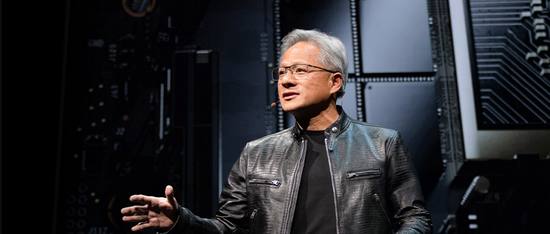
黄仁勋:中国对手正在进步,H200在华尚未有收入
Feng Huang Wang· 2026-02-26 02:28
Core Insights - Nvidia reported record revenue of $68.127 billion for Q4 2026, a 73% increase from $39.331 billion year-over-year, with a net profit of $42.96 billion, up 94% from $22.091 billion [1] - For the full fiscal year 2026, Nvidia achieved a record revenue of $215.938 billion, marking the first time annual revenue surpassed $200 billion [1] - The company did not include revenue from data centers in China in its performance outlook [1] Group 1 - Nvidia has sufficient inventory to meet demand for the upcoming quarters [2] - In February 2026, the U.S. government granted Nvidia a license to ship H200 products in small quantities to specific customers in China, but no revenue has been generated from this license so far [2] - Nvidia sold approximately $60 million worth of H20 chips in China [2] Group 2 - Nvidia's CFO stated that there is no bubble in the AI market, as customer investments are yielding substantial returns, leading to increased investment [3] - The CFO noted that competitors in China are making progress and mentioned companies that have strengthened due to recent IPOs, which could disrupt the global AI landscape and impact Nvidia's competitive position [3] - The first samples of Vera Rubin for testing have been delivered to customers [3] Group 3 - Nvidia's CEO indicated that the company is close to finalizing an investment agreement with OpenAI [4] - The CEO mentioned that the cost-effectiveness of space data centers is currently not ideal, but this situation is expected to improve over time [5] - Following the earnings report, Nvidia's stock price rose by less than 1% in after-hours trading [5]