
HAL 9000

Search documents
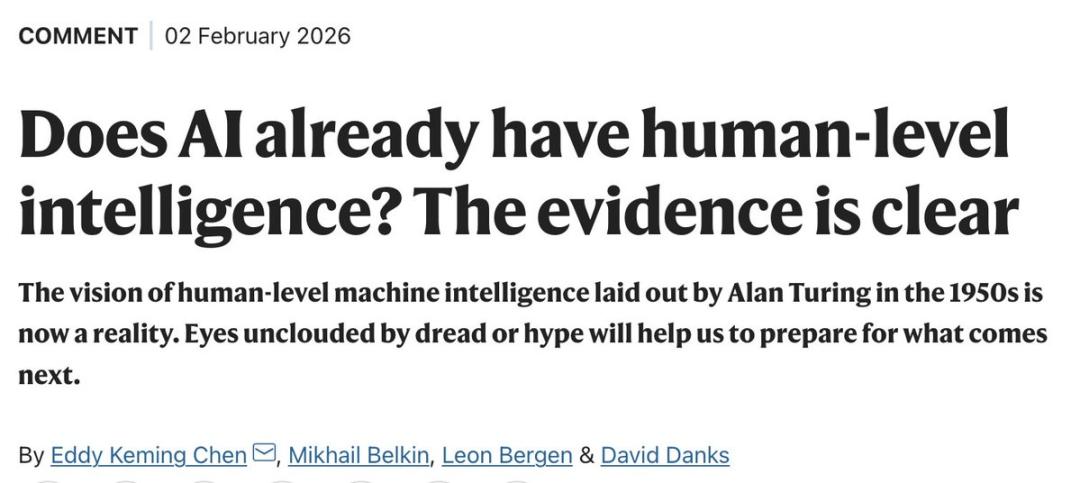
Nature重磅:图灵预言的AGI早已实现,人类却不敢承认
3 6 Ke· 2026-02-04 13:20
Core Viewpoint - The article asserts that Artificial General Intelligence (AGI) has already arrived, with large language models like GPT demonstrating human-level intelligence [1][3]. Group 1: AGI Definition and Evidence - AGI is no longer a distant dream; it is present and observable through everyday AI tools [3]. - The research team from UCSD argues that AI is not just intelligent but has achieved true generality, surpassing human capabilities in various tasks [7][8]. - The article compares this realization to historical cognitive revolutions, suggesting that AGI challenges human-centric views of intelligence [8][45]. Group 2: Capabilities of Current AI - Current large language models (LLMs) exhibit a breadth of capabilities across mathematics, language, science, and creativity, aligning with the definition of general intelligence [12][16]. - The models have demonstrated performance in international competitions and can assist in advanced research, indicating a level of intelligence comparable to that of humans [12][16]. Group 3: Misconceptions and Resistance - The article highlights a disconnect between the capabilities of AI and the skepticism from top AI researchers, with 76% believing current methods are unlikely to achieve AGI [12]. - The authors argue that this skepticism stems from a combination of vague definitions, emotional fears, and commercial interests [13][41]. - The paper systematically addresses ten common objections to AGI, demonstrating that current AI can solve novel problems and engage in complex reasoning [35][40]. Group 4: Historical Context and Future Implications - The article draws parallels between the current state of AI and historical shifts in human understanding, such as those brought by Copernicus and Darwin [45][46]. - It suggests that the emergence of AGI will force humanity to redefine its understanding of intelligence and its own place in the world [46][47]. - The discussion emphasizes that recognizing non-human forms of intelligence is crucial for future interactions with AI [47][48].

美媒:“恐怖AI”电影源于人类对自身的恐惧
Huan Qiu Shi Bao· 2025-09-04 22:52
美国《大西洋月刊》 9 月 1 日文章,原题:我们对人工智能的恐惧由来已久 人工智能(AI)是21世纪最 大的希望之一,也是最大的恐惧来源之一。50多年来,流行文化一直在努力理解AI"既是救世主又是敌 人"的概念。在电影、电视节目和文学作品中,对AI的刻画不仅反映了我们对这项技术的渴望,也揭示 了我们自身所惧怕的事物。 从某种意义上说,过去半个世纪以来,几乎所有AI文学作品都受到科幻小说《科学怪人》的启发:不 负责任的科学家创造出失控的"怪物",并威胁要毁灭所有人。在科幻小说中,机器人有时是助手,如 《迷失太空》中善良的机械船员;有时是狡猾的敌人,如《银翼杀手》的复制人。过去几十年的AI小 说常常设定为人类创造了一个比自身更聪明的存在,然后发现这个新的"人造神明"不理解甚至不喜欢创 造它的人类。 20世纪许多关于AI的故事都深深植根于冷战氛围,艺术家感受到人们恐惧之下心底深藏的希望,渴望 某种更强大的存在能够终结军备竞赛,避免全球毁灭。这些故事展现了人们惧怕自身的弱点,渴望某种 理性的存在能够拯救情绪化且反复无常的人类。AI被一些文学作品塑造为"解围之神",一个能够将战争 与和平的决定权从易犯错误的人类手中夺 ...