IO期权

Search documents
市场避险情绪较浓,建议防御为主:股指期权周度观察-20260322
Guo Lian Qi Huo· 2026-03-22 13:27
Report Title - The report is titled "Weekly Observation of Stock Index Options: Market Risk Aversion is Strong, Suggesting a Defensive Approach" [1] Core View - Last week, the implied volatility of each option continued to rise significantly. The average implied volatility of the at-the-money options for April IO, HO, and MO is around 18%, 18.2%, and 27.01% respectively, with premiums of about 3.18, 3, and 1.56 percentage points compared to the 30-day historical volatility. The implied volatility premiums of IO and HO options are slightly high. The 30-day historical volatility of the underlying has gradually risen above the 60-day historical volatility, and technically, the volatility is in an upward cycle. Due to the high uncertainty in the Middle East situation and the relatively restrained pricing of the tail risk brought by high oil prices in the equity market, it is expected that the short-term implied volatility may still rise [4] - The decline of the underlying index drives the implied volatility to rise synchronously, indicating that the short-term option market's risk aversion willingness is still strong. The decline of the IO option position PCR value is more restrained than that of the MO option. Compared with the small and medium-cap index, option sellers are more optimistic about the large-cap index. It is expected that the downside space of the CSI 300 index in the short term is generally limited [4] - In terms of position distribution, the contract with the highest call option position of MO has moved down to the 8300-point level. During the market decline on Friday, the call contract with a strike price of 8000 added more than 2000 lots. From the perspective of selling options, it is expected that the upside of the CSI 1000 index will still face relatively large pressure in the short term [4] - In terms of strategies, due to the relatively strong short-term market risk aversion sentiment, investors are advised to mainly sell out-of-the-money call options of MO at high prices. Investors with long positions in stock index futures can consider using collar strategies to prevent short-term market uncertainty risks [4] Directory Summary 01 Stock Index Option Data Tracking - **成交持仓情况**: The report presents data on trading volume and open interest, but specific data details are not described in the text [8][11] - **PCR值与标的指数走势**: The relationship between the PCR value and the underlying index trend is presented, but specific analysis is not provided [15] - **持仓量分布情况**: The position distribution of HO2604, IO2604, and MO2604 is shown through charts, including the distribution of call and put option positions [21][23] - **近一年波动率锥**: The volatility cone data for the past year is presented, but specific analysis is not provided [26][29] - **隐含波动率和历史波动率**: The relationship between implied volatility and historical volatility is presented, but specific analysis is not provided [32][35] - **波动率曲面结构**: The volatility surface structure is mentioned, but specific content is not provided [50] - **偏度与标的指数走势**: The relationship between skewness and the underlying index trend is presented, but specific analysis is not provided [55][58]
股指期权周度观察:隐波或将继续呈低位震荡格局-20251109
Guo Lian Qi Huo· 2025-11-09 14:15
1. Report Industry Investment Rating - No information provided 2. Core Viewpoints - Last week, the implied volatility of each option showed a pattern of rising first, then falling and oscillating back. Affected by factors such as overseas liquidity from Monday to Wednesday, the implied volatility locally soared, but the A - shares in China were quite resilient. As market sentiment recovered on Thursday and Friday, the implied volatility hit a new low in this round. Currently, the average at - the - money implied volatility of November IO, HO, and MO options is around 13.95%, 14%, and 18.3% respectively, with premiums of about - 2.89, - 2, and - 0.3 percentage points compared to the 30 - day historical volatility. The premiums are generally at a relatively low level in history, and it is expected that the room for further decline in implied volatility is relatively limited. Under the characteristic of volatility clustering, it will continue to show a low - level oscillation pattern [4]. - The continuous decline in implied volatility indicates that the options market is more likely to price in an oscillating upward trend. The probability of short - term upward acceleration of each index remains low [4]. - The position PCR value has significantly increased, and call option sellers showed an obvious trend of reducing positions in the last two trading days of last week, indicating that the capital view is more inclined to believe that the downside space of the index is limited [4]. - The dense holding area of MO put options is below the strike price of 7400 points, and that of IO put options still has extremely high positions at the strike price of 4700 points. However, combined with the technical form, it is more inclined to use the low point of last week as the defensive area for put option sellers in November [4]. - In general, as the remaining time of the November contract enters the last two weeks, the time value decays faster. On the one hand, sellers of out - of - the - money put options in November can still consider continuing to hold, and new investors are advised to pay attention to the layout opportunities of MO put option sellers below the strike price of 7300 points; on the other hand, investors with long positions in stock index futures are still advised to use out - of - the - money call option sellers to increase income on rallies [4]. 3. Summary by Directory 3.1 Index Option Data Tracking - **Main Indicator Overview**: No specific content provided - **Trading Volume and Open Interest**: The report does not elaborate on specific data and trends, but only lists the data sources as WIND and the Research Institute of Guolian Futures [10][14] - **PCR Value and Underlying Index Trend**: The report does not elaborate on specific data and trends, but only lists the data sources as WIND and the Research Institute of Guolian Futures [20] - **Open Interest Distribution**: The report shows the open - interest distribution chart of HO2511, but does not provide detailed analysis [22][23] - **One - Year Volatility Cone**: The report does not elaborate on specific data and trends, but only lists the data sources as WIND and the Research Institute of Guolian Futures [29][32] - **Implied Volatility and Historical Volatility**: The report does not elaborate on specific data and trends, but only lists the data sources as WIND and the Research Institute of Guolian Futures [35][39][42] - **Volatility Surface Structure**: The report does not elaborate on specific data and trends, but only lists the data sources as WIND and the Research Institute of Guolian Futures [55] - **Skewness and Underlying Index Trend**: The report does not elaborate on specific data and trends, but only lists the data sources as WIND and the Research Institute of Guolian Futures [61]
上半年金融期权市场活跃度分化明显
Qi Huo Ri Bao Wang· 2025-07-18 01:11
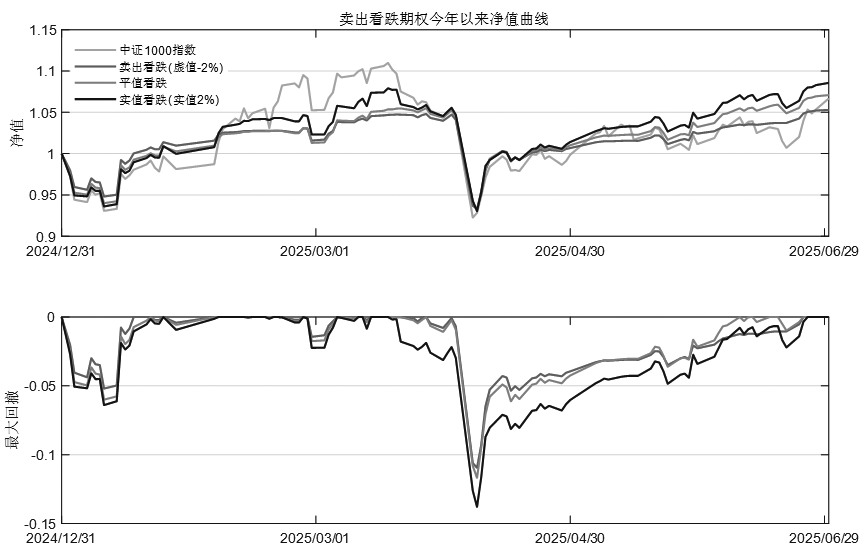
Core Insights - The overall financial options market showed a total trading volume of 690 million contracts in the first half of 2025, with a daily average trading volume of 6.39 million contracts and a total trading value of 589.44 billion yuan, reflecting a mixed performance compared to the same period in 2024 [1] Trading Volume and Market Share - The trading volume of options related to small and mid-cap indices, such as the CSI 1000 Index options and the Huatai-PineBridge Innovation 50 ETF options, saw significant increases, with the latter experiencing a daily average trading value growth of 42.09% compared to 2024 [2] - The CSI 1000 Index options market share rose to 36.13%, while the Southern CSI 500 ETF options followed with a 22.12% share, indicating a market preference for trading small-cap index options due to their higher elasticity [2] Volatility Trends - Implied volatility for options generally trended downward in the first half of the year, with notable spikes following the imposition of "reciprocal tariffs" by the U.S. in early April, where IO and MO options reached highs of approximately 50% and 70% respectively [3] - The implied volatility for the CSI 300 Index and CSI 1000 Index options has dropped to historical lows of 13% and 18%, respectively, indicating a low volatility environment, but with a premium over historical volatility still above 3% [4][9] Strategy Performance - Selling put options yielded positive results, with absolute returns of 7.08% and 8.56% for at-the-money and in-the-money options, respectively, outperforming the CSI 1000 Index by 0.39% and 1.87% [5] - The dual selling strategy of simultaneously selling out-of-the-money call and put options showed stable performance, with absolute returns of 8.99% and 5.95% for IO and HO options, although both strategies faced significant drawdowns post-Qingming Festival [7][9] Market Dynamics - The liquidity in the financial options market showed a noticeable decline in the second quarter compared to the first quarter, with a clear preference for trading small-cap index options [9] - The potential for a resurgence in volatility is anticipated, particularly during significant events such as the Central Political Bureau meeting and U.S.-China tariff negotiations, suggesting that option sellers should remain vigilant [4][9]