
Integrated Circuit

Search documents
Photronics Q1 Earnings Surpass Estimates, Revenues Increase Y/Y
ZACKS· 2026-02-26 18:55
Core Insights - Photronics (PLAB) reported first-quarter fiscal 2026 non-GAAP earnings of 61 cents per share, exceeding the Zacks Consensus Estimate by 12.96% and reflecting a year-over-year increase of 17.3 [1][7] - Revenues for the quarter reached $225.1 million, marking a 6.1% increase year over year and a 4.3% increase sequentially [1][7] Revenue Breakdown - Integrated Circuit revenues rose 5% sequentially and 7% year over year to $165.3 million, driven by higher demand in high-end IC sales ahead of the Chinese New Year [2] - FPD revenues increased by 3% both year over year and sequentially to $59.8 million, with significant growth in the Mainstream sub-segment driven by China's IT market [2] Financial Metrics - Gross margin for the first quarter contracted by 60 basis points year over year to 35% [3] - Research & development expenses as a percentage of revenues decreased by 90 basis points year over year to 1.1% [3] - Selling, general, and administrative expenses as a percentage of revenues increased by 50 basis points year over year to 9.5% [3] - Operating income was $54.9 million, up 5.1% year over year, while operating margin contracted by 20 basis points year over year to 24.4% [3] Balance Sheet & Cash Flow - As of February 1, 2026, cash and cash equivalents and short-term investments totaled $636.9 million, up from $588.2 million as of October 31, 2025 [4] - Total debt remained flat at $0.02 million compared to the previous quarter [4] - Cash generated from operating activities was $97.3 million, with $47.6 million invested in organic growth through capital expenditures [4] Q2 2026 Guidance - For the second quarter of fiscal 2026, Photronics expects revenues between $212 million and $220 million [5] - The company anticipates an operating margin in the range of 22-24% for the second quarter [5] - Earnings are projected to be between 49 cents and 55 cents per share [5] Stock Performance - Photronics currently holds a Zacks Rank 3 (Hold) [6] - The company's shares have increased by 91.7% over the past 12 months, outperforming the Zacks Computer & Technology sector, which saw a 32% increase [6]



圣邦股份成立微电子新公司,含多项集成电路业务
Qi Cha Cha· 2026-02-11 08:02
Core Viewpoint - The establishment of Wuhan Shengbang Microelectronics Co., Ltd. marks a strategic expansion into the integrated circuit sector by Shengbang Co., Ltd. [1] Group 1: Company Overview - Wuhan Shengbang Microelectronics Co., Ltd. has been registered with a capital of 30 million yuan [1] - The company is wholly owned by Shengbang Co., Ltd. (stock code: 300661) [1] Group 2: Business Scope - The business scope of the new company includes integrated circuit design, chip design and services, manufacturing, and sales [1] - The company will engage in various integrated circuit-related activities, indicating a comprehensive approach to the semiconductor market [1]

北京经济技术开发区:积极部署人工智能安全体系 重点突破深度伪造识别、生成内容合规检测等技术
Jin Rong Jie· 2026-01-31 14:13
Core Viewpoint - The Beijing Economic and Technological Development Zone Management Committee has issued an implementation plan for accelerating the construction of a comprehensive artificial intelligence city from 2026 to 2027, focusing on enhancing foundational capabilities in AI and integrated circuit manufacturing [1] Group 1: AI Infrastructure Development - The plan emphasizes leveraging integrated circuit manufacturing capabilities to promote a collaborative development model that integrates design, manufacturing, testing, and computing power [1] - It aims to drive continuous iteration of computing infrastructure and high-performance intelligent computing industries [1] Group 2: Chip Architecture Innovation - The initiative includes advancing research and innovation in chip architectures such as mixed-signal and storage-computing integration [1] - It seeks to extend the industrial chain to include scenario-defined chips, industry-specific chips, and enabling software [1] Group 3: Model Development and Testing - The plan supports the collaborative development of general and vertical models, accelerating the upgrade from cognitive models to proactive models [1] - It also promotes the establishment of national-level AI hardware and software testing verification centers and large model evaluation centers to strengthen foundational capabilities in "chip-model adaptation" [1] Group 4: AI Security Framework - The initiative actively deploys an AI security system, focusing on breakthroughs in deep forgery detection and compliance checks for generated content [1] - It aims to build a secure and trustworthy foundation for AI applications [1]
新城市志|三省一市增速均跑赢全国,长三角凭什么
Xin Lang Cai Jing· 2026-01-31 06:04
Core Insights - The Yangtze River Delta (YRD) region has achieved impressive economic growth, with a total economic output surpassing 34.66 trillion yuan in 2025, an increase of 1.49 trillion yuan from the previous year, and a rise of 7.06 trillion yuan since the beginning of the 14th Five-Year Plan [1][3] - All provinces in the YRD outperformed the national average growth rate of 5.0%, with Shanghai, Jiangsu, Zhejiang, and Anhui recording growth rates of 5.4%, 5.3%, 5.5%, and 5.5% respectively [3][4] Economic Performance - Shanghai's GDP reached 56,708.71 billion yuan, Jiangsu at 142,351.5 billion yuan, Zhejiang at 94,545 billion yuan, and Anhui at 52,989 billion yuan, collectively adding 1.49 trillion yuan compared to the previous year [3][4] - The YRD's GDP share of the national total increased from 24.1% to 24.7% from 2021 to 2025, indicating a significant contribution to national economic growth [3] New Economic Milestones - The YRD welcomed new members to its "trillion GDP city club," with Wenzhou in Zhejiang surpassing the trillion yuan mark at 10,213.9 billion yuan, and Xuzhou in Jiangsu expected to follow suit [4] - A total of 11 cities in the YRD are now part of this club, including major cities like Shanghai, Suzhou, and Hangzhou [4] Sectoral Highlights - In specific sectors, Shanghai's fixed asset investment grew by 4.6%, while Jiangsu's productive service industry contributed 77.4% to the growth of all regulated service industries [6][10] - Zhejiang's per capita disposable income exceeded 70,000 yuan for the first time, and Anhui led the nation in automotive and new energy vehicle production [6][10] Innovation and Technology - The YRD has become a hub for technological innovation, with nearly one-third of China's 26 national advanced manufacturing clusters located in the region [8] - Shanghai's three leading industries—integrated circuits, biomedicine, and artificial intelligence—saw a manufacturing output growth of 9.6% [8] Structural Transformation - Jiangsu's high-tech industry accounted for 52.1% of the regulated industrial output, with high-tech manufacturing value-added growing by 11.9% [10] - Zhejiang's private enterprises and digital economy saw a 7.2% increase in industrial output, contributing significantly to GDP growth [10] Integration and Connectivity - The YRD has made significant progress in infrastructure connectivity, resolving historical issues with inter-provincial "broken roads" and investing over 130 billion yuan in railway construction in 2025 [12][15] - A collaborative innovation system has been established, enhancing resource allocation and optimizing industrial chains across the region [12][15] Global Competitiveness - With all provinces in the YRD now part of the "trillion-dollar foreign trade club," the region is enhancing its global competitiveness through platforms like the Belt and Road Initiative and free trade zones [16] - The YRD's economic output has reached levels comparable to major developed economies, indicating a successful regional integration model [16]
2025年中国集成电路产量为4842.8亿块 累计增长10.9%
Chan Ye Xin Xi Wang· 2026-01-30 03:45
Group 1 - The core viewpoint of the articles highlights the growth trajectory of China's semiconductor integrated circuit industry, with significant production increases projected for the coming years [1][2] - According to the National Bureau of Statistics, the production of integrated circuits in China is expected to reach 48.1 billion units by December 2025, reflecting a year-on-year growth of 12.9% [1] - Cumulatively, the total production of integrated circuits in China for the year 2025 is projected to be 484.28 billion units, marking a cumulative growth of 10.9% [1] Group 2 - The articles mention several listed companies in the semiconductor sector, including Nasda (002180), Weir Shares (603501), Jiangbolong (301308), Silan Microelectronics (600460), China Resources Microelectronics (688396), Baiwei Storage (688525), Zhaoyi Innovation (603986), Hangjin Technology (000818), Haiguang Information (688041), and Amlogic (688099) [1] - The report by Zhiyan Consulting outlines the competitive landscape and development prospects of the semiconductor integrated circuit industry in China from 2026 to 2032 [1][2]

大基金三期旗下基金入股聚合微电子公司
Sou Hu Cai Jing· 2026-01-29 09:49
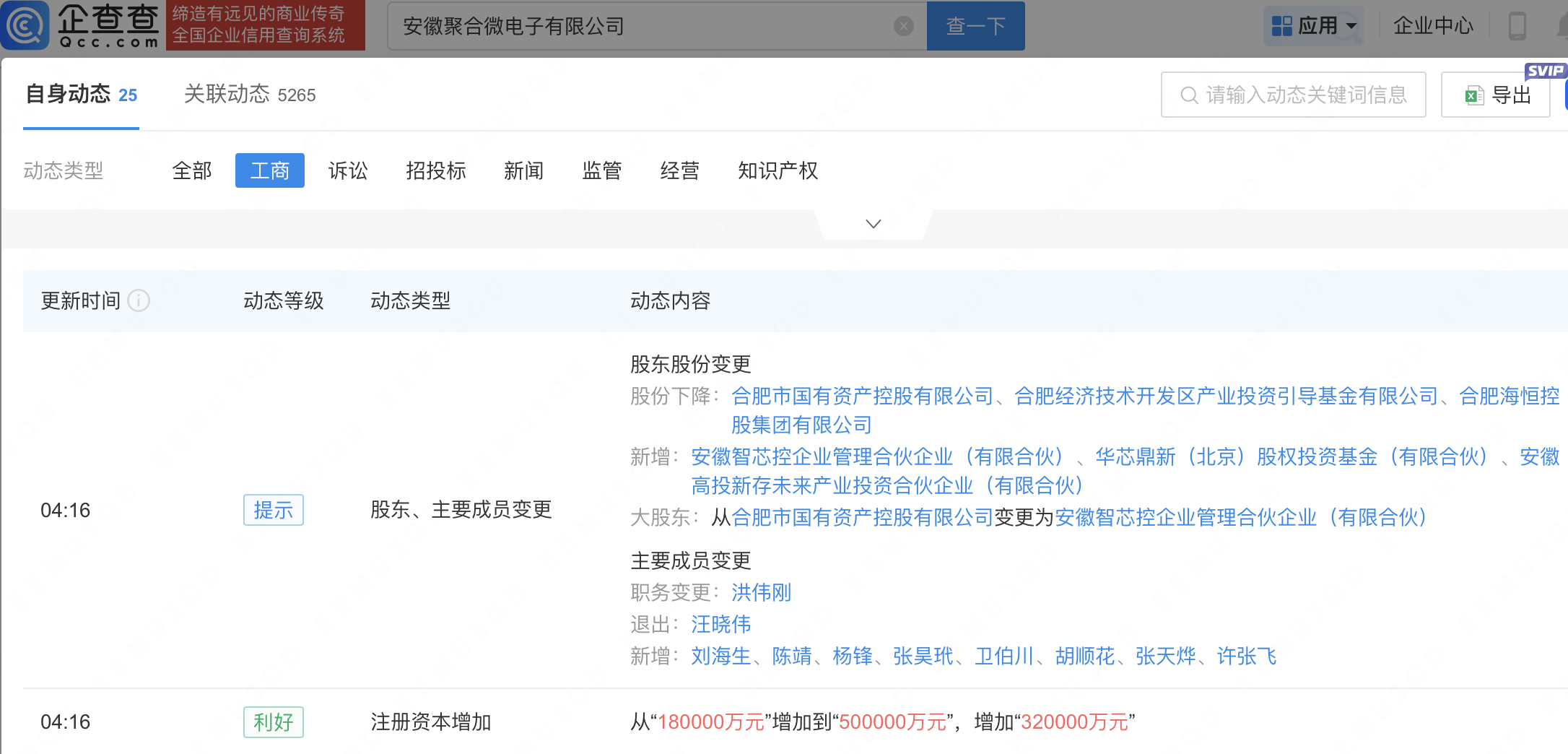
Core Insights - Anhui Poly Microelectronics Co., Ltd. has undergone a business change, with the addition of Huaxin Dingxin (Beijing) Equity Investment Fund as a shareholder and an increase in registered capital from 1.8 billion RMB to 5 billion RMB [1] - The company was established in 2024 and operates in the integrated circuit design, manufacturing, and sales sectors [1] Company Information - The company is located in Hefei Economic and Technological Development Zone, Anhui Province, and has a workforce of 100-199 employees, with 127 insured individuals as of the 2024 report [3] - The registered address is in the China (Anhui) Pilot Free Trade Zone, Hefei area [3] - The business scope includes technology services, integrated circuit chip design and services, retail and wholesale of electronic components, software development, and import-export of goods [3] Shareholder Structure - The major shareholders include Anhui Zhixin Control Enterprise Management Partnership (Limited Partnership) with a 26% stake, Hefei State-owned Assets Holding Co., Ltd. with a 20% stake, and Huaxin Dingxin (Beijing) Equity Investment Fund with an 18% stake [3] - The state-owned enterprise, National Integrated Circuit Industry Investment Fund Phase III, holds a significant stake of 99.9001% with a capital contribution of 9.3 billion RMB [4]
温州新晋“万亿之城” 长三角“深水博弈”开场
2 1 Shi Ji Jing Ji Bao Dao· 2026-01-27 16:19
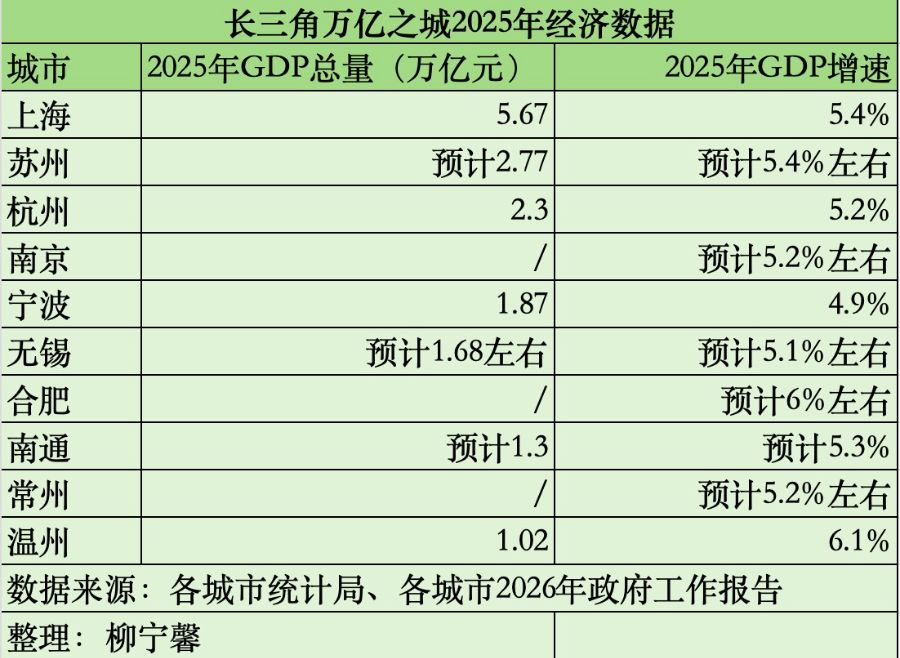
Core Insights - The Yangtze River Delta region is witnessing a significant increase in the number of cities with a GDP exceeding 1 trillion yuan, reaching a total of 10 by 2025, with Shanghai leading at 5.67 trillion yuan [1][2] - The focus of urban competition is shifting from merely achieving a trillion GDP to enhancing the quality and sustainability of economic growth, emphasizing innovation, industrial structure, and living standards [2][6] Economic Data Summary - Shanghai's GDP is projected to be 5.67 trillion yuan with a growth rate of 5.4% in 2025 [1][3] - Suzhou's GDP is expected to reach 2.77 trillion yuan, while Nanjing is approaching the 2 trillion yuan mark [2][4] - Hangzhou's GDP is estimated at 2.3 trillion yuan, with a growth rate of 5.2% [1][3] - Ningbo's GDP is projected at 1.87 trillion yuan, growing at 4.9% [1][4] - Wenzhou has recently crossed the 1 trillion yuan threshold, achieving a GDP of 1.02 trillion yuan with a growth rate of 6.1% [1][5] Industrial Development Trends - Shanghai is focusing on high-end industrial clusters, with significant growth in advanced manufacturing sectors such as integrated circuits (15.1% growth) and artificial intelligence (13.6% growth) [3][8] - Hangzhou is emphasizing the integration of digital economy with advanced manufacturing, with notable growth in new energy vehicles and industrial robots [4][9] - Suzhou is transitioning from traditional manufacturing to a modern industrial system, targeting sectors like biomedicine and high-end medical devices [8][10] - Wenzhou's economic growth is driven by its manufacturing sector, with strategic emerging industries and high-tech sectors showing substantial growth [5][11] Future Industry Layout - Cities in the Yangtze River Delta are actively planning for future industries, focusing on sectors like quantum technology, synthetic biology, and advanced semiconductor materials [10][11] - The competition among cities is increasingly defined by their ability to innovate and create sustainable industrial ecosystems rather than just GDP figures [6][7] Long-term Competitiveness Factors - Key variables for long-term competitiveness include the originality and resilience of industrial ecosystems, efficiency in innovation and technology transfer, and the ability to attract and retain talent [11][12] - Cities are encouraged to create favorable living conditions and cultural experiences to enhance their attractiveness to talent [11]
温州新晋“万亿之城”,长三角“深水博弈”开场
2 1 Shi Ji Jing Ji Bao Dao· 2026-01-27 12:33
Core Viewpoint - The quality of industries is becoming a longer-term competitive variable for the trillion GDP cities in the Yangtze River Delta region, shifting the focus from mere GDP scale to the quality and sustainability of development [1][4]. Economic Data Summary - In 2025, the total number of trillion GDP cities in the Yangtze River Delta will increase to 10, with Shanghai leading at 5.67 trillion yuan and new entrant Wenzhou reaching 1.02 trillion yuan [2][3]. - Expected GDP growth rates for 2025 include: Suzhou at approximately 5.4%, Hangzhou at 5.2%, Nanjing at around 5.2%, and Ningbo at 4.9% [2][3]. Industry Development Trends - The new industrial layout in the Yangtze River Delta is focusing on high-end industrial clusters and the extension of new tracks based on existing manufacturing strengths [3][10]. - Shanghai's GDP growth is supported by new momentum in industries such as integrated circuits and artificial intelligence, with respective growth rates of 15.1% and 13.6% [5]. - Hangzhou's economy is characterized by a strong service sector, contributing 73.8% to its GDP, with significant growth in the digital economy [6][12]. - Wenzhou's manufacturing sector is evolving towards technology-intensive and intelligent production, with strategic emerging industries growing by 14.4% [8][12]. Long-term Competitiveness Factors - Key variables for long-term competitiveness include the originality and resilience of the industrial ecosystem, innovation efficiency, and the ability to attract and retain talent [13]. - The focus is shifting from GDP scale to the health of industries, innovation density, and sustainable growth metrics as new evaluation criteria for urban competitiveness [10][13].
时空科技等成立存储技术公司,含集成电路及半导体业务
Qi Cha Cha· 2026-01-19 02:53
Group 1 - Shenzhen Shikong Storage Technology Co., Ltd. has been established with a registered capital of 50 million yuan [1] - The company's business scope includes integrated circuit chip design and services, semiconductor discrete device manufacturing, and sales [1] - The company is jointly held by Shikong Technology's wholly-owned subsidiary, Shikong Storage (Shenzhen) Semiconductor Co., Ltd., among others [1]

12月进出口数据双超预期,出口链盈利改善明确
Jin Rong Jie· 2026-01-15 01:09
Group 1 - In December, China's imports in USD terms increased by 5.7% year-on-year, exceeding the expected growth of 0.9% and the previous value of 1.9% [1] - China's exports in December rose by 6.6% year-on-year, surpassing the expected growth of 3.1% and the previous value of 5.9% [1] - The trade surplus in December was $114.14 billion, slightly below the expected surplus of $114.35 billion [1] Group 2 - The core driver of the unexpected growth in exports is attributed to product structure upgrades and market diversification, with high-tech product exports expected to grow by 13.2% in 2025 [1] - The export scale of "new three items" (electric vehicles, photovoltaic products, lithium batteries) is close to 1.3 trillion, with exports to ASEAN and Belt and Road countries increasing by 11.2% each [1] - The recovery in import growth is due to improved domestic demand and stabilization of commodity prices, with imports of mechanical and electrical products and integrated circuits increasing by 6% and 7.3% year-on-year, respectively [1] Group 3 - Looking ahead, foreign trade is expected to maintain steady growth in 2026, with exports continuing to shift towards high-tech and high-value-added products [2] - The trade surplus is anticipated to remain within a reasonable range, with foreign trade continuing to exert a positive impact on the economy [2] - In the A-share market, the improved export data in December enhances economic resilience and market risk appetite, benefiting high-tech manufacturing sectors such as new energy, photovoltaics, and high-end equipment [2]