KILIAN PARIS

Search documents
Estee Lauder Q2 Earnings Beat Estimates, 2026 Guidance Raised
ZACKS· 2026-02-05 17:36
Core Insights - The Estee Lauder Companies Inc. (EL) reported strong second-quarter fiscal 2026 results, with both revenue and earnings exceeding expectations and showing year-over-year growth [1][2]. Financial Performance - Adjusted earnings per share were 89 cents, surpassing the Zacks Consensus Estimate of 84 cents, and increased 43% from 62 cents in the same quarter last year [3]. - Quarterly net sales reached $4,229 million, beating the Zacks Consensus Estimate of $4,226 million, and increased by 6% year over year. Organic net sales rose 4% to $4,155 million [3]. Category-Wise Revenue Results - Skin Care sales increased by 6% year over year to $2,054 million, driven by brands like La Mer and Estée Lauder [4]. - Makeup revenues declined by 1% year over year to $1,164 million, primarily due to Estee Lauder's performance, although operating performance improved [5]. - Fragrance category revenues rose by 6% to $812 million, led by luxury brands such as TOM FORD and Le Labo [6]. - Hair Care sales totaled $168 million, up 5% year over year, supported by strong demand for The Ordinary [7]. Regional Revenue Results - Sales in the Americas were stable at $1,218 million, while revenues in the EUKEM region increased by 2% to $1,183 million. Asia-Pacific sales rose by 2% to $900 million, with Mainland China seeing a 13% increase to $928 million [8]. Margin Insights - Adjusted gross margin expanded by 40 basis points year over year to 76.5%, aided by the Profit Recovery and Growth Plan (PRGP), despite challenges from tariffs and inflation [9]. - Operating earnings were reported at $401 million, a significant improvement from a loss of $580 million in the prior year [10]. Restructuring and Future Outlook - The company is advancing its PRGP, which is expected to generate annual gross benefits of $0.80-$1.00 billion, with a net workforce reduction of 5,800-7,000 positions [14]. - EL raised its fiscal 2026 outlook, now forecasting net sales growth of 3-5% and adjusted earnings per share of $2.05-$2.25, reflecting strong first-half performance [15][16].



Estée Lauder(EL) - 2026 Q2 - Earnings Call Transcript
2026-02-05 14:32
Financial Data and Key Metrics Changes - The company reported a 4% year-over-year organic sales growth, with a 43% increase in EPS, rising from $0.62 to $0.89 [5][20][23] - Gross margin expanded by 40 basis points to 76.5%, while operating margin increased by 290 basis points to 14.4% [22][27] - The effective tax rate decreased to 39.8% from 42.6% due to lower tax expenses related to stock-based compensation [23] Business Line Data and Key Metrics Changes - Skincare and fragrance segments both grew by 6%, contributing significantly to overall sales growth [20] - Makeup category remains at a break-even level, with ongoing efforts to improve profitability through innovation and distribution strategies [60][62] Market Data and Key Metrics Changes - Retail sales in Mainland China showed double-digit growth, outperforming the prestige beauty market [7][8] - In North America, sales were flat, with improvements noted in market share and volume, particularly in skincare and makeup [34][36][80] Company Strategy and Development Direction - The company is focused on its "Beauty Reimagined" initiative, aiming for operational, leadership, and cultural transformation to enhance consumer-centricity [6][15] - Expansion into high-growth channels such as Amazon and TikTok Shop is a priority, with 12 brands now present on Amazon [9][88] - The company is also investing in travel retail and pharmacy channels to diversify its business [10][12] Management's Comments on Operating Environment and Future Outlook - Management expressed confidence in the company's turnaround, raising the fiscal 2026 outlook for organic sales growth to a range of 1%-3% [15][26] - Despite challenges in the macroeconomic environment, particularly in Western Europe, management sees opportunities for improvement [16][26] - The company anticipates a stronger Q4 compared to Q3, driven by innovation and consumer engagement strategies [38] Other Important Information - The company is on track for innovation to represent at least 25% of sales, with a goal to increase the percentage of innovations launched in less than a year [12] - Significant progress has been made in cash flow generation, with net cash flows from operating activities improving to $785 million [25] Q&A Session Questions and Answers Question: Insights on Americas performance and growth expectations - Management acknowledged the flat growth in the Americas but highlighted improvements in market share and volume, particularly in skincare and makeup [34][36] Question: State of the travel retail business - Management reported strong momentum in Hainan, with improved conversion rates and market share across multiple brands, despite disruptions in other travel retail areas [44][49] Question: Profitability in the makeup segment - Management noted that makeup profitability was impacted by innovation returns but expects improvements as new products are launched and distribution is optimized [60][62] Question: Promotional environment in China - Management emphasized the importance of maintaining strong performance during promotional periods while also focusing on everyday consumer engagement and experience [71][74]
暴跌390%!雅诗兰黛2025财年亏损达11.33亿美元
2 1 Shi Ji Jing Ji Bao Dao· 2025-08-22 12:22
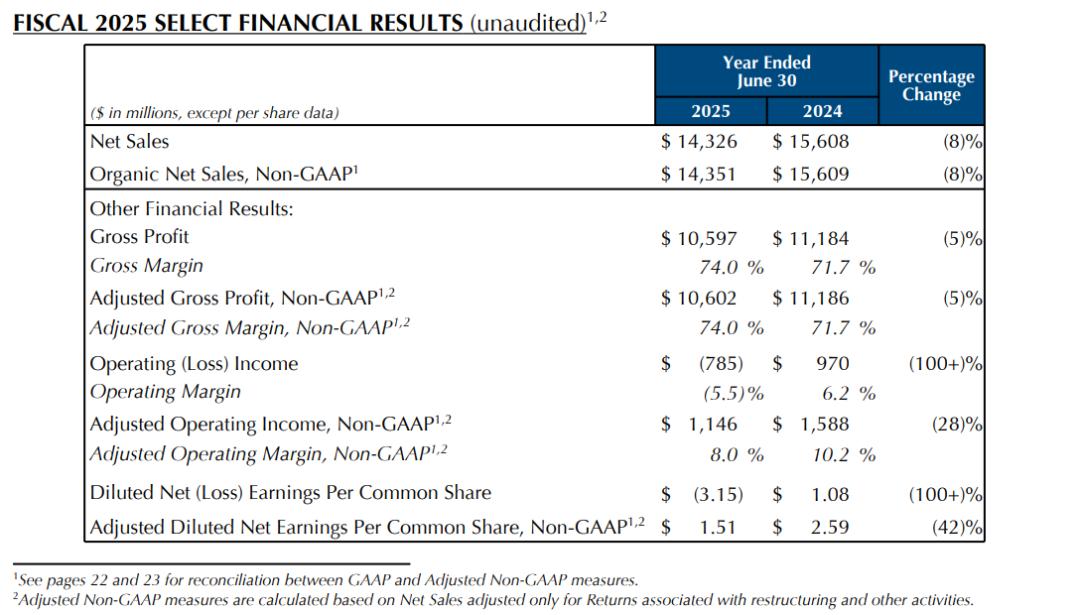
Core Viewpoint - Estée Lauder reported its largest loss in two decades for the fiscal year 2025, with net sales declining by 8% to $14.326 billion and a net profit drop of 390%, resulting in a loss of $1.133 billion [1][2] Group 1: Financial Performance - For fiscal year 2025, Estée Lauder's net sales were $14.326 billion, down 8% year-over-year, and net profit fell from $390 million to a loss of $1.133 billion [1] - The stock price dropped nearly 15% following the earnings report, with current shares at $87.72, down from $374.2 at the beginning of 2022 [1] - Morgan Stanley maintains a "neutral" bearish rating on Estée Lauder, predicting a potential decline of over 20% in the next 12 months [1] Group 2: Product Category Performance - All major product categories except for fragrance saw declines, with skincare and scalp care down 12% and 10% respectively, and makeup down 6% [2] - The fragrance category remained stable, with brands like Le Labo contributing to double-digit growth [5][6] - The skincare segment, previously a stronghold, faced significant declines attributed to underperformance of key brands like Estée Lauder and La Mer [2] Group 3: Market Trends and Consumer Behavior - Consumers are increasingly focused on cost-effectiveness and product efficacy, impacting Estée Lauder's high-end positioning [3] - The Chinese high-end beauty market is experiencing a compound annual growth rate decline of 3% from 2021 to 2024, with a market size reduction from 257.8 billion to 236.4 billion [3] - Emerging brands are capturing market share from traditional giants by offering innovative products and marketing strategies [3] Group 4: Strategic Changes and Future Outlook - Estée Lauder is undergoing significant operational changes, including a global workforce reduction of approximately 7,000 positions, with over 3,200 already cut [4] - The company projects a net sales growth of 2% to 5% for fiscal year 2026, with adjusted earnings per share expected to rise by 26% to 39% [4] - The company plans to enhance its product innovation, aiming for innovative products to account for over 25% of sales in fiscal year 2026 [3][4] Group 5: Fragrance Market Potential - The fragrance market in China is still in its infancy, with a penetration rate of only 5%, compared to over 40% in Western markets [5] - The fragrance segment is expected to grow at a compound annual growth rate of 21.78% from 2021 to 2026, outpacing most other beauty categories [5] - Despite current success, the fragrance business faces challenges from established luxury brands and shifting consumer preferences [7]
裁员3200人,雅诗兰黛巨亏56亿
3 6 Ke· 2025-08-21 00:54
Core Viewpoint - Estée Lauder is facing significant challenges in its recovery path, with a decline in net sales and operating income amid economic downturns and geopolitical factors [1][3]. Financial Performance - For the fiscal year 2025, Estée Lauder reported a net sales decline of 8% year-over-year, totaling $14.33 billion (approximately ¥1028.01 billion) [1][2]. - The company's gross profit decreased by 5% to $10.60 billion, with a gross margin of 74.0% [2]. - Operating income turned into a loss of $785 million, marking a significant decline from a profit of $970 million in the previous year [2][6]. - The diluted net loss per share was $3.15, compared to earnings of $1.08 per share in the prior year [2]. Business Segment Performance - The only category to show growth was the fragrance segment, which remained flat with a slight increase, while skincare, makeup, and hair care categories experienced declines of 12%, 6%, and 10% respectively [4][6]. - The skincare segment's decline was attributed to decreased sales of brands like Estée Lauder and La Mer, alongside a drop in Asian travel retail sales [7][11]. - The makeup segment's downturn was primarily due to poor performance from brands like M·A·C and Too Faced [7][8]. Regional Performance - All regions reported declines in net sales, with the EMEA region experiencing the largest drop of 12%, followed by Asia/Pacific at 7% and the Americas at 4% [10][11]. - In mainland China, net sales fell by 6%, influenced by a challenging retail environment and low consumer sentiment [11][14]. Strategic Initiatives - Estée Lauder is undergoing a restructuring plan (PRGP) aimed at restoring profitability, which has already led to over 3,200 job cuts, with projections of total cuts reaching between 5,800 to 7,000 positions [19][22]. - The company anticipates that the restructuring will incur pre-tax costs between $1.6 billion to $3.3 billion [19]. Future Outlook - Despite current challenges, Estée Lauder's management expressed confidence in achieving organic sales growth in fiscal year 2026 and aims to rebuild operational profitability [3][22]. - The company plans to report its financials based on a new geographical structure starting Q1 of fiscal year 2026, which will include China as a separate reporting region [11][19].