Kimi K3

Search documents
X @The Wall Street Journal
The Wall Street Journal· 2026-07-18 12:03
Industry Trends and Market Sentiment - The emergence of AI products like Moonshot's Kimi K3 has triggered industry-wide discussions regarding the long-term sustainability of the current technology boom [1] - Market analysts are increasingly scrutinizing whether the rapid development of generative AI models can maintain its momentum and deliver lasting value [1]
Chinese AI Model Raises Pressure on US Spending
Bloomberg Television· 2026-07-18 11:53
Market Dynamics and Competitive Landscape - Chinese startup Moonshot AI launched the "Kimi K3" model, featuring 2.8 trillion parameters, which reportedly outperforms major rivals including Anthropic's Claude 3.5 and OpenAI's ChatGPT-4o by 5.6% [3] - Asian tech markets experienced a sell-off with indices dropping over 6% as investors reassess the justification for massive capital expenditure (CapEx) by firms like Samsung and SK Hynix, totaling 600 billion USD in new factory investments [4] - Chinese AI companies are increasingly utilizing "distillation" techniques to develop rival chatbots, leading to accusations from U.S. firms like Anthropic regarding the improper extraction of data and model results [5][7] Strategic Industry Shifts - China is positioning its AI sector as a primary export engine to transition away from the struggling property industry, supported by the government's "AI Plus" plan aimed at decade-long cross-sector adoption [18][19] - Chinese startups are gaining traction by offering "open weight" models that allow for easier modification and parameter adjustment compared to the API-restricted frontier models produced by U.S. labs [12][13] - U.S. enterprises are increasingly sensitive to the bottom line, shifting focus toward more cost-effective AI service alternatives as the expenses of deploying current U.S.-based AI tools rise [14] Regulatory and Macro Environment - U.S. tech companies are advocating for a coherent, industry-funded regulatory framework similar to the FINRA model to replace ad-hoc export controls and safety reviews [26][27] - China is actively shaping global AI norms through initiatives like the "World AI Cooperation Organization," which has attracted 29 member countries, and by offering 5,000 AI training opportunities to developing nations [23] - Despite short-term market volatility, major industry players including TSMC, SK Hynix, and Nvidia maintain that demand for AI chips and hardware remains robust through 2030 [29][30]


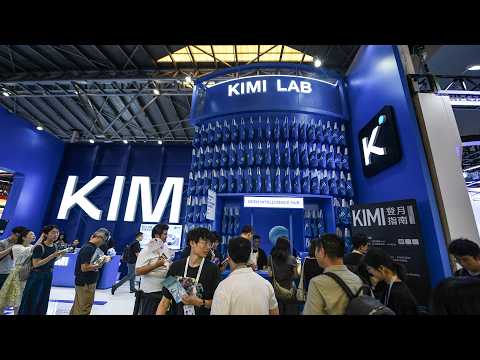
Did Kimi K3 really beat Fable?
Matthew Berman· 2026-07-18 06:14
Model Performance and Technical Specifications - Moonshot AI's Kimmy K3 is a 2.8 trillion parameter model, currently the largest open-source model available [3][5] - Kimmy K3 achieved a 76% score on the Arena AI front-end development benchmark, outperforming Fable 5 at 63% [3] - The model features a 1 million token context window, optimized for long-horizon coding, reasoning, and knowledge-intensive tasks [4] - Kimmy K3 demonstrated a 92% success rate in agent performance evaluations, ranking as a top-tier model for web engineering [17] - Internal writing benchmarks show Kimmy K3 reaching a 2,840 ELO score, surpassing previous industry leaders [18] Economic and Competitive Landscape - Kimmy K3 input costs are $3 per million tokens, with output costs at $15 per million tokens, approximately half the price of comparable proprietary models [8] - Despite lower costs, the model exhibits high "token hunger," requiring twice the token volume to achieve intelligence parity with leading closed-source models [10][11][28] - Industry analysis suggests US-based closed-source labs (OpenAI, Anthropic) likely maintain an 8 to 10-month lead in internal model development compared to current open-source releases [24] - The proliferation of high-quality Chinese open-source models exerts significant competitive pressure on US proprietary labs, potentially accelerating global AI innovation [26] Strategic Risks and Industry Implications - Concerns exist regarding potential data distillation, with allegations that Kimmy K3 may have been trained using data sourced from Anthropic models [20] - A primary geopolitical risk involves the potential dependency of US enterprises on Chinese open-source models that may be optimized specifically for Chinese hardware architectures [27] - Regulatory fragmentation in the United States is cited as a factor that may slow domestic frontier labs compared to the rapid release cycles of Chinese AI entities [14][15]

全球资本市场下跌,美股储存板块过山车,加密市场略有下跌,清晰法案今年内通过难度较大【Vic TALK第1738期】
Vic TALK· 2026-07-18 00:05
AI Industry Developments - Kimi K3 model has been officially released, with the industry focusing on its pricing strategy and community performance testing [1] - AI model competition is shifting from basic capabilities toward workflow integration and automation [1] - Domestic AI models are narrowing the technological gap with their United States counterparts [1] OpenAI and Global Tech Updates - OpenAI has initiated model resets and reported growth in Codex users [1] - OpenAI has officially launched new AI hardware products [1] - The "GPT Red" team model has been introduced to enhance safety and testing [1] - Grok Build has been officially open-sourced, while updates regarding Gemini 3.5 Pro have been released [1]