智能体集群

Search documents
首次完整披露!月之暗面创始人英伟达大会重磅发声
Zhong Guo Ji Jin Bao· 2026-03-18 06:08
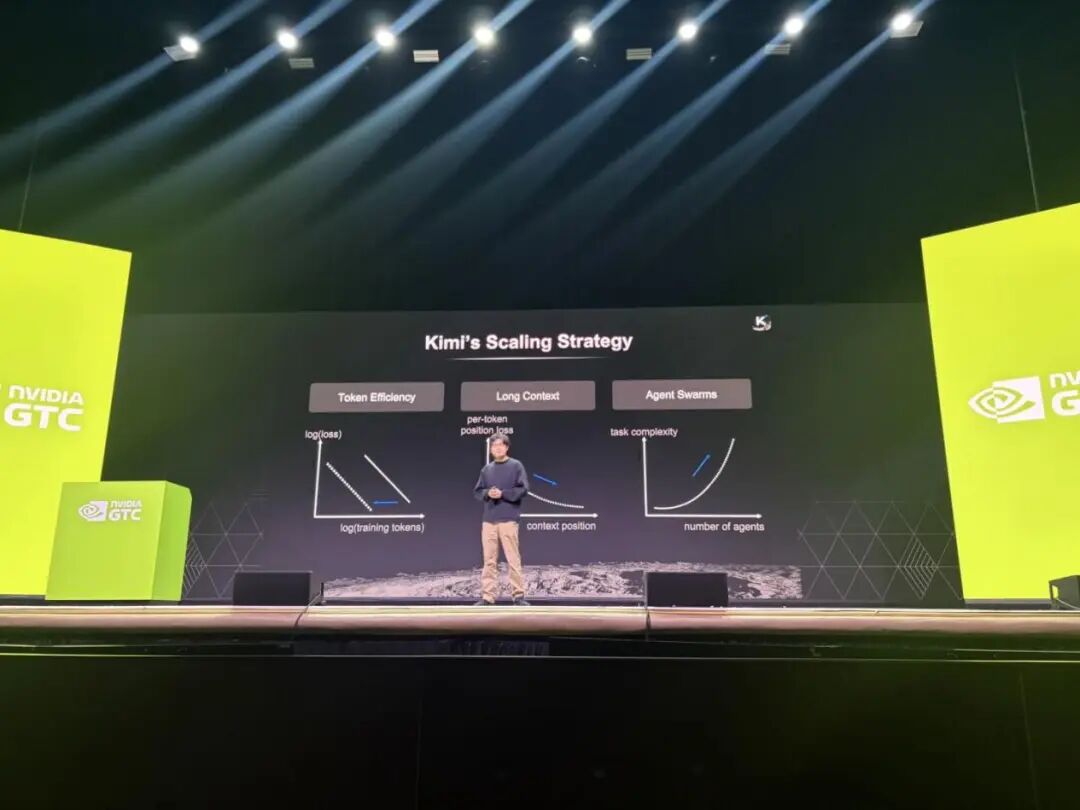
Core Insights - The founder of Moonlight, Yang Zhilin, disclosed the complete technical roadmap for Kimi during a presentation at the NVIDIA GTC 2026 conference, emphasizing the need to reconstruct foundational elements like optimizers, attention mechanisms, and residual connections to push the limits of large model intelligence [1][3] Group 1: Kimi's Technical Roadmap - Kimi's evolution is summarized in three dimensions: Token efficiency, long context, and agent swarms, indicating a shift from mere resource accumulation to achieving scale effects through computational efficiency, long-term memory, and automated collaboration [3] - The presentation highlighted the limitations of existing technology standards, which are considered outdated and becoming bottlenecks for scaling [3][4] - Kimi introduced a hybrid linear attention architecture, Kimi Linear, challenging the conventional use of full attention across all layers [3][4] Group 2: Innovations in AI Research - Kimi has implemented Attention Residuals, replacing traditional fixed additive accumulation with Softmax attention on previous layer outputs, prompting discussions among AI experts about the understanding of foundational works in the field [4] - The Orchestrator mechanism in Kimi K2.5 allows for the decomposition of complex tasks into parallel processing by multiple sub-agents, addressing potential single-point dependencies that could lead to serial collapse [4] - The shift in AI research paradigms is noted, with current researchers able to conduct rigorous scaling experiments due to improved computational resources, leading to more confident and reliable conclusions [5] Group 3: Funding and Valuation - Moonlight's Kimi is currently seeking $1 billion in a new funding round, with a pre-money valuation of $18 billion (approximately 120 billion RMB), following a previous funding round that raised over $700 million at a valuation of $10 billion [1]


Kimi K2.5登顶开源第一!15T数据训练秘籍公开,杨植麟剧透K3
量子位· 2026-02-03 00:37
Core Insights - Kimi K2.5 has achieved significant recognition, topping the Trending chart on Hugging Face with over 53,000 downloads [2] - The model excels in agent capabilities, outperforming flagship closed-source models like GPT-5.2 and Claude 4.5 Opus in various benchmark tests [3] - Kimi K2.5's technical report reveals its development process and innovative features [5] Group 1: Model Architecture and Training - Kimi K2.5 is built on the K2 architecture and has undergone continuous pre-training with 15 trillion mixed visual and text tokens [6] - The model adopts a native multimodal approach, allowing it to process visual signals and text logic within the same parameter space [7] - This extensive data training has led to synchronized enhancements in visual understanding and text reasoning, breaking the previous trade-off between the two [8] - Kimi K2.5 demonstrates high cost-effectiveness, achieving better performance than GPT-5.2 while consuming less than 5% of its resources [9] Group 2: Visual Programming and Debugging - The model has unlocked "visual programming" capabilities, enabling it to infer code directly from video streams [11] - Kimi K2.5 can accurately capture the dynamics of visual elements in videos and translate them into executable front-end code [12] - To address issues with code execution and styling, K2.5 integrates a self-visual debugging mechanism that verifies the rendered interface against expected outcomes [14] - If discrepancies are found, the model can autonomously query documentation to identify and correct issues [15] - This "generate-observe-query-fix" automated loop simulates a senior engineer's debugging process, allowing the model to independently complete end-to-end software engineering tasks [16] Group 3: Agent Swarm Architecture - Kimi K2.5 features an Agent Swarm architecture, capable of autonomously constructing digital teams of up to 100 agents for parallel task execution [17] - This system breaks down complex tasks into numerous concurrent subtasks, significantly reducing processing time [18] - The operation of this large team is managed by the PARL (Parallel Agent Reinforcement Learning) framework, which includes a core scheduler and multiple sub-agents [20][21] - The scheduler oversees task distribution, while sub-agents focus on efficiently executing specific instructions [22] - The design balances flexibility in planning with the logical rigor required for large-scale parallel operations [23] Group 4: Training and Efficiency - The training process employs a phased reward shaping strategy to encourage efficient division of labor among agents [25] - Initially, the focus is on incentivizing the scheduler for parallel exploration, gradually shifting to the success rate of tasks as training progresses [26] - This gradual approach fosters a mindset in the model to maximize concurrency while ensuring result accuracy [27] - Efficiency evaluation incorporates critical steps as a core metric, emphasizing the reduction of end-to-end wait times [28] Group 5: Future Developments and Community Engagement - Following the launch of K2.5, the founders of Moonlight appeared on Reddit for a 3-hour AMA, discussing the model's development and future plans [29] - The team hinted at the next-generation Kimi K3, which may be based on a linear attention mechanism, promising significant advancements [31] - They acknowledged that while they cannot guarantee a tenfold improvement, K3 will likely represent a qualitative leap over K2.5 [32] - The team also addressed the model's occasional misidentification as Claude, attributing it to the high-quality programming training data that included Claude's name [34] - The laboratory emphasizes that achieving AGI is not solely about increasing computational power but also about developing more efficient algorithms and smarter architectures [38]

中国AI“三杰”同日轰炸,召唤百个Agent的门票终于发到每个人手里
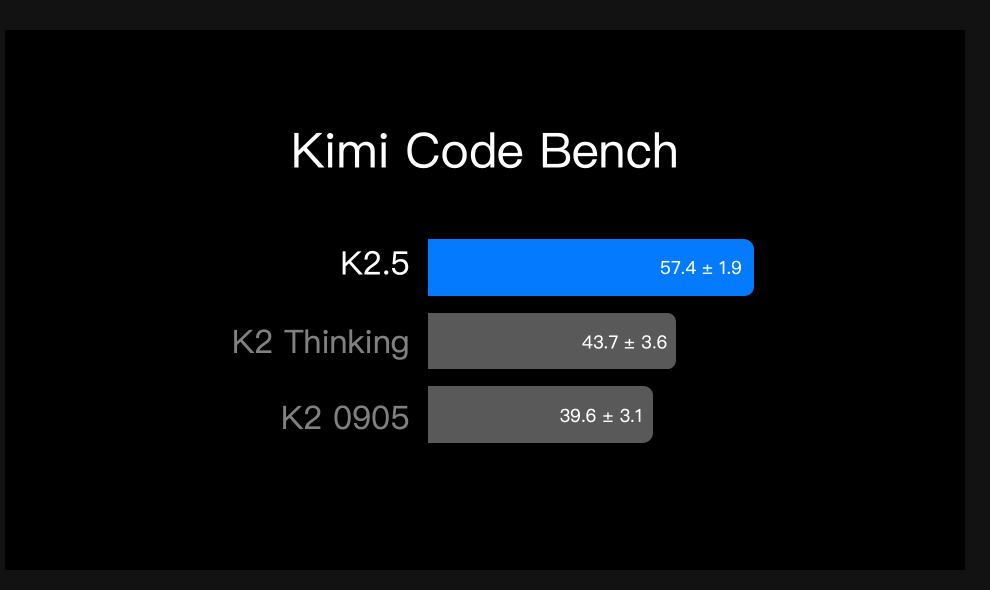
Guan Cha Zhe Wang· 2026-01-28 09:37
Core Insights - The AI industry in China witnessed a significant event on January 27, with major updates from leading open-source projects like DeepSeek, Tongyi Qianwen, and Yuezhianmian, but Kimi K2.5 captured the most attention, surpassing 17,000 mentions online, even outpacing OpenAI's Prism [1][3] Group 1: Kimi K2.5 Features - Kimi K2.5 introduces native multimodal capabilities, allowing the model to understand visual inputs directly integrated with its language and coding abilities, fundamentally changing product development processes [11][14] - The model can generate complete HTML, CSS, and JS code from simple sketches or even rough doodles, significantly reducing the time and effort required for web development [11][14] - Kimi K2.5's dynamic understanding capability allows it to replicate complex interactive features from competitor websites, enhancing its utility beyond simple image recognition [13][14] Group 2: Efficiency and Productivity - The introduction of the Agent Swarm architecture enables Kimi to act as a project manager, coordinating multiple AI agents to handle complex tasks simultaneously, drastically improving efficiency [17][19] - In large-scale search scenarios, the Agent Swarm can reduce the number of key steps needed to achieve goals by 3 to 4.5 times, with actual processing time potentially shortened by up to 4.5 times [19][20] - Kimi's capabilities can be integrated into existing workflows, such as Excel and Word, allowing for significant time savings in data processing tasks [20][21] Group 3: Business Model Transformation - The release of Kimi K2.5 signifies a shift from software sales to service delivery, positioning companies like Yuezhianmian to provide direct solutions rather than just tools [22][23] - The cost of deploying a large-scale AI agent team is high, making cloud services more appealing for businesses compared to self-deployment, thus creating a profitable business model for Yuezhianmian [23] - Kimi's subscription model offers significant cost savings for companies, as it can perform the work of a junior engineer at a fraction of the cost, leading to a potential shift in budget allocations [23] Group 4: Future Implications - The evolution of AI from tools to coworkers indicates a fundamental change in how businesses will operate, with the potential to redefine productivity and organizational structures [24][26] - Kimi's advancements suggest that the ultimate value of technology lies in its ability to empower individuals, expanding their capabilities and imagination [26][27]
刚刚,杨植麟亲自开源Kimi K2.5!国产大模型打架的一天
机器之心· 2026-01-27 09:45
Core Viewpoint - The article discusses the launch of Kimi K2.5, a new model that significantly enhances visual understanding and coding capabilities, positioning itself as a leading open-source model in the AI landscape [4][65]. Group 1: Model Capabilities - Kimi K2.5 features a foundation model with 1 trillion parameters, showing substantial improvements in visual understanding and coding abilities compared to its predecessor [4]. - The model achieved state-of-the-art (SOTA) performance in challenging assessments, such as 50.2% in HLE and 74.9% in BrowseComp [4]. - Kimi K2.5's programming capabilities are notable, scoring 76.8% on SWE-bench Verified, narrowing the gap with top proprietary models [4][6]. Group 2: Cost Efficiency - Kimi K2.5 operates at a fraction of the cost of GPT-5.2-xhigh while outperforming it in several assessments [7]. Group 3: Unified Model Features - Kimi K2.5 is an all-in-one model that integrates visual, text, and coding capabilities, allowing users to generate code from design sketches without needing to write code or use prompt engineering [12]. - The model can interpret images and videos to produce code, enhancing user experience in design modifications [13][14]. Group 4: Agent Swarm Functionality - Kimi K2.5 introduces the "Agent Swarm" feature, enabling it to coordinate up to 100 agents to work in parallel, significantly speeding up task completion [21]. - This parallel processing capability can reduce tasks that typically take days to mere minutes [25]. Group 5: Real-World Applications - Kimi K2.5 can handle complex office tasks, including document editing and financial modeling, with the ability to produce extensive outputs, such as 10,000-word papers or 100-page documents [29]. - The model's agent capabilities allow for sophisticated task management, such as creating a new language with consistent linguistic structures [51]. Group 6: Development and Future Outlook - The release of Kimi K2.5 sets a new benchmark for open-source models globally, indicating a shift in the standards of AI development [65]. - The advancements in visual and agent capabilities suggest that AI is moving closer to achieving artificial general intelligence (AGI) [67].
全能视觉助手来了!Kimi低调上线K2.5,可同时调度100个智能体,效率最高提升4.5倍
Hua Er Jie Jian Wen· 2026-01-27 06:57
Core Insights - The company has made significant upgrades to its flagship model, launching the Kimi k2.5, which enhances its multi-modal capabilities and agent cluster collaboration, aiming to solidify its leading position in the competitive Chinese AI market [1][3]. Model Features - The Kimi k2.5 model utilizes a native multi-modal architecture, capable of processing text, images, and videos simultaneously through a single prompt. Its most notable breakthrough is the "agent cluster" capability, allowing it to autonomously schedule up to 100 sub-agents to work in parallel, reducing execution time for complex tasks by up to 4.5 times [1][3]. - The model has been pre-trained on approximately 15 trillion mixed visual and text tokens, enabling deep visual understanding beyond simple OCR text recognition. Users can upload complex diagrams or financial reports, and K2.5 can analyze and derive logic from them [5]. Agent Cluster Technology - The core highlight of this update is the "agent cluster" paradigm, which employs Parallel Agent Reinforcement Learning (PARL) technology. This allows K2.5 to manage and orchestrate a cluster of 100 sub-agents without predefined roles or workflows, significantly enhancing its ability to handle large-scale searches and complex workflows [7]. - Internal testing indicates that this parallel processing mechanism reduces end-to-end runtime by 80% and supports up to 1,500 coordinated steps in parallel workflows, breaking through traditional single-agent capability limitations [7]. Performance Metrics - Kimi k2.5 has outperformed open-source counterparts in several benchmark tests, particularly in programming and logical reasoning. It aims to compete with top proprietary models, such as Claude Code from Anthropic PBC, through its automated coding tools [9]. - In practical office scenarios, K2.5 has shown a 59.3% performance improvement in handling end-to-end tasks like document processing and financial modeling compared to its predecessor, K2 Thinking [9]. Financing and Market Context - The company, founded by former Tsinghua University professor Yang Zhilin, has recently completed a funding round, raising $500 million from investors including Alibaba and IDG Capital, with a post-money valuation of $4.3 billion. It is currently seeking to raise funds at a valuation of up to $5 billion [3][10]. - The competitive landscape is intensifying, with rivals like Zhipu and MiniMax Group Inc. recently raising over $1 billion through IPOs. The launch of K2.5 ahead of competitors is a strategic move to demonstrate the company's ongoing technological advancement and capital attractiveness [10].