M5 Pro芯片

Search documents
苹果芯片,惊人改变
半导体行业观察· 2026-03-04 01:53
Core Insights - Apple has introduced the M5 Pro and M5 Max chips, marking a significant advancement in performance for professional-grade laptops, utilizing a new Fusion Architecture that integrates two silicon chips into a single system-on-chip (SoC) [14][15] - The M5 series features an 18-core CPU architecture, including 6 high-performance "super cores" and 12 new performance cores, enhancing multi-threaded performance by up to 30% compared to previous models [14][17] - The M5 Max chip is designed for demanding workloads, featuring up to 40 GPU cores and supporting a maximum of 128GB of unified memory with a bandwidth of 614GB/s, significantly improving performance for AI tasks and graphics processing [19][12] Technical Details - The M5 Pro and M5 Max utilize a new Fusion Architecture that combines two chips into one, with one chip handling CPU and I/O functions and the other focused on graphics processing, both manufactured using TSMC's 3nm process [3][4] - The M5 Pro features up to 20 GPU cores and a memory bandwidth of 307GB/s, while the M5 Max doubles the GPU cores to 40 and increases memory bandwidth to 614GB/s [4][12] - The new CPU architecture includes a third type of core, optimized for multi-threaded performance, which is distinct from the super cores and efficiency cores used in previous models [6][7] Performance Comparisons - Compared to the M4 Pro, the M5 Pro has 4 additional cores, resulting in a multi-threaded performance increase of up to 30%, while the M5 Max shows a similar performance increase over the M4 Max [17][19] - The M5 series chips demonstrate a significant improvement in AI processing capabilities, with peak GPU performance for AI tasks increasing by over 4 times compared to previous generations [15][19] - The M5 Max's graphics performance is enhanced by up to 30% for applications utilizing ray tracing technology compared to the M4 Max [19][15] Market Positioning - The M5 Pro is tailored for professionals such as data modelers and sound designers, requiring robust processing power and graphics performance for complex projects [17] - The M5 Max targets 3D animators and AI researchers, providing the necessary computational power and memory bandwidth for handling large datasets and complex scenarios [19] - The introduction of the M5 series raises questions about the future of Apple's Ultra chips, particularly whether they will continue to combine two Max chips or develop independent architectures for the Ultra line [13]



泄露:苹果处理器疑似采用2.5D芯片
半导体行业观察· 2026-02-08 03:29
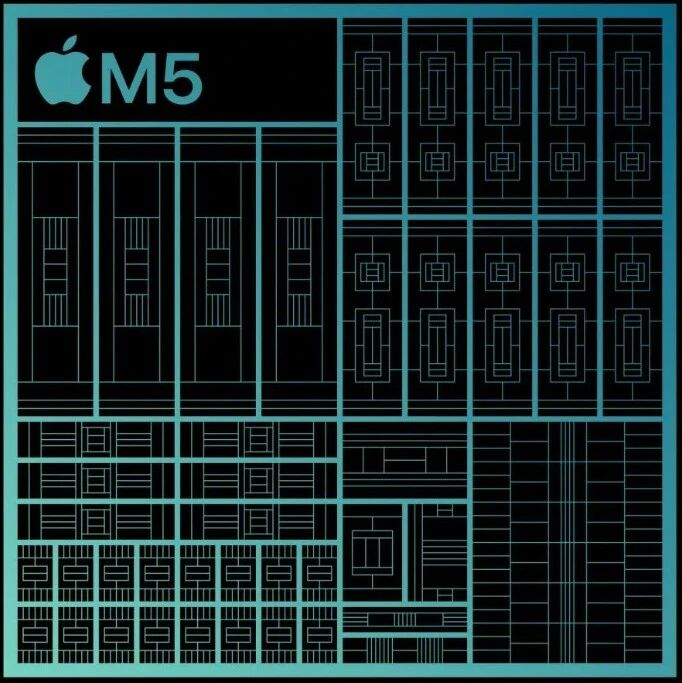
Core Viewpoint - Apple is set to release the M5 Pro and M5 Max chips, utilizing a new 2.5D chip technology that enhances scalability and manufacturing efficiency, potentially leading to significant cost savings for the company [4][5]. Group 1: Chip Design and Cost Efficiency - The M5 Pro and M5 Max chips will share a common design, allowing Apple to reduce the number of SKUs and design costs by reusing existing M5 chip designs [4][5]. - The M5 Max will feature a CPU chip, two GPU chips, and multiple RAM chips, while the M5 Pro will be a variant with two P-cores disabled and only one GPU chip [5]. - This chiplet-based design enables Apple to use the same logic board for all three M5 chips (M5, M5 Pro, and M5 Max) [5]. Group 2: Market Speculation and Reliability of Sources - There is currently no specific information on the release date for the new MacBook Pro models featuring the M5 Pro and M5 Max chips [5]. - Caution is advised regarding the information from the Max Tech YouTube channel, as it does not have the same reliability record as other industry insiders like Mark Gurman or Ming-Chi Kuo [6].
苹果将发布M5 Pro与M5 Max MacBook Pro,经销商库存告急预示新品临近
Huan Qiu Wang Zi Xun· 2026-02-04 07:32
Core Viewpoint - Apple is expected to officially release new MacBook Pro models featuring the M5 Pro and M5 Max chips soon, as indicated by low inventory levels at third-party retailers, a common sign before new product launches [1]. Group 1: Product Release Timeline - The new MacBook Pro models are anticipated to launch in February or March 2026, coinciding with the development cycle of the new macOS Tahoe 26.3 system [5]. - Apple has released the Release Candidate (RC) version of Xcode 26.3, suggesting that related system updates are in the final testing phase [5]. - Historical patterns show that Apple often delays the release of candidate versions of iOS and macOS when new hardware is involved to prevent early leaks of device identifiers [5][6]. Group 2: Product Features and Market Position - The upcoming MacBook Pro models are expected to fill the gap in the product line for higher-performance 14-inch and 16-inch Pro and Max models, enhancing Apple's competitiveness in professional creative and high-performance computing sectors [7]. - The macOS Tahoe 26.3 is likely to include support information for the M5 Pro and M5 Max models, which may explain the delay in releasing its RC version [6]. Group 3: Related Product Inventory - Inventory levels for the HomePod mini are also reported to be low, with several models sold out, although it is unclear if this is directly related to the release of a new generation of HomePod mini or other supply chain adjustments [7].

苹果MacBook Pro将迎重大升级 或采用OLED触控屏等新设计
Huan Qiu Wang Zi Xun· 2026-01-23 04:21
Core Viewpoint - Apple is expected to soon release MacBook Pro models equipped with M5 Pro and M5 Max chips, with a significant redesign anticipated for the next generation MacBook Pro by late 2026 or 2027 [1][3] Group 1: Upcoming Releases - The new MacBook Pro models featuring M5 Pro and M5 Max chips are likely to be launched shortly [1] - The next generation MacBook Pro is projected to undergo a major redesign, expected to be unveiled by the end of 2026 or in 2027 [1][3] Group 2: Rumored Features - Six rumored new features for the upcoming MacBook Pro include OLED display, touch functionality, Dynamic Island, M6 Pro and M6 Max chips manufactured using TSMC's 2nm process, a thinner design, and built-in cellular connectivity [3] - The exact release date for the new features remains uncertain, but the possibility of a release later this year for models with OLED displays is mentioned [3]

曝光:苹果内部正开发的七款自研芯片
是说芯语· 2025-07-10 06:39
Core Viewpoint - Apple is advancing its self-developed chip strategy with the upcoming launch of the iPhone 17 series, new Mac models, and Apple Watch, indicating a significant shift in its hardware differentiation and vertical integration approach [1][2]. Group 1: Chip Development - Apple is developing at least seven new chips, including A19, A19 Pro, M5, M5 Pro, a new Apple Watch chip, a second-generation 5G modem (C2), and a combined Bluetooth and Wi-Fi chip (Proxima) [1][2]. - The A19 chip will be used in the iPhone 17 Air, while the A19 Pro will be featured in the iPhone 17 Pro and Pro Max, reinforcing Apple's strategy of using differentiated processors for high-end models [1]. - The M5 and M5 Pro processors are expected to be introduced in the updated 14-inch and 16-inch MacBook Pro series following the iPhone launch, continuing Apple's chip upgrade rhythm in its laptop product line [1]. Group 2: Enhancements in Wearable Technology - The Apple Watch Series 11 is anticipated to introduce a new processor (Bora), likely based on the A18 architecture, which will enhance the watch's performance and AI capabilities, solidifying Apple's leadership in the wearable market [2]. - The integration of Bluetooth and Wi-Fi into a single chip (Proxima) is expected to improve space utilization and power management across devices [2]. Group 3: 5G Technology and Future Outlook - The second-generation 5G modem (C2) is set to replace the current C1 chip used in the iPhone 16e, with expectations for it to debut in the iPhone 17e by 2025, showcasing Apple's efforts to reduce reliance on Qualcomm and strengthen its own connectivity solutions [2]. - This chip strategy reflects Apple's ongoing commitment to vertical integration and paves the way for enhanced collaboration among diverse devices, AI applications, and integrated communication technologies [2].